Follow Us on Google Discover
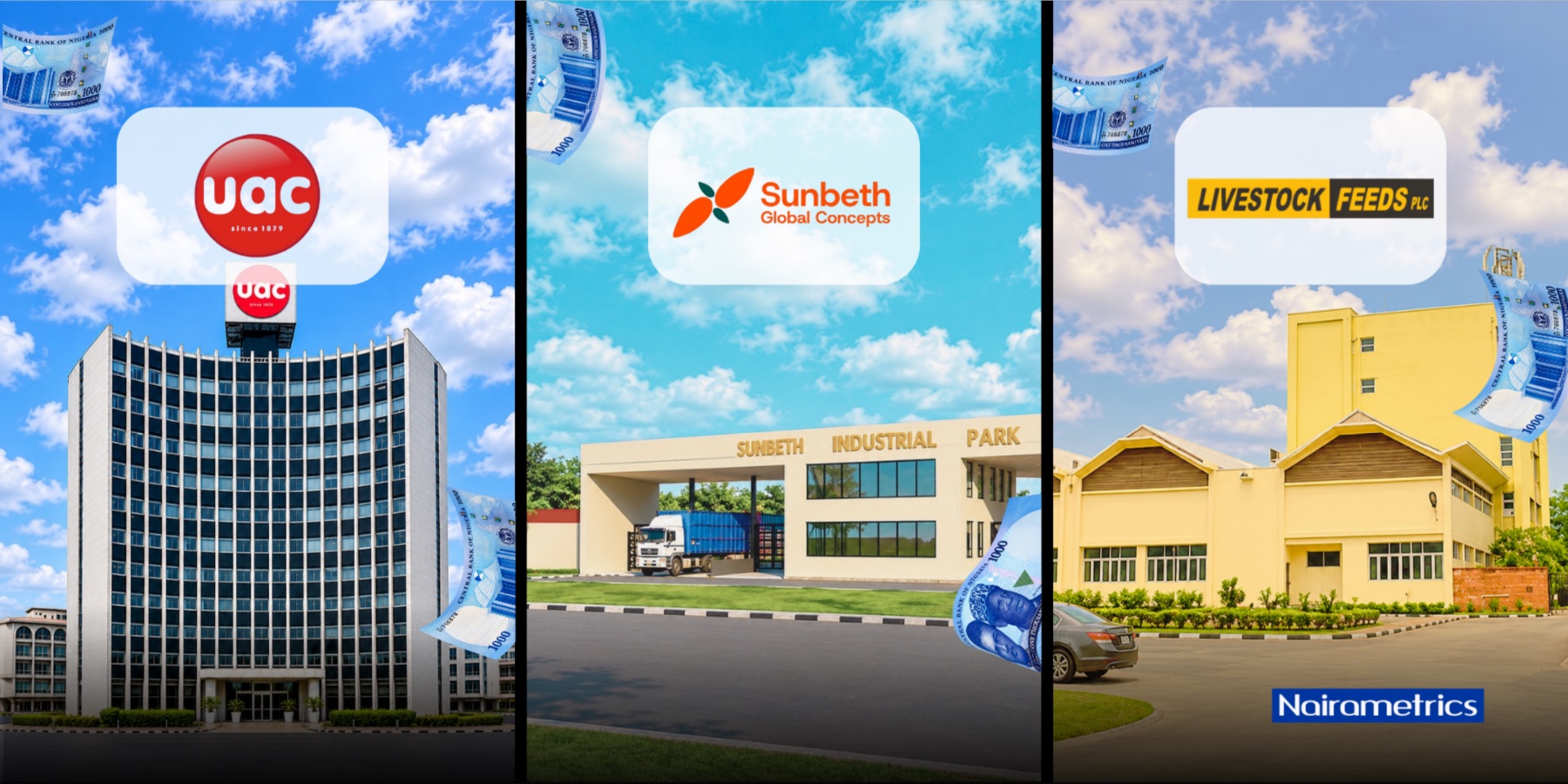
The completion of Sunbeth’s N19.5 billion acquisition of a 73.29% controlling stake in Livestock Feeds Plc from UAC of Nigeria Plc has brought an end to UAC’s ownership of the animal-feed manufacturer.
The transaction, first announced on September 30, 2026, was completed on November 17 following regulatory approvals, with Sunbeth Treenuts and Sesame Limited becoming the new majority shareholder.
For UAC, the deal brings in N19.5 billion in cash and removes a business that has struggled with declining revenue and significant financing requirements.
For Sunbeth, it provides control of an established animal-feed producer listed on the Nigerian Exchange (NGX), with manufacturing and distribution operations across Nigeria.
Also Read
Livestock Feeds, meanwhile, gets a new majority shareholder at a time when its earnings are recovering, but its cash flow remains under pressure.
The question for investors is who stands to gain the most from the transaction, especially as both UAC and Livestock Feeds are publicly listed companies.
What UAC is walking away with
UAC appears to be the most immediate beneficiary of the transaction, considering the price it received and the financial position of the business it sold.
Under the agreement, Sunbeth paid N8.85 per share for approximately 2.2 billion Livestock Feeds shares, valuing the entire company at about N26.55 billion.
That valuation is significant when compared with the company’s financial position as of September 30, 2026.
- According to its nine-month 2026 financial statements published on the NGX, Livestock Feeds had total assets of N12.81 billion and liabilities of N11.17 billion, leaving shareholders’ equity of just N1.64 billion.
This places the acquisition valuation at about 16 times the company’s book value.
However, the picture changes when compared with Livestock Feeds’ stock market valuation.
- Its share price closed at N13.10 on November 17, putting Sunbeth’s N8.85 acquisition price at a discount of approximately 32.4%.
- By November 18, the stock was quoted at N14.05, implying a total market valuation of N42.15 billion, compared with the N26.55 billion implied by the acquisition.
- For UAC, the sale also supports its broader strategy of reducing debt and concentrating on its larger businesses.
- Its nine-month 2026 results showed that net debt declined by N62.8 billion to N231 billion, while free cash flow reached N98.4 billion.
As earlier reported by Nairametrics, revenue grew by 227.7% to N523 billion, largely driven by the consolidation of C.H.I. Limited, the producer of Chivita and Hollandia.
- The N19.5 billion sale proceeds provide additional financial flexibility, although UAC has yet to disclose how the money will be deployed.
The difference between the sale consideration and Livestock Feeds’ book equity should not, however, be treated as UAC’s accounting profit from the disposal. The actual gain will depend on the investment carrying value and other accounting adjustments.
What Sunbeth is buying
For Sunbeth, the acquisition provides control of an established animal-feed manufacturer that has returned to profitability despite declining sales.
According to Livestock Feeds’ nine-month 2026 financial statements:
- Revenue declined by 24.8% to N22.39 billion from N29.77 billion in the corresponding period of 2025.
- Profit after tax recovered to N1.25 billion from a loss of N326.54 million, supported by stronger gross margins and a 52.4% reduction in finance costs to N1.27 billion.
- Despite the return to profitability, operating cash flow turned negative at N6.96 billion, compared with a positive N10.95 billion a year earlier.
- Inventories rose to N8.01 billion, while interest-bearing borrowings stood at N7.93 billion.
These figures show that while the company’s earnings have improved, converting profits into cash remains a major challenge.
At the acquisition price, Livestock Feeds is valued at 15.9 times its annualised nine-month earnings.
For Sunbeth, the investment case may therefore depend less on the company’s current financial position and more on its ability to improve raw material sourcing, reduce costs, and expand production through its wider agricultural network.
Whether these benefits materialize will determine if the N19.5 billion acquisition ultimately delivers value.
There is another interesting aspect of Sunbeth’s expansion.
The wider Sunbeth business has become an active participant in Nigeria’s commercial paper market, raising substantial short-term funding to finance agricultural commodity purchases.
In March 2026, Sunbeth Global Concepts Limited announced that its Series 1, 2 and 3 commercial paper issuances attracted N165.73 billion, exceeding the initial N100 billion target. Of this, N150.4 billion was accepted across the three series.
The company subsequently redeemed its N25.1 billion Series 1 commercial paper in September.
- In October, Sunbeth announced plans to raise up to N150 billion under a new N500 billion commercial paper programme, with the funding intended primarily for cocoa procurement and working-capital requirements.
- Commercial papers are short-term debt instruments companies use to raise money from investors, often to finance inventory and other business operations.
- The fundraising demonstrates Sunbeth’s access to the domestic debt capital market, which could be useful as the wider group expands its agricultural operations.
However, there is no confirmed disclosure that proceeds from these commercial paper issuances financed the Livestock Feeds acquisition.
The distinction matters because commercial paper must eventually be repaid, while acquiring a manufacturing business involves longer-term investment commitments.
For Sunbeth, the challenge will be ensuring that expansion does not place excessive pressure on liquidity and future debt repayments to holders.
What changes for Livestock Feeds shareholders?
Although Livestock Feeds is at the centre of the deal, the N19.5 billion consideration was paid to UAC for its existing shares.
It was not a fresh capital injection into Livestock Feeds.
The company therefore retains its existing financial obligations, including its borrowings and working-capital requirements, unless Sunbeth subsequently provides additional funding or restructures them.
The new ownership could still create opportunities.
Sunbeth’s agricultural sourcing experience may help Livestock Feeds obtain raw materials more efficiently, improve production costs, and expand its distribution network.
But these benefits will need to show up in the company’s financial performance.
Another issue is the position of minority shareholders, who collectively hold 26.71% of Livestock Feeds.
With Sunbeth now controlling 73.29%, investors will be watching for further disclosures on any takeover offer obligations, regulatory exemptions and the company’s longer-term listing plans.
For now, the change in ownership does not automatically mean that Livestock Feeds will leave the NGX.
As reported by Nairametrics on November 17, the completion also resulted in a reconstitution of the board, with three directors resigning and five new directors appointed.
Who gained the most?
Looking at the transaction today, UAC appears to have secured the clearest immediate financial advantage.
- It receives N19.5 billion in cash while exiting a business whose sales have contracted and whose operations continue to absorb significant working capital.
- The disposal also supports UAC’s efforts to simplify its portfolio and concentrate on packaged foods, beverages, and other operations.
- Sunbeth, however, could emerge as the bigger long-term winner.
It has acquired controlling ownership of an established manufacturer for N8.85 per share, with the potential to improve earnings through better sourcing, distribution, and business integration.
- Whether the acquisition eventually proves attractive will depend on how much of that potential Sunbeth can turn into actual profits and cash.
- For Livestock Feeds shareholders, the real test begins after the ownership change.
The company has already returned to profitability. What investors will now want to see is whether the new majority owner can reverse declining revenue, reduce financing pressure, and improve cash generation.
Ultimately, UAC has secured the cash today, while Sunbeth is betting on the value it can create tomorrow.