 Follow Us on Google Discover
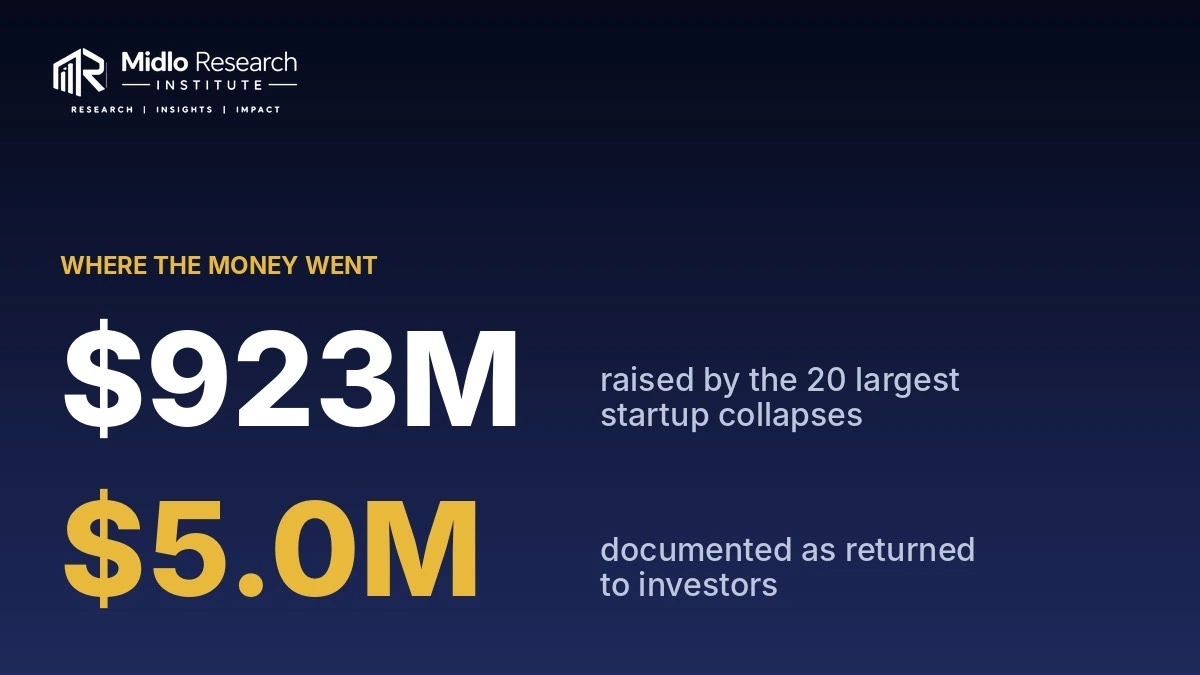
The Midlo Research Institute has released Where the Money Went, a study of 20 major startup collapses in Kenya, Nigeria and Ghana that raised about $923 million, finding that failure was a sequence rather than a single event, with warning signs that were visible long before the end.
The report, produced in partnership with Nairametrics, is available at https://docsend.com/v/6p3jn/where-the-money-went. It finds that companies could leave the path at any step, but the 20 it examined went through most or all of them.

Six stages from the peak of a round to the process
- Raise at the peak: capital arrives on 2021 valuations and a growth story.
- Scale the cost base: hubs, fleets, agents, countries or products are added ahead of margin.
- Signals appear: pivots, departures, insider-led rounds and questions about metrics.
- The window closes: the next round slips, shrinks or does not come.
- Distress shows: payroll, suppliers and creditors are paid late, and cuts come without notice.
- The process: administration, liquidation, sale, closure or an orderly wind-down.
Debt and the problem of the second cheque
At least $149.6 million, or 16%, of the $923 million was debt or convertible instruments, and debt sat at the centre of several of the largest failures. Twiga Foods’ last identified round was a $35 million convertible from existing investors, while Koko Networks carried a $60 million facility secured on all assets, which ranks ahead of every equity holder.
Also Read
Several of the largest companies did not raise equity at the end at all, and the report lists “no second cheque” among the six recurring patterns. When a follow-on round fails to close, it says, the loss falls on lenders and secured creditors rather than equity investors.
The pattern repeats across the cases the report examines. About half of MarketForce’s $40 million Series A was debt, and $10 million of Float’s $17 million seed package was debt. The report’s point is that debt is fine against assets that earn, and lethal against assets that do not.
The warning signs were visible
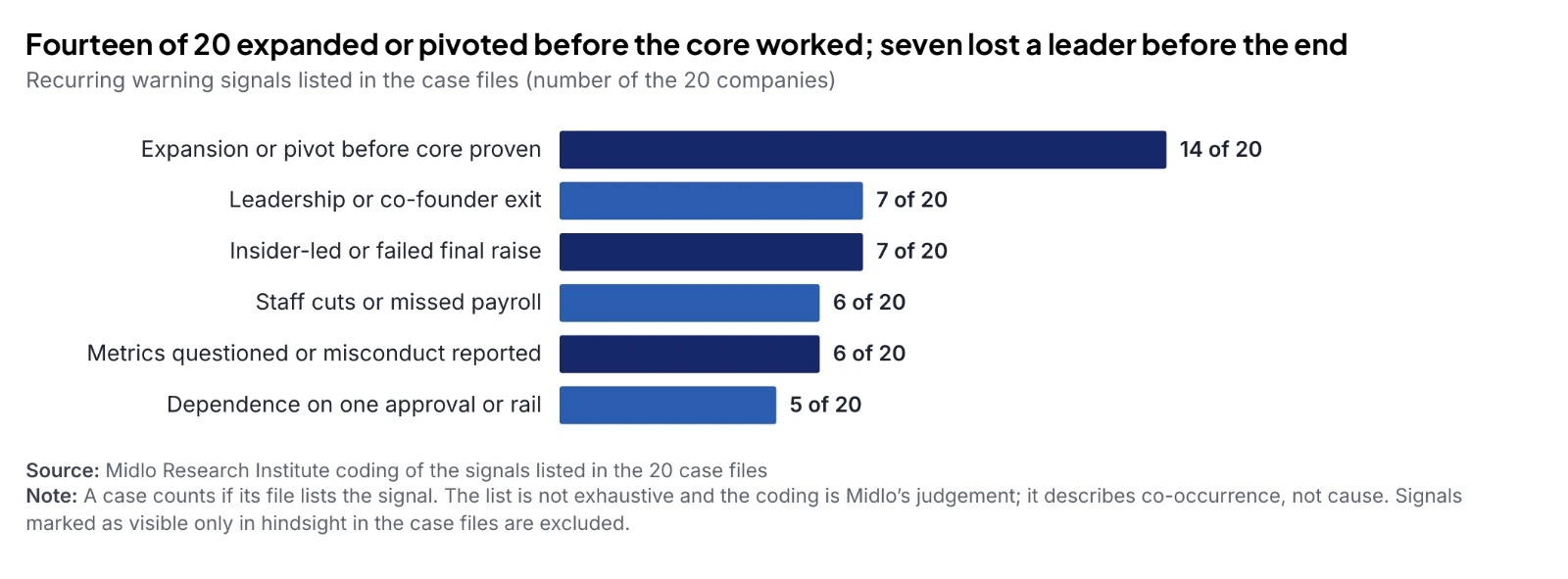
Fourteen of the 20 companies expanded or pivoted before the core business worked. Seven lost a founder or senior leader, seven had an insider-led or failed final raise, six had staff cuts or missed payroll, six had questions raised about their metrics, and five depended on a single approval or rail.
What investors can do
The report turns the pattern into eight practices for funds and investors. The first is to price the unit rather than the story. “If delivery cost exceeds gross profit per unit, you are funding a loss,” it says.
- Match capital to asset life, with debt placed against assets with proven payback.
- Map single points of failure, such as a licence, approval or subsidy the business cannot lose.
- Reserve for no second round by modelling break-even on current cash.
- Agree a runway trigger, with a board review of options if runway falls below six months.
- Take partial profits into strength. In Dash, the syndicate’s 11.3× exit and 50% liquidation came before the collapse.
What founders can learn
For founders, the report groups the failures into six overlapping patterns: physical distribution on thin margins, debt and capital structure, a single point of failure outside the founder’s control, governance that never forced the question, no second cheque, and a monetisation gap.
It points to Koko as an example of how one government authorisation can decide a business’s fate. Each case file ends with a diligence checklist, which founders can run against their own business before an investor does.
What to watch next
The report says the wave of collapses that began in 2023 is not over. The 2021 vintage has largely been resolved, the larger and slower cohort of asset-heavy companies is still unwinding, and the debt raised during the 2025 recovery will mature into the next down-cycle.
- The debt repayment calendar: debt reached a record $1.64 billion in 2025, or 41% of African tech funding, according to Partech. The 2021 vintage failed on equity, the report says, and the 2025 vintage will test lenders.
- Open administrations: the report notes that Koko’s administrators have invited bids above $15 million, and says the outcomes will add recovery data where there is almost none today.
- Currency: currency exposure was visible in at least six cases after the 2023 naira devaluation.
- Local capital at the later stage: if African LP commitments turn into follow-on cheques at Series A to C, the “no second cheque” pattern should weaken.
What you should know
African trackers disagree by a factor of 2.5 on 2025 funding. Disrupt Africa recorded $1.64 billion, Bloomwit $3.9 billion and Partech $4.1 billion in equity and debt. The report says that if the ecosystem cannot agree on what went in, it will struggle to say what came out.
The report calls for a shared, comparable format for reporting failure, so that a collapse can be described as consistently as a funding round. Corrections and contributions, with sources, are welcome at midloangels.org.
Disclosure: Midlo Research Institute is the research arm of the Midlothian Angel Network. Payday, one of the companies examined in the report, is a Midlo portfolio company.