Follow Us on Google Discover
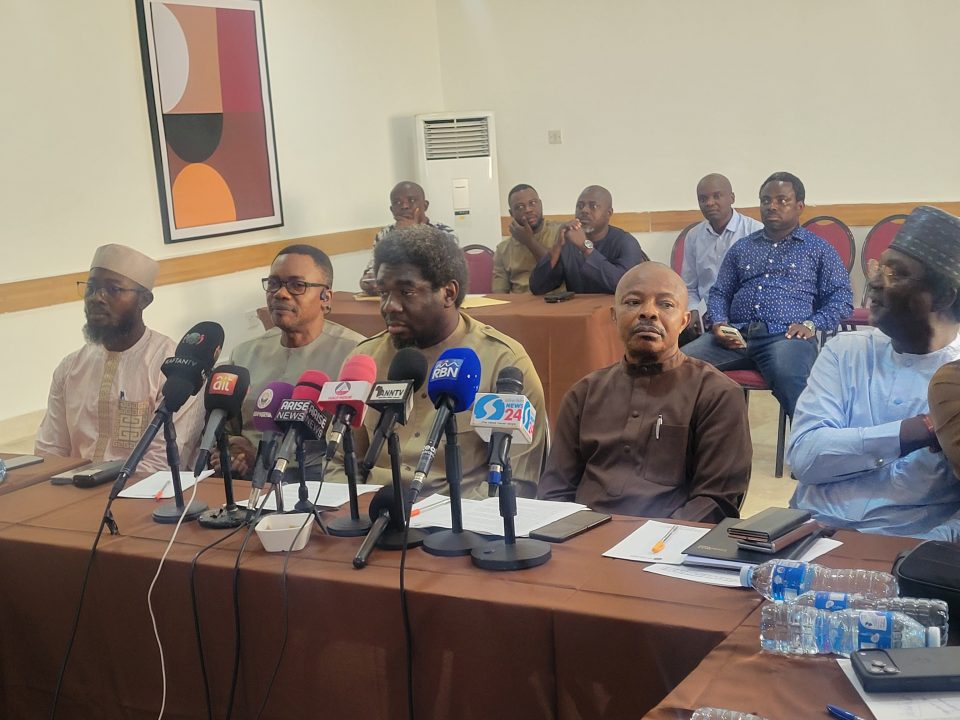
The Nigeria Labour Congress (NLC) and the Trade Union Congress of Nigeria (TUC) have resolved their public disagreement over the Federal Government’s N70,000 one-off transport allowance for workers, following days of public exchanges between the leadership of both labour centres.
The two organisations announced the resolution on Wednesday, November 18, 2026, at a joint press conference in Abuja, reaffirming their commitment to a united labour movement and the collective defence of Nigerian workers’ rights.
In a joint statement signed by NLC President, Joe Ajaero, and TUC President-General, Festus Osifo, the unions described their disagreement as a family misunderstanding that had been amicably settled through the intervention of former leaders of both organisations.
How the disagreement started
The disagreement began after the Federal Government, on October 28, 2026, announced a N70,000 monthly transport allowance for public servants for six months, following negotiations with the NLC and other labour representatives.
Also Read
While the NLC and other participating labour groups accepted the arrangement, the TUC rejected it, arguing that it was not adequately represented in the discussions and that workers needed a salary increase rather than a temporary transport allowance.
Speaking on Channels Television’s The Morning Brief, NLC President Joe Ajaero argued that the NLC had the authority to negotiate independently based on the International Labour Organisation (ILO) principle of the most representative workers’ organisation.
TUC President-General Festus Osifo, however, described the arrangement as an aberration and challenged Ajaero to produce the ILO regulations supporting his interpretation.
Osifo also questioned the legitimacy of the meeting at which the allowance was agreed upon, arguing that it was not a meeting of the Joint National Public Service Negotiating Council (JNC) and did not meet its quorum requirements. He maintained that the TUC, with about 40 affiliates, had the right to represent its members independently, regardless of the NLC’s larger membership.
Ajaero, in response, cited the Trade Union Amendment Act 2005 and Section 40 of the 1999 Constitution, which guarantee workers’ freedom to choose their unions.
He also argued that seven of the eight union bodies in the JNC belong to the NLC, while only one is affiliated with the TUC, supporting his position on the NLC’s stronger representation.
NLC, TUC commit to working together
At the Wednesday, November 18, 2026 joint press conference in Abuja, the two labour centres provided further details of their resolution, saying they had unanimously agreed to work together in an atmosphere of mutual respect, trust and cooperation to defend the interests of Nigerian workers, pensioners and other vulnerable groups.
In their joint statement, they said the unity of Nigerian workers was more important than disagreements between their leadership, adding that their shared history and responsibility to defend workers’ rights should not be undermined by institutional differences.
- “We wish to place it on record that the unity of the Nigerian working class is far greater than any disagreement between its leadership,” the statement read.
The unions also acknowledged the challenges facing workers and said the labour movement needed solidarity and collective action rather than division or rivalry.
Nigeria’s minimum wage and salary adjustments
The resolution comes against the backdrop of Nigeria’s evolving minimum wage framework, with implementation and salary adjustments continuing to shape discussions around workers’ welfare.
- President Bola Tinubu signed the N70,000 National Minimum Wage Act into law on July 29, 2024, reducing the statutory minimum wage review interval from five years to three years.
- The new wage followed months of negotiations between the Federal Government and organised labour, after the government initially proposed N62,000 while labour demanded N250,000.
- The implementation of the new minimum wage has, however, varied across states, with some governments offering amounts above the N70,000 national benchmark.
Nairametrics Research reported in May 2026 that minimum wage implementation varied across states, with Imo paying N104,000, Ebonyi N90,000 and Lagos and Rivers N85,000 each, while several states remained at the federal benchmark of N70,000.