Follow Us on Google Discover
The World Health Organization (WHO) says Africa accounted for about 75% of confirmed mpox cases reported globally in July, as the public health risk from the ongoing multi-country outbreak remains moderate.
The WHO disclosed this in its 69th situation report on Monday, which assessed the global epidemiological situation and reported continued transmission of mpox across several regions.
Mpox is a viral disease caused by the monkeypox virus and is mainly contracted through close physical contact with an infected person, contaminated materials or infected animals.
What they are saying
WHO said 32 countries across four regions reported 1,370 confirmed mpox cases and seven deaths in July, putting the global case fatality ratio at 0.5%.
Also Read
It said 11 African countries recorded active transmission between July 6 and August 16, accounting for 1,153 confirmed cases and all seven deaths reported in the region during the period.
- “Madagascar, Angola, Kenya, the Democratic Republic of the Congo (DRC) and Cameroon recorded the highest number of cases in Africa during the six-week period,” it said.
According to WHO, confirmed mpox cases in Africa increased in July compared with June, while the Americas, Western Pacific, European and South-East Asia regions recorded declines.
- “The Eastern Mediterranean Region reported no confirmed mpox cases in July, continuing the trend recorded in June.
- “Globally, Madagascar, Angola, China, the DRC and Kenya reported the highest numbers of confirmed mpox cases during July,” it said.
WHO said transmission continued to affect key populations largely through sexual transmission, followed by household spread and community outbreaks.
It added that all clades of the monkeypox virus continued to circulate, highlighting the need for sustained surveillance and coordinated response efforts.
Get up to speed
WHO declared the mpox outbreak a public health emergency of international concern (PHEIC) on August 14, 2024, following a surge in cases in the Democratic Republic of the Congo and the spread of a new clade to neighbouring African countries. It was the second such declaration in two years.
- However, WHO ended the PHEIC on September 5, 2025, after determining that the outbreak no longer met the criteria for an international public health emergency, although it retained standing recommendations for the continued management of mpox.
- Africa recorded 14,669 laboratory-confirmed mpox cases and 55 deaths in 2024, according to figures cited by WHO Regional Director for Africa Dr Matshidiso Moeti.
In April 2025, Africa CDC and WHO said more than $220 million was required to sustain and scale up the continent’s response, as transmission continued within and beyond Africa.
What you should know
A global initiative to establish an mpox vaccine stockpile was launched on August 27 to create a long-term mechanism for ensuring countries can access vaccines during outbreaks.
- WHO said the stockpile is expected to begin operations later in September and will be accessible to countries responding to mpox outbreaks. It was approved by the Gavi Board in 2025, funded by Gavi and coordinated through the International Coordinating Group on Vaccine Provision, whose partners include WHO, UNICEF, Médecins Sans Frontières and the International Federation of Red Cross and Red Crescent Societies.
- The initiative comes as WHO continues to report a significant concentration of mpox cases in Africa. From January 2022 to July 2026, 145 countries and territories reported 190,683 confirmed cases and 529 deaths globally, according to WHO.
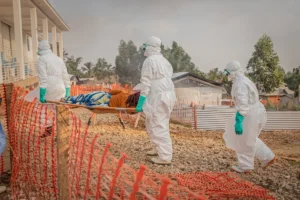
The development also comes amid another major disease outbreak in the Democratic Republic of the Congo, where the ongoing Bundibugyo virus outbreak has become the largest Ebola outbreak ever reported in the country.
As of September 7, the DRC had reported 6,757 confirmed Ebola cases and 3,267 deaths, according to the latest WHO update.