Follow Us on Google Discover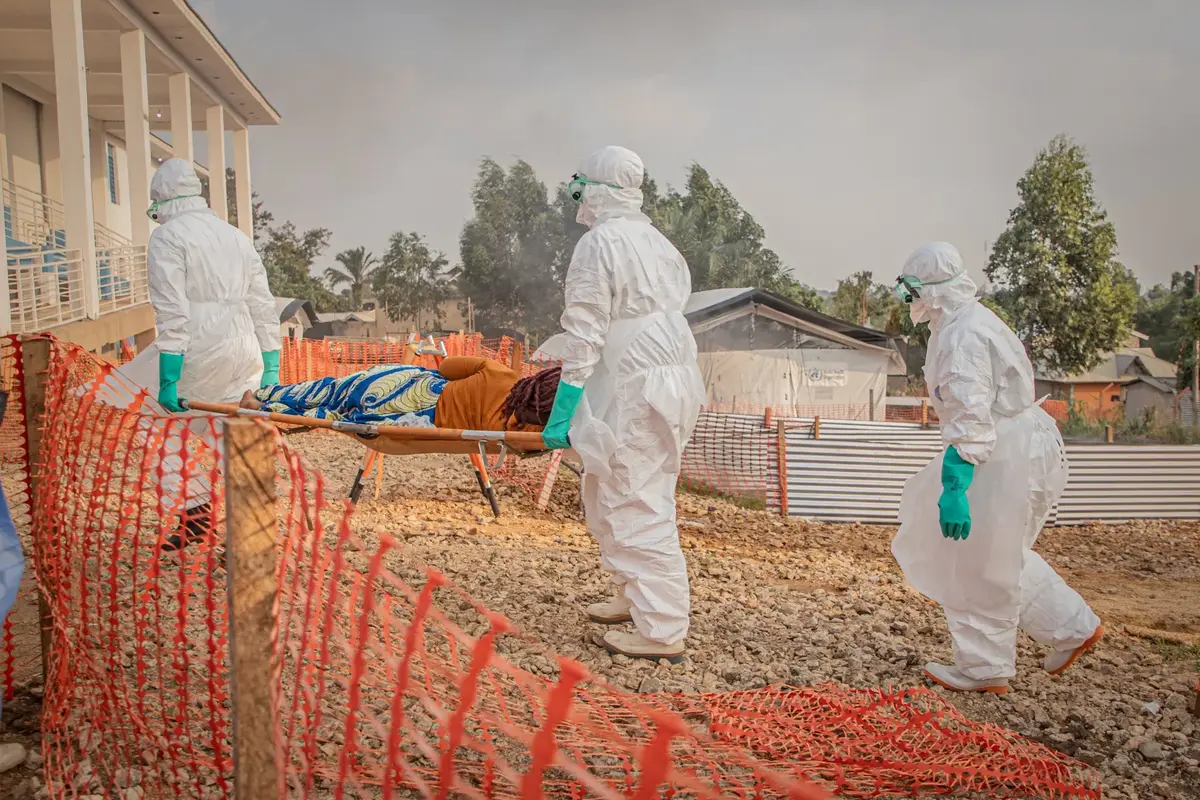
The World Health organization(WHO) has said that the Democratic Republic of Congo’s Ebola outbreak needs about 5000 trained health workers, international organizations or funding to keep pace with the virus as it spreads across the country.
According to the WHO on Tuesday, the outbreak, which began in the eastern city of Bunia, has now reached six provinces.
Health authorities are responding by shifting toward a more decentralized strategy, opening treatment centres closer to communities where new infections are being reported, Reuters first reported.
Nearly 1,400 treatment beds have been established across 59 centres, a rapid expansion that a WHO official described as one of the fastest responses he had witnessed. But another 1,600 beds are still needed.
What they are saying
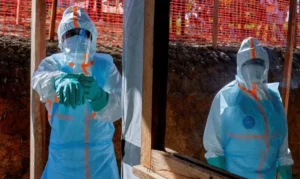
Luca Fontana, a WHO technical officer, said the response would require about three health workers for every Ebola treatment bed. WHO estimates around three health workers are needed for each Ebola patient bed, meaning around 9,000 staff would be required for the planned capacity of 3,000 beds.
That would require the recruitment and training of roughly 5,000 additional health workers.
- “Every time a healthcare worker walks inside the patient’s area, wearing the full gear, the personal protective equipment, it’s approximately $25. We have hundreds of staff walking inside the patient’s area every single day,” Fontana said.
Compounding the challenge, the pool of international organisations capable of running Ebola treatment centres is limited, partly due to the impact of broader global donor funding cuts, Fontana said.
- “Where are all the organisations that were running treatment centres in West Africa outbreaks in 2014 to ’16? Why they are not currently in the field to support this current response is probably because of lack of resources, and this is probably one of the bottlenecks now that can delay the scale-up plan,” he said,
Only five or six major organizations currently have the capacity to operate such centers, he said. Without additional partners, experienced groups could become tied up running existing facilities instead of moving into areas where the outbreak is expanding.
The WHO is urging donors to accelerate funding for Congo’s government-led response plan, which calls for $1.3 billion over the next six months.
Get up to speed
The current outbreak is being driven by the Bundibugyo species of Ebola, a relatively rare strain for which there is no approved vaccine specifically targeting the virus.
- Nairametrics reported last week that confirmed Ebola cases in Congo had crossed 6,000, while the death toll had reached 2,911. The outbreak had already become the largest and deadliest Ebola epidemic recorded in the country.
- Earlier in September, Nairametrics also reported that the WHO had rejected the broad rollout of the Ervebo vaccine against the Bundibugyo strain, saying the available evidence was not sufficient to establish that it provides meaningful protection against the virus. The vaccine is licensed for the Zaire species of Ebola, not Bundibugyo.
The WHO has instead said Ervebo should be used against Bundibugyo only within a research protocol while scientists work to determine whether it can offer protection.
The outbreak has continued to expand geographically despite efforts by Congo’s health authorities and international partners. The WHO says the response now needs to move closer to newly affected communities rather than relying primarily on centralized treatment facilities.
What you should know
Congo’s Ebola outbreak has become a test of whether an already stretched international health system can mobilise resources quickly enough as a disease spreads across a large and difficult-to-reach territory.
The shortage of international response organizations adds another layer of pressure. Congo’s Health Ministry has begun taking responsibility for some treatment centers established earlier in the outbreak, but WHO officials warned that government capacity could also become stretched if the epidemic continues to expand.
The outbreak’s scale has already surpassed the previous Ebola record in Congo. Nairametrics reported in August that the death toll had overtaken the 2,299 deaths recorded during the country’s 2018-2020 Ebola outbreak.