Follow Us on Google Discover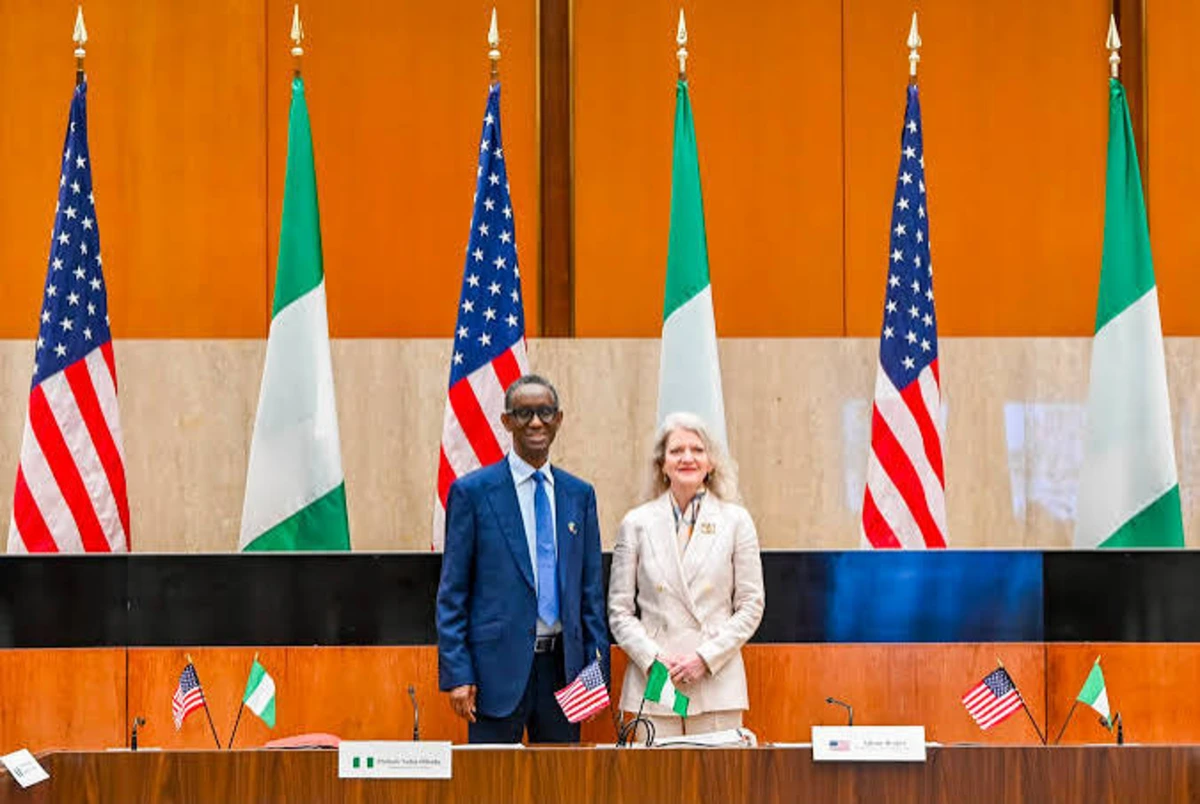
Nigeria remains under the United States’ Country of Particular Concern (CPC) designation after Washington and Abuja concluded the second session of their Joint Working Group without announcing any change to the designation.
The development was disclosed in a U.S. State Department statement released on Thursday after Under Secretary of State for Political Affairs Allison Hooker hosted a Nigerian delegation led by National Security Adviser Mallam Nuhu Ribadu in Washington on August 12, 2026.
The meeting was the second formal engagement under the bilateral framework established after Nigeria’s designation as a Country of Particular Concern, with both sides reviewing progress on security, religious freedom, and accountability issues.
On October 31, 2025, U.S. President Donald Trump designated Nigeria as a Country of Particular Concern, marking a return to a similar designation imposed during his first term in office in 2020 over what he described as the persecution of Christians, particularly in northern Nigeria.
Also Read
What they are saying
The Washington meeting was the second Joint Working Group (JWG) since Nigeria’s CPC designation and built on progress made since the inaugural session held in Abuja on January 22, 2026.
- According to the U.S. State Department, discussions focused on three priority areas: protecting Christian communities in Nigeria’s Middle Belt, strengthening judicial and security institutions to hold perpetrators of violence accountable, and expanding military-to-military cooperation.
- While both sides reviewed progress on the resettlement of internally displaced persons (IDPs), counterterrorism prosecutions, and efforts to combat terrorism financing, the Joint Working Group identified continuing challenges, including reports of civilian fatalities and gaps in humanitarian expenditure transparency.
The United States acknowledged Nigeria’s reported efforts, stating:
- “The United States noted Nigeria’s reported efforts to date, including the prosecution of hundreds of Boko Haram and Islamic State-West Africa (ISIS-WA) suspects, expansion of judicial capacity, and recruitment and training of 50,000 additional police officers.”
Both governments also discussed further cooperation on countering terrorism financing, expanding biometric information sharing to support accountability measures, and strengthening law enforcement capabilities through the U.S. Department of State’s Bureau of International Narcotics and Law Enforcement Affairs and Bureau of Counterterrorism.
Hooker also held a separate meeting with Ribadu to advance broader bilateral priorities, including efforts to protect Christian communities and deepen security cooperation between both countries.
Get up to speed
Nigeria’s CPC designation became a major diplomatic issue after President Trump announced the decision in October 2025, citing reports of widespread attacks on Christian communities.
- Trump argued that Christianity was facing an existential threat in Nigeria and accused radical Islamist groups of carrying out mass killings of Christians.
- The Nigerian government rejected the designation, insisting that the country’s constitution guarantees freedom of religion and arguing that the security crisis affects citizens of all faiths rather than Christians alone.
As part of its response, the Federal Government reportedly engaged a Republican-linked lobbying firm in Washington under a contract reportedly worth $750,000 per month to counter claims of ‘Christian genocide’ and challenge separatist narratives circulating within conservative and evangelical political circles close to the Trump administration.
What you should know
The latest Washington meeting is part of a series of engagements that have taken place since Nigeria’s CPC designation.
- The first Joint Working Group session was held in Abuja on January 22, 2026, where both countries agreed to strengthen cooperation on security, justice sector reforms, and the protection of vulnerable communities.
- That meeting followed the U.S. military strike on terrorist targets in northwestern Nigeria on Christmas Day 2025, which Washington said was aimed at disrupting extremist networks.
- In February 2026, Trump publicly described Nigeria’s First Lady, Senator Remi Tinubu, as a “very respected woman” during the National Prayer Breakfast in Washington, signalling continued engagement with the Nigerian government despite tensions over the CPC designation.
More recently, in late July 2026, President Trump praised President Bola Tinubu for his actions against violence, suggesting an improvement in security cooperation between both countries compared with the sharp rhetoric that followed Nigeria’s designation in 2025.
Although U.S. officials acknowledged Nigeria’s increased efforts in counterterrorism prosecutions, judicial reforms, and the protection of Christian communities, the second Joint Working Group ended without any indication that Washington had decided to remove Nigeria from the Country of Particular Concern designation.