
 Follow Us on Google Discover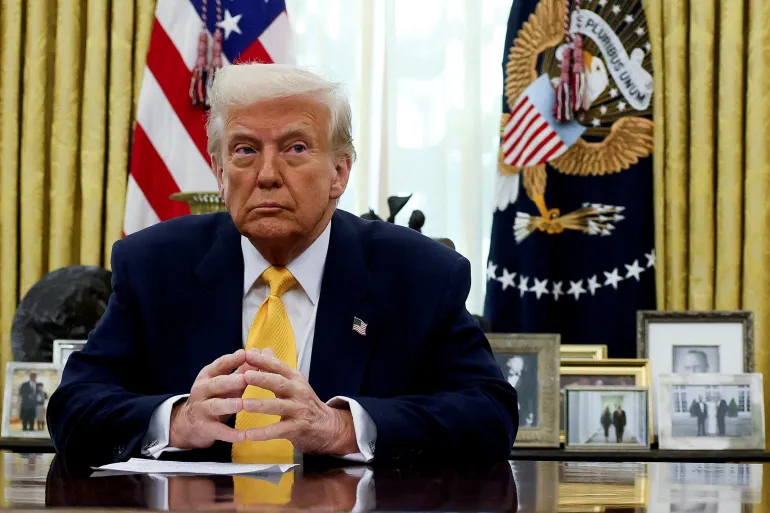
The President of the United States of America (USA), Donald Trump, has issued a 48-hour ultimatum to Iran to fully reopen the Strait of Hormuz or face military strikes on its power plants.
This announcement was made via a late-night post on Trump’s Truth Social account and shared by the official X account of The White House.
The warning comes amid rising tensions in the Middle East and growing fears over disruptions to global energy supplies as Iran continues to block the strategic waterway.
What they are saying
Trump stressed that the United States would act decisively if Iran failed to comply, highlighting the potential targeting of Iranian power facilities.
- “If Iran doesn’t FULLY OPEN, WITHOUT THREAT, the Strait of Hormuz, within 48 HOURS from this exact point in time, the United States of America will hit and obliterate their various POWER PLANTS, STARTING WITH THE BIGGEST ONE FIRST!”
- He warned that the strait must be fully opened without any obstruction to avoid a direct military response.
- The U.S. will prioritize the largest power plants first and continue as necessary to enforce the ultimatum.
The message highlights the urgency of the situation and reflects Washington’s determination to secure uninterrupted shipping through this critical corridor.
Get up to speed
The conflict involving Israel, the USA, and Iran has been ongoing since February 28, 2026, and the Strait of Hormuz has been heavily restricted since the outset.
- Shipping through the strait, which carries roughly one-fifth of global oil and significant volumes of gas, has been curtailed by Iran.
- Major marine insurers, including Gard, Skuld, NorthStandard, London P&I Club, and American Club, withdrew war risk coverage for vessels in the Gulf and surrounding waters on March 1, 2026.
- Trump announced on March 3 that the U.S. Navy could escort vessels through the strait, with additional political risk insurance provided by the United States Development Finance Corporation (DFC).
- Despite these measures, the blockade persisted, prompting Trump to call on March 14 for other countries, including China, France, Japan, South Korea, and the United Kingdom, to deploy naval forces to support U.S. efforts in keeping the waterway open and secure
The 48-hour ultimatum is the latest escalation in a series of measures aimed at reopening the strait.
What you should know
The closure of the Strait of Hormuz has disrupted global energy trade, driving up crude and refined product prices and threatening jet fuel supplies.
- Airlines may face cancellations of long-haul flights due to anticipated jet fuel shortages caused by the Strait’s closure.
- China, Thailand, and Vietnam have restricted fuel exports to protect domestic supply, intensifying global constraints.
- In Nigeria, petrol (PMS) prices have risen to N1,300–N1,350 per litre, while jet fuel now sells above N2200 per litre, up from N900–N1000 before the conflict.
- Days ago, Ministers of Foreign Affairs from 12 countries, including Qatar, Egypt, Saudi Arabia, and Pakistan, issued a joint statement demanding Iran cease attacks and reopen the strait, emphasizing respect for international law and maritime security.
The escalation demonstrates how vulnerable global energy markets and aviation are to geopolitical tensions, highlighting the urgent need to keep one of the world’s most critical shipping lanes operational.
Please don’t bomb their power plants