Follow Us on Google Discover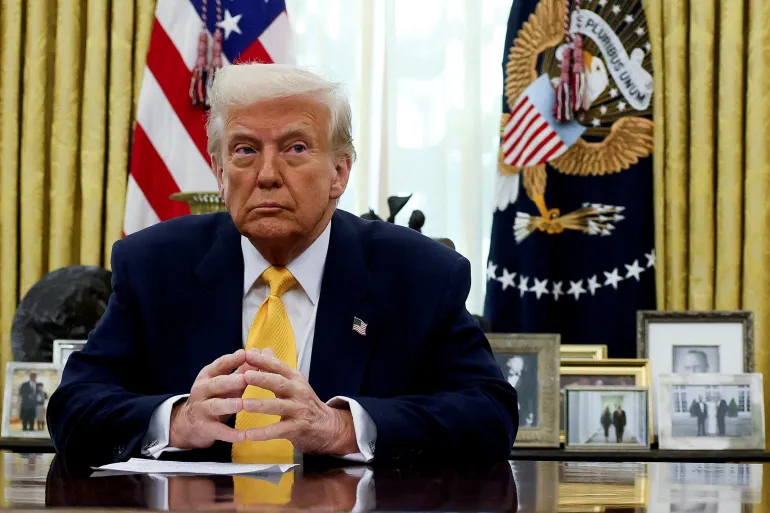
The President of the United States of America, Donald Trump, has signaled that the U.S. Navy may escort vessels through the Strait of Hormuz to prevent disruptions in global energy supplies.
The disclosure was made by Trump via his Truth Social account and shared on the official The White House X account on Tuesday, March 3, 2026.
The announcement follows rising regional tensions and the withdrawal of war risk insurance by major marine insurers operating in Iranian waters and the Gulf.
What they are saying
Trump indicated that the U.S. will use a combination of military and financial measures to protect global energy shipments.
Also Read
- While the U.S. Navy may escort vessels if necessary, the United States Development Finance Corporation (DFC) will provide political risk insurance and guarantees to shipping lines operating in the Gulf.
- “Effective IMMEDIATELY, I have ordered the United States Development Finance Corporation (DFC) to provide, at a very reasonable price, political risk insurance and guarantees for the Financial Security of ALL Maritime Trade, especially Energy, traveling through the Gulf. This will be available to all Shipping Lines. If necessary, the United States Navy will begin escorting tankers through the Strait of Hormuz, as soon as possible,” Trump’s post read in part.
The White House added that all shipping lines navigating the Gulf will have access to DFC-backed insurance coverage.
Trump emphasized that these measures are designed to ensure uninterrupted energy transit and prevent disruptions to global oil and gas markets.
Get up to speed
The move comes amid a growing crisis in the Middle East. Leading marine insurers, including Gard, Skuld, NorthStandard, the London P&I Club, and the American Club, withdrew war risk coverage for vessels operating in Iranian waters, the Gulf, and surrounding seas, effective March 5.
- The cancellations followed a series of attacks on vessels and regional strikes, creating significant operational and financial risks for shipowners.
- According to Nairametrics reporting on Sunday, at least 150 vessels, including oil and LNG tankers, were anchored in the Strait of Hormuz and nearby waters, slowing energy shipments.
The withdrawal of insurance further complicates maritime operations and heightens the risk exposure for shipping companies in the region.
These developments have added urgency to U.S. proposals to provide DFC-backed insurance and potential naval escorts.
What you should know
The escalation of conflict between the United States, Israel, and Iran is impacting global energy markets, beyond disruptions at the Strait of Hormuz.
- Saudi Aramco suspended operations at its 550,000 barrels-per-day Ras Tanura refinery in Saudi Arabia’s Eastern Province after a drone attack linked to Iran’s retaliatory actions. The refinery serves as a major crude export terminal on the Gulf Coast.
- QatarEnergy halted downstream production following attacks on its LNG facilities in Ras Laffan Industrial City and Mesaieed Industrial City.
- In Nigeria, the Nigerian National Petroleum Company Limited (NNPCL) increased the pump price of Premium Motor Spirit (PMS) at its retail outlets in Abuja to N960 per litre from N875, reflecting surging global crude oil prices. Dangote Petroleum Refinery also raised its ex-depot rate by N100, to N874 per litre from N774.
These developments indicate a ripple effect of Middle East tensions on energy supply chains and fuel prices globally, including domestic markets in Nigeria.