Follow Us on Google Discover
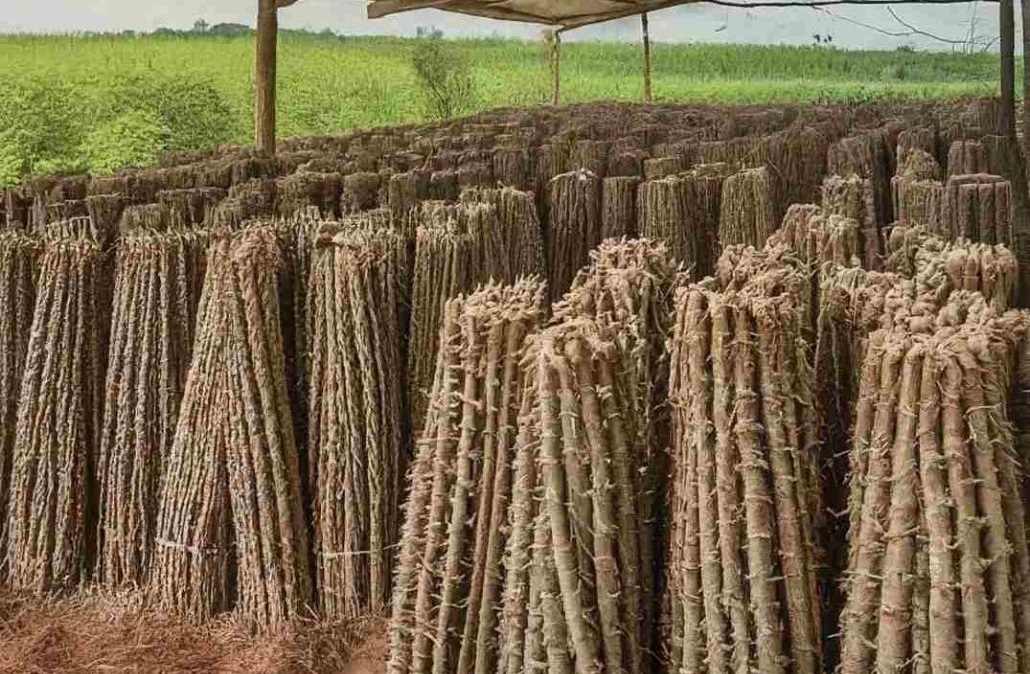
The International Institute of Tropical Agriculture (IITA) says Nigeria requires more than 450 million bundles of cassava stems annually to meet the planting material needs of over six million smallholder farmers across the country.
Mr Kayode Olasupo, IITA GoSeed Agronomist, disclosed this on Monday in Abuja, noting that the country currently supplies less than 10% of the estimated demand.
Olasupo, who identified Nigeria as the world’s largest cassava producer, attributed the supply gap partly to the limited presence of seed companies within farming communities, leaving farmers with high transportation costs when sourcing quality planting materials.
He said many farmers consequently rely on adulterated, uncertified and unimproved cassava varieties, obtain stems from neighbours or recycle existing planting materials, limiting their productivity.
Also Read
Nigeria faces cassava planting material shortage
According to Olasupo, estimates from IITA projects indicate that more than six million smallholder farmers cultivate cassava across Nigeria, creating significant demand for quality planting materials.
- “When we did the estimate, we discovered that they needed more than 450 million bundles annually. And what we currently supply is less than 10 per-cent of actual requests,” he said.
- “That is why most of them end up getting adulterated, uncertified, unimproved varieties on their farms. Some of them are still depending on their neighbours or are recycling the stems they have, which is not increasing their productivity,” he added.
He said the shortage was compounded by the concentration of seed companies away from farming communities, forcing farmers to spend heavily on logistics.
Olasupo noted that transportation expenses sometimes exceed the cost of the planting materials themselves, making it difficult for farmers to obtain improved varieties.
IITA deploys technology to improve cassava stem supply
The IITA agronomist said access to quality planting materials would improve cassava productivity, increase farmers’ profitability and strengthen their livelihoods.
He explained that improved varieties developed by research institutions often take too long to reach farmers, leaving the intended beneficiaries unable to enjoy the gains from agricultural research.
- “Over time, most varieties released by research institutions remained in the institutes, with farmers having no adequate access to them. When they do not have access to those varieties, the benefits of those varieties will not get to the end users, which are the farmers,” he said.
Olasupo identified IITA GoSeed as an early-generation seed company using technology to rapidly multiply improved varieties released by IITA and other research institutions.
He said the organisation was working to bridge the supply gap by making improved cassava varieties available and affordable to farmers shortly after their release.
One of the technologies being deployed is Semi-Autotrophic Hydroponics (SAH), which Olasupo said could reduce the time required to deliver newly released cassava varieties to farmers to between two and three years.
He explained that cassava has a relatively low multiplication ratio because it is a vegetatively propagated crop, with conventional methods producing about 10 planting materials from a single stem.
However, with SAH technology, hundreds of thousands of plantlets can be produced annually from one cassava stem, significantly increasing the volume of planting materials available to farmers.
Nigeria’s cassava production challenges
Nigeria’s cassava production challenges extend beyond the volume of tubers harvested, with limited access to improved planting materials, weak seed systems and gaps in the value chain continuing to constrain productivity.
- In April 2026, Nairametrics reported that Nigeria’s cassava value chain remained underdeveloped despite the country’s position as the world’s largest producer. The report highlighted limited access to credit, traditional processing methods and poor infrastructure as major constraints.
Efforts to address the seed supply gap have been ongoing for years. In October 2020, Nairametrics reported that IITA signed a Memorandum of Understanding with the Nigerian Cassava Growers Association under the BASICS-II project to improve cassava seed varieties and develop a commercially sustainable seed system.