Follow Us on Google Discover
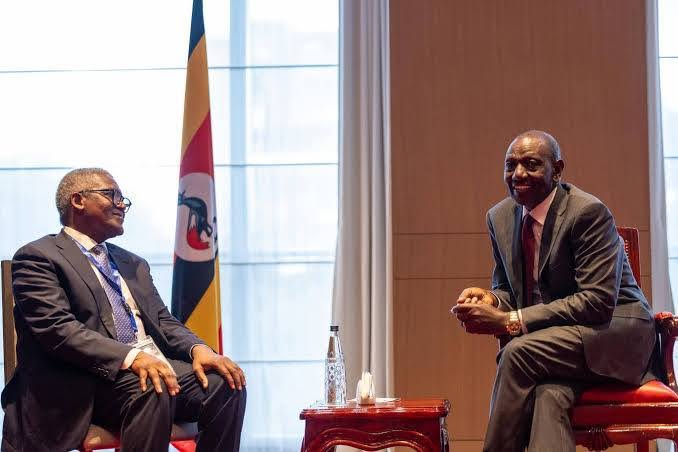
Kenya plans to grant tax exemptions on value-added tax (VAT), excise duty and railway development levies for equipment imported by Aliko Dangote for his proposed $16 billion oil refinery in the country.
Kenya’s Treasury Secretary, John Mbadi, disclosed this in an interview with Nairobi-based Citizen TV, as reported by Bloomberg on Wednesday.
The proposed refinery, expected to process 700,000 barrels of crude oil daily, would be located in the historic coastal town of Lamu and is intended to reduce Eastern Africa’s dependence on imported petroleum products.
Kenya outlines tax waivers for Dangote refinery
Mbadi said the proposed investment qualifies for tax exemptions under Kenyan law because it exceeds the minimum investment threshold of 5 billion Kenyan shillings, equivalent to approximately $38 million, required for such incentives.
Also Read
He explained that the exemptions would apply to capital goods imported for the project, including machinery and equipment, and cover VAT, excise duty and railway development levies.
- “Any capital goods that they are bringing will attract the tax exemption as any other, and there will be a formal request,” Mbadi said during the interview.
The Treasury Secretary said Dangote would need to submit a formal application to obtain the exemptions. He also indicated that the company could recover taxes already paid on equipment imported to commence work on the project.
According to Mbadi, the company had already paid applicable taxes on some imported equipment but would be entitled to claim refunds after submitting the necessary request.
- “They must have paid,” Mbadi said.
- “Then they will claim, and we will give them,” he added.
The proposed incentives are expected to support the establishment of the refinery, which would be modelled after Dangote’s existing facility in Nigeria.
Kenya weighs refinery tax breaks against revenue losses
The proposed incentives come as the Kenyan government faces revenue shortfalls, rising public expenditure and mounting debt, raising questions about the fiscal implications of granting tax concessions to large-scale private investments.
According to Kenya’s Treasury, the country’s tax expenditure, representing government revenue forgone through exemptions, deductions, reduced tax rates and other preferential tax treatments, stood at 262.6 billion Kenyan shillings ($2.02 billion) in 2025.
The amount represented approximately 1.5% of Kenya’s gross domestic product (GDP), according to the Bloomberg report.
The figure highlights the scale of revenue the government already sacrifices through tax incentives.
Granting exemptions to the refinery would add to the range of tax concessions available to investors, although the government expects the project to deliver wider economic benefits.
The proposed refinery is expected to strengthen Kenya’s position as a regional petroleum refining hub while supporting fuel supply to neighbouring countries. However, the government will have to balance the anticipated economic benefits of the investment against the revenue losses associated with the tax exemptions.
Dangote appoints firms for Kenya refinery
The development of the Lamu refinery has also advanced through major engineering and construction agreements, including a contract worth more than $450 million signed with India’s Engineers India Limited (EIL).
The Indian engineering firm previously worked on Dangote’s Nigerian refinery, providing project management, engineering, procurement and construction management support.
Nairametrics also reported on September 30 that Dangote had selected US-based Honeywell Technologies to provide engineering services, technology licensing and equipment for the Kenyan facility.
These appointments are part of the preparations for the proposed investment, which is expected to extend Dangote’s refining operations beyond Nigeria and serve markets across Eastern Africa.
Dangote’s Kenya refinery targets 2030 completion
The proposed refinery is expected to process 700,000 barrels of crude oil daily and produce petrol, diesel and jet fuel for Kenya and other East African markets.
The facility is planned for Lamu, a historic coastal town, and is intended to reduce the region’s dependence on imported petroleum products by expanding local refining capacity.
The project is expected to be completed within approximately 40 months of its September 30, 2026 groundbreaking.
Commissioning is targeted for 2030.
Its planned output is expected to serve Kenya and neighbouring markets across Eastern Africa.
The investment is expected to strengthen Kenya’s position as a regional petroleum refining hub while providing an additional source of fuel supply to neighbouring countries. It also marks a major expansion of Dangote’s refining footprint beyond Nigeria.