Follow Us on Google Discover
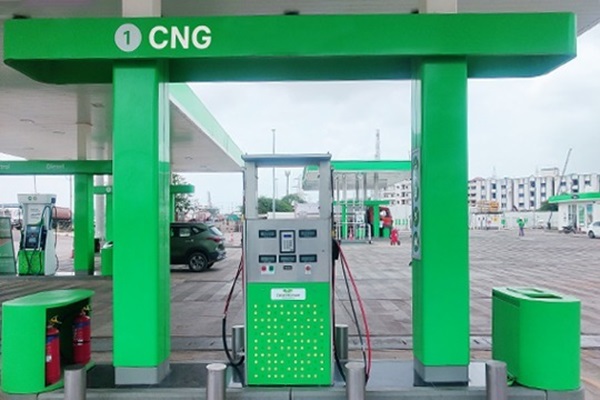
The Lagos State Government plans to commission five additional compressed natural gas (CNG) refuelling stations in November 2026, as it targets a network of 29 stations by the first quarter of 2028.
The disclosure was made by Tayo Gbajumo, Managing Director of Ibile Oil and Gas Corporation, during a media briefing on Thursday ahead of the 2026 Lagos Energy Summit, scheduled for November 10 to 12.
The expansion is intended to improve access to CNG across the state as motorists and transport operators explore alternatives to petrol amid elevated fuel costs.
However, limited refuelling infrastructure remains a constraint, with motorists facing long queues at existing stations.
Also Read
Lagos targets 19 CNG stations by 2027
Gbajumo said the Lagos State Government, through the Ministry of Energy and Mineral Resources, was working to expand CNG infrastructure across the state, with an initial target of 19 stations by the first quarter of 2027.
He said three stations are currently operating in Agege, Ojota and Oshodi, while five additional facilities are expected to be commissioned by November 12.
- “Regarding CNG, the ministry is working hard to develop infrastructure across the state. By Q1 2027, we will have 19 stations across the state. The idea is to continue expanding the network as we go further.”
- “Hopefully, by Q1 2028, we will have an additional 10 stations, which will provide coverage across different locations in the state.”
- “Infrastructure is the most important thing. That is why there are long queues, but we are trying to reduce them by increasing the infrastructure.”
Gbajumo also said converting a vehicle to run on CNG costs between N700,000 and N1 million, depending on the equipment and standards used. He noted that a 60kg tank costs about N5,000 to fill and can provide a range of approximately 200 kilometres, depending on usage.
He added that Ibile Oil and Gas uses European-standard equipment and stressed that vehicle conversions should be carried out by certified engineers to ensure safety.
Lagos Energy Summit to address power challenges
The CNG expansion announcement comes ahead of the 2026 Lagos Energy Summit, which the Commissioner for Energy and Mineral Resources, Biodun Ogunleye, said would bring together regulators, investors, energy experts, electricity distribution companies and innovators to examine developments across the energy sector.
Ogunleye said discussions at the November 10–12 summit would cover electricity supply, renewable energy, metering, energy affordability and mobility, including the adoption of CNG and electric vehicles.
- He explained that the state is seeking to develop a framework for a secure, interoperable and efficient energy system.
- The framework is intended to improve electricity access and reduce dependence on conventional fuels.
- The ministry’s Permanent Secretary, Ibilola Kasunmu, said the summit would focus on practical solutions to Nigeria’s electricity challenges, with an emphasis on moving beyond discussions to actionable outcomes.
The summit is expected to provide a platform for stakeholders to examine developments and practical solutions across the energy sector.
Lagos moves regulated buses away from diesel
The planned expansion of refuelling infrastructure comes as Lagos is also tightening its alternative-fuel policy for public transportation. The Lagos Metropolitan Area Transport Authority (LAMATA) stopped accepting new diesel-powered buses into its regulated transport system in January 2026.
- The policy requires new buses entering the system to run on CNG or electricity, while existing diesel buses are expected to be progressively replaced.
- LAMATA Managing Director and Chief Executive Officer, Abimbola Akinajo, said the transition was partly driven by the need to reduce transport emissions and operating costs.
The agency had about 150 CNG buses before recently receiving 20 additional high-capacity buses under the Federal Government’s Presidential Initiative on Compressed Natural Gas and Electric Vehicles (PI-CNG&EV). Some of the additional buses were expected to serve the Ikorodu-TBS corridor.
The shift also comes amid rising diesel prices, which reportedly increased from about N950 per litre at the start of 2026 to between N1,950 and N2,100 per litre.
Federal Government targets 1,000 CNG stations
At the national level, the Federal Government is pursuing a broader CNG adoption programme, with PI-CNG&EV Chairman, Ismael Ahmed, proposing that commercial vehicles should eventually be required to transition to alternative fuels.
- Ahmed said Nigeria has about 12 million vehicles, with commercial vehicles accounting for between 55% and 60% of the total.
- The Federal Government is also expanding the infrastructure needed to support the programme:
- The Midstream and Downstream Gas Infrastructure Fund is financing more than 100 gas infrastructure projects, including 15 CNG mother stations and 86 daughter stations.
- The government has outlined plans to add 500 CNG refuelling stations to the 500 already ordered, bringing the planned network to 1,000 stations nationwide.
It is targeting the conversion of one million commercial petrol-powered vehicles by 2027.
Energy consultant Omid Hamidkhani has, however, warned that Nigeria’s gas reserves alone would not guarantee a successful transition without adequate supply and distribution infrastructure. He identified the need for investment in pipelines, CNG trucking and liquefied CNG infrastructure, alongside incentives to encourage private-sector participation.