Follow Us on Google Discover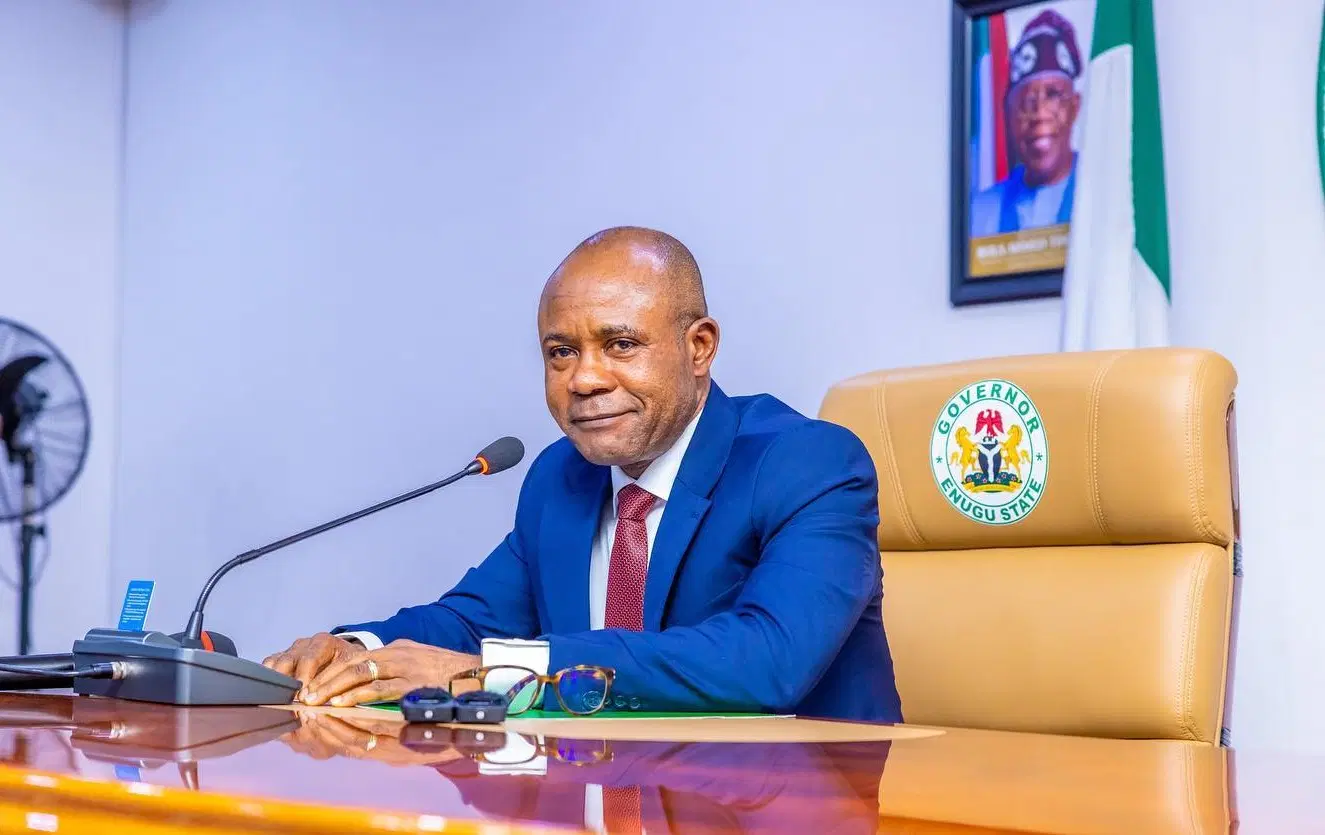
Enugu State has secured a $200 million investment to develop a 100-megawatt (MW) solar power project aimed at improving electricity supply to homes and businesses across the state.
The investment was disclosed in a meeting between Governor Peter Mbah and a delegation from Eauxwell Nigeria Ltd., led by its Managing Director, Edwin Enwegbara, at the Government House in Enugu on Thursday, according to the News Agency of Nigeria (NAN).
Estimated at about N300 billion, the proposed project will combine distributed solar generation with battery storage to provide more reliable electricity to households, agricultural processors, small businesses and other enterprises.
Enugu reviews solar tariffs and timeline
Mbah said the state’s objective went beyond attracting investment, emphasising the need to establish an electricity market that delivers reliable and affordable power to consumers.
Also Read
The governor noted that the tariff assumptions and financial model presented by the investors required further review to balance investors’ need to recover their costs with the ability of households and businesses to pay for electricity.
- “The Enugu State Government has secured a $200 million dollar investment for the development of a 100-megawatt (MW) solar power aimed at improving electricity supply to homes and businesses across the state”, the NAN report read in part.
Mbah called for a shorter implementation timeline and pledged government support to remove bureaucratic and institutional bottlenecks that could delay the project.
Enwegbara said the final electricity tariff would be determined in consultation with regulators, balancing investors’ cost recovery with affordability.
He added that the project’s solar generation and battery storage systems would support households, agricultural processors and small businesses.
Olufemi Akinyelure, Head of the Nigeria Electrification Programme at the Rural Electrification Agency (REA), joined virtually to explain the structure, objectives and implementation of the Distributed Access through Renewable Energy Scale-up (DARES) programme.
Niger State advances 100MW solar project
Enugu’s investment follows a similar initiative in Niger State, where the government secured a $150 million Islamic Development Bank (IsDB) loan in July for a 100MW solar project.
Mustapha Abubakar, Chairman of the New Niger Development Project, said the state would contribute another $10 million, bringing total funding to $160 million. The project will be sited in Maikunkele and include social intervention programmes for surrounding communities.
In January, the state announced plans for the IsDB-backed Niger State Solar Electrification Project, valued at about $163 million. The proposed 200-hectare project is expected to generate 100MW to support households, businesses, agriculture and industrial growth while reducing dependence on the national grid.
DARES targets 17.5 million Nigerians
Nigerian states are increasingly turning to alternative power sources amid persistent grid failures and inadequate electricity supply. Solar projects are gaining traction, supported by the country’s solar potential and development financing.
- Nigeria’s solar industry is also expanding. Rural Electrification Agency (REA) Managing Director Abba Aliyu said domestic solar panel manufacturing capacity had risen to 300MW from 120MW two years ago, with a 3.7-gigawatt project pipeline.
- Renewable energy investments reached about $425 million in 2025, supporting eight manufacturing facilities.
- Locally produced solar panels are being exported to Ghana, while other African countries have expressed interest in Nigeria’s electricity access model.
- The 2026 Mini-Grid Regulations permit interconnected mini-grids of up to 10MW and simplify licensing and environmental assessments.
The REA has secured a N100 billion revolving credit facility with Lotus Bank to expand electricity access in underserved communities and partnered with ECOWAS to solarise 15 public institutions.
The DARES programme aims to connect 17.5 million Nigerians through more than 2.5 million household connections and 1,350 mini-grids, including 250 interconnected systems. Backed by $750 million in funding, it is expected to attract an additional $1.1 billion in private investment.