Follow Us on Google Discover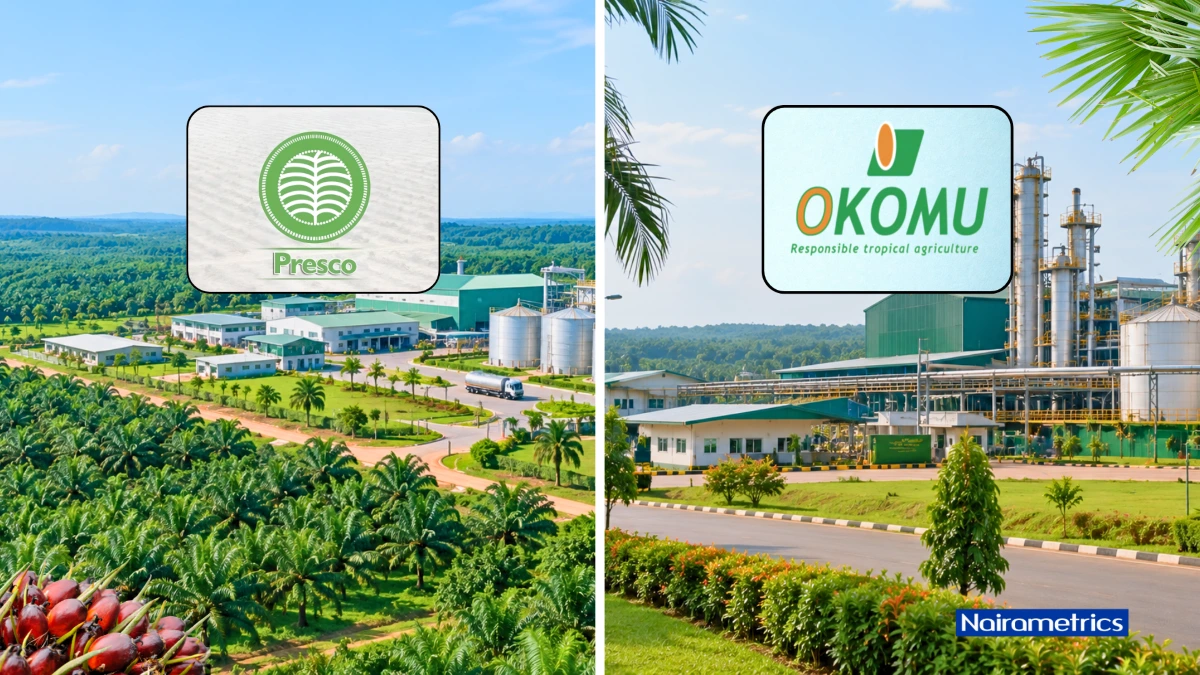
If you invested N1 million each in Presco Plc and Okomu Oil Palm Plc a little over ten years ago, those investments would be worth approximately N61.98 million and N42.12 million, respectively, today.
Such is the scale of wealth creation delivered by two of Nigeria’s largest listed palm oil producers, which have emerged as some of the Nigerian Exchange’s biggest long-term compounders over the past decade.
Nairametrics Research analysis from share price data published by the Nigerian Exchange (NGX) was utilized. Entry prices are based on the December 31, 2015 closing price, which served as the reference opening prices for the first trading session of 2016 on January 4.
Between the start of 2016 and September 24, 2026, Presco delivered a share price return of 6,098%, effectively multiplying investor capital almost 62 times, while Okomu Oil returned 4,112%, representing nearly 42 times the initial investment.
Also Read
Put together, N2 million invested equally in both companies would have grown to about N104.10 million over the period, excluding dividends, brokerage fees and taxes.
Presco and Okomu Oil, the two dominant listed palm oil producers in Nigeria, have been the sector’s standout performers, compounding investor capital at rates that most asset classes anywhere in the world would struggle to match.
What the data is saying
At the start of 2016, Presco’s shares were trading at N33.00. An investor who put N1 million into the stock at that price would have acquired 30,303 shares.
- By September 24, 2026, those shares were priced at N2,045.30, giving the same position a market value of N61.98 million, a gain of N60.98 million. That represents a total price return of 6,098% over the period, or a compound annual growth rate of 47.30%.
- To put that in context, an investor doubling their money every two years for a decade would achieve a CAGR of roughly 41%. Over the roughly 10 years 7 months holding period, Presco’s CAGR of 47.30% means the stock was growing faster than that, consistently, across a period that included Nigeria’s recession of 2016, the COVID-19 disruption of 2020, and the sharp naira devaluations of 2023 and 2024.
Okomu Oil Palm’s shares were trading at N30.30 at the start of 2016. An investor who put N1 million into the stock at that price would have acquired 33,003 shares.
- By September 24, 2026, those shares were priced at N1,276.20, giving the position a market value of N42.12 million, a gain of N41.12 million. That represents a total price return of 4,112% over the period, or a compound annual growth rate of 42.05%.
- The gap between Okomu and Presco in absolute naira terms reflects the difference in their starting prices and subsequent trajectories, but both companies delivered returns that are extraordinary by any conventional standard.
- An investor who chose Okomu over a broad Nigerian equities exposure still massively outperformed the market, they simply captured less of the upside than an investor in Presco.
Okomu’s business model through the decade was similarly structured to Presco’s, with revenues effectively linked to international palm oil prices converted at the prevailing naira exchange rate.
More insights
The extraordinary returns delivered by Presco and Okomu over the past decade were underpinned by equally strong growth in their businesses.
- Between 2016 and 2025, Presco’s revenue rose from N15.72 billion to N330.64 billion, representing a CAGR of 40.3%. Operating profit grew even faster, from N7.03 billion to N214.95 billion, while its operating margin expanded from 44.7% to 65.0%. Earnings per share increased from N21.76 to N120.65.
- Okomu also compounded strongly. Revenue increased from N14.36 billion in 2016 to N198.15 billion in 2025, a CAGR of 33.9%, while profit after tax rose from N4.91 billion to N57.95 billion. Earnings per share climbed from N5.15 to N60.75. Unlike Presco, however, Okomu’s operating margin remained broadly around 48%, meaning much of its profit growth came from selling more at higher prices rather than a major expansion in margins.
- That momentum continued into 2026. In the first half of the year, Presco generated N198.75 billion in revenue and N82.27 billion in profit after tax, while Okomu recorded N125.29 billion in revenue and N39.73 billion in profit.
- The strength of the underlying businesses helps explain the exceptional performance of their shares. But there is an important distinction between the returns seen by a naira investor and those seen by an investor measuring wealth in dollars.
- Consider an investor who put N1 million into either stock at the beginning of 2016. At an exchange rate of roughly N197 to the dollar, that investment was worth about $5,076.
- By September 24, 2026, a N1 million investment in Presco had grown to about N61.98 million. In naira terms, that is a return of roughly 6,098%. But at an exchange rate of N1,328 to the dollar, the investment was worth approximately $46,671, still an extraordinary dollar return of about 819%, equivalent to roughly 23% a year.
- The same N1 million invested in Okomu grew to about N42.12 million, a naira return of roughly 4,112%. Converted at the September 2026 exchange rate, it was worth around $31,716, representing a dollar return of roughly 525%, or about 19% annually.
The difference is the naira. Over the period, the naira lost approximately 85% of its value against the dollar, falling from roughly N197 to N1,328. As a result, the spectacular naira gains translated into much smaller, though still exceptional, returns in dollar terms.
That distinction matters. Presco turned roughly $5,076 into $46,671, while Okomu turned it into about $31,716. Those are outstanding long-term outcomes by almost any standard. But they also show why Nigerian equity returns should not be judged by naira appreciation alone.
What you should know
In an earlier article published by Nairametrics looking at where to invest in September 2026, Presco and Okomu Oil were both highlighted as preferred agricultural plays in the equities section, with Presco described as a preferred agro play and Okomu noted as offering quality but at a higher valuation.
- As of the close of August 2026, 61 stocks had delivered more than 30% year-to-date share price gains, including 18 with triple-digit returns before considering dividend income, with the equities market described as the strongest option for investors targeting returns above 30%.
- Nigeria entered September 2026 with external reserves above $53 billion, headline inflation falling to 15.43% in July from 15.91% in June, and the naira trading around N1,340 to N1,350 to the dollar, providing a more supportive backdrop for Nigerian assets than earlier in the year.
- The FTSE Russell Frontier Market reclassification of Nigeria, confirmed for September 21, 2026, was identified as a key catalyst for renewed foreign institutional participation in the equities market, alongside potential major listings including Dangote Refinery.
For investors whose target return is below 30%, OMO Bills and Treasury Bills with stop rates of 19.32% to 19.90% and 16.30% to 17.15% respectively offered strong risk-adjusted alternatives to equity exposure, while money market funds led by DLM at 20.69% provided another route to competitive returns without equity market risk.