Follow Us on Google Discover
Eight listed consumer goods companies recorded a combined N70.1 billion in royalties, technical fees, licence fees and management charges in H1 2026, based on their financial statement disclosures.
The fees reflect the cost of using global brands, production know-how, technical expertise, and other support provided by multinational partners.
Financial statements reviewed by Nairametrics Research show that the N70.1 billion recorded in H1 2026 was only slightly higher than the N69.7 billion recorded in the same period of 2025.
The analysis focuses on listed consumer goods companies with December year-ends, so their H1 2026 results cover the same six-month reporting period, making the comparison more consistent.
Also Read
Fees to group and related parties reach N70.1 billion
Across the eight companies reviewed, fees to group rose by N333 million in H1 2026, increasing from N69.7 billion in H1 2025 to N70.1 billion.
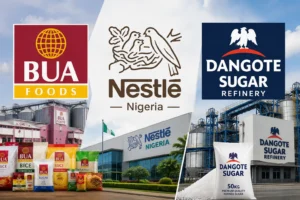
- Nestlé Nigeria has the largest fees, recording N23.2 billion on general license fees to Société des Produits Nestlé S.A. in Switzerland. The amount was equivalent to 3.57% of Nestlé Nigeria’s revenue, the highest fee-to-revenue ratio among the companies reviewed.
- Nigerian Breweries followed with N21.9 billion in royalty and technical fees to Heineken N.V. and Heineken group entities. The amount represented 31.2% of the total fees recorded across the eight companies and 2.72% of Nigerian Breweries’ revenue.
- International Breweries recorded N8 billion in technical management fees, reflecting services provided within the AB InBev group, while Guinness Nigeria recorded N6.4 billion in royalties and technical fees to members of the Diageo Group.
BUA Foods recorded N5.4 billion in management fees to BUA International Limited. Unilever Nigeria, Cadbury Nigeria and NASCON Allied Industries together accounted for another N5.2 billion.
Why consumer firms pay technical fees
Consumer goods companies that operate under multinational brands often pay for the right to use trademarks, production formulas, technical systems and marketing support owned by their group.
- These fees are a normal part of many multinational business arrangements. In return for access to established brands, technical expertise and operating systems, the Nigerian company may pay a fixed fee or a percentage of revenue.
This helps explain why the fees are concentrated among some of the biggest multinational-linked consumer goods companies in Nigeria.
- Nestlé Nigeria, Nigerian Breweries, International Breweries, Guinness Nigeria and Cadbury Nigeria accounted for N61 billion, or about 87% of the total fees recorded during the period.
- Guinness Nigeria, for example, continued its commercial relationship with Diageo after Diageo sold its controlling stake in the company to Tolaram in 2024. Following the transition, Diageo retained its role as a technical partner and adviser, providing technical and commercial support under existing service, trademark and quality-control agreements.
- Nestlé Nigeria also illustrates the arrangement clearly. Under its General License Agreement with Société des Produits Nestlé S.A., Switzerland, the company receives technological, scientific and professional assistance for the manufacture, marketing, quality control and packaging of its products, as well as access to patents, brands, inventions and know-how. The agreement runs from January 1, 2024 to December 31, 2026,
- International Breweries draws on services from several companies within the AB InBev group, including management support from AB InBev Africa, technical and project support from South African Breweries and marketing-related services from AB InBev Services LLC.
- Cadbury Nigeria also operates under an arrangement with Mondelēz International AMEA PTE Ltd, which holds the exclusive rights to manufacture, distribute and market Mondelēz international brands in Nigeria and also provides other services to the company. In return, Cadbury pays royalties as well as fees for technical know-how and management services to Mondelēz International AMEA PTE Ltd.
The arrangements show that these fees are largely tied to access to global brands, technical expertise, production systems, and management support. While the structure differs across companies, the common feature is that multinational support comes at a recurring cost.
Consumer giants report stronger results
The size of the fees recognised is only one side of the picture. Several of the companies recording the largest fees also recorded stronger revenue, profits and margins in H1 2026, suggesting that the value of these relationships is better assessed alongside the operating performance they help support.
- Nigerian Breweries reported revenue of N803.7 billion, up 8.88% from N738.1 billion in H1 2025, while profit after tax rose to N92.95 billion.
- International Breweries recorded revenue of N342.07 billion during the period. Gross profit increased by 16.21% to N141.29 billion, while operating profit rose by 24.66% to N69.88 billion.
- Guinness Nigeria also recorded stronger performance, with sales rising 11.8% to N265.04 billion from N237.00 billion in H1 2025. Gross profit increased to N97.47 billion, while operating profit reached N41.52 billion.
The results suggest that the impact of these groups should not be judged only by the fees recognized. For the companies involved, the bigger question is whether access to established brands, technology and operating expertise is helping to support stronger revenue, margins and returns to shareholders.