
 Follow Us on Google Discover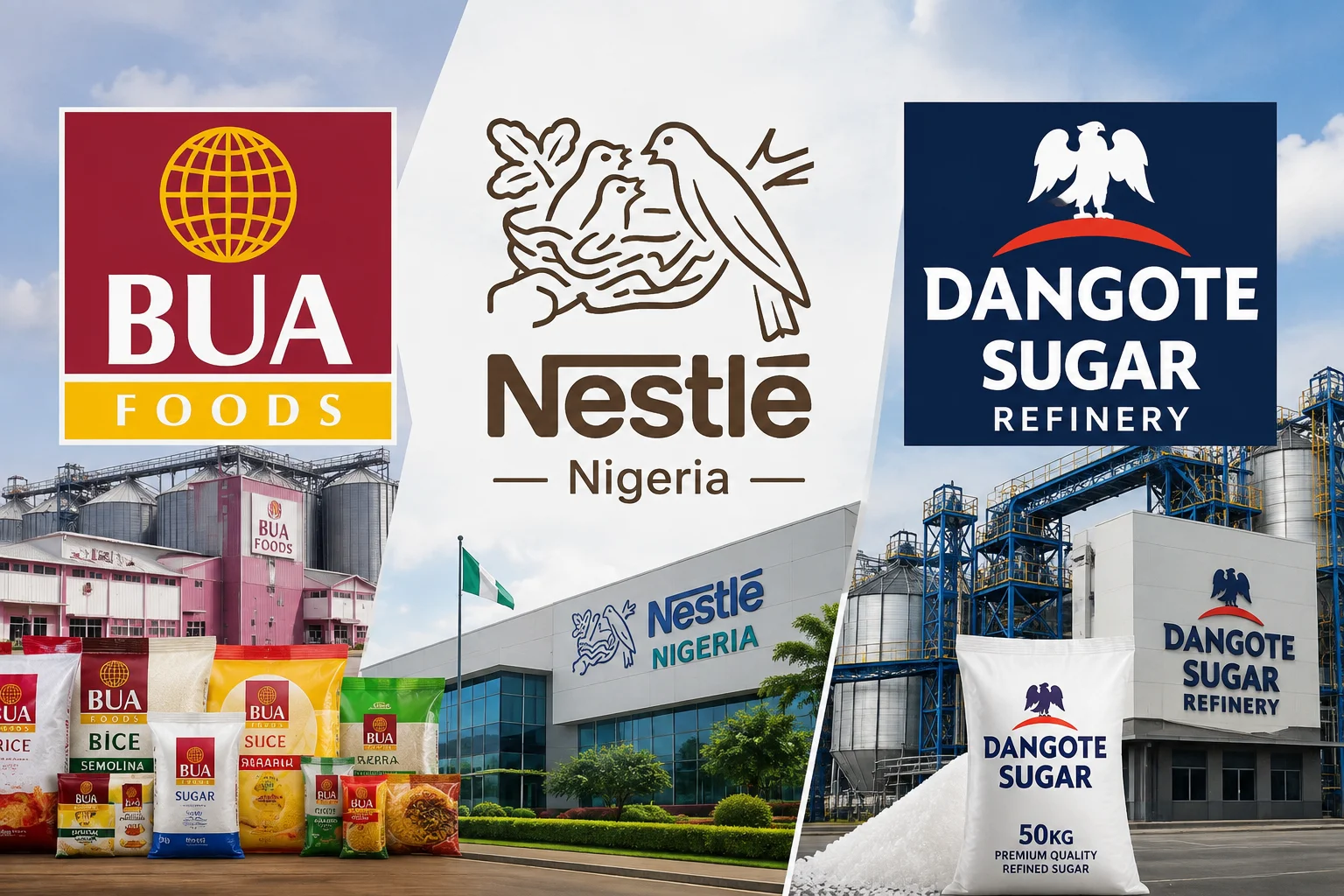
Nigeria’s six leading listed consumer goods companies spent N1.55 trillion to generate N2.09 trillion in revenue in the first half of 2026, highlighting the persistent cost pressures facing the country’s largest manufacturers.
This is according to a Nairametrics analysis of the H1 2026 financial statements of BUA Foods, Nestlé Nigeria, Dangote Sugar Refinery, Unilever Nigeria, NASCON Allied Industries and Cadbury Nigeria.
The companies’ combined revenue declined by 3.9% from N2.18 trillion recorded in H1 2025, as rising distribution, administrative, financing, energy and logistics expenses continued to weigh on their operations.
What the data is saying:
The six companies recorded combined identifiable operating costs of N1.55 trillion during the period, equivalent to 74.1% of their total revenue. However, the cost pressures varied significantly across the companies.
Also Read
- Cost of sales declined by 13.85% to N1.26 trillion from N1.46 trillion in H1 2025, largely due to lower raw sugar input costs at BUA Foods and Dangote Sugar.
- Combined selling, distribution and administrative expenses rose by 13.9% to N236.4 billion from about N207.6 billion.
- Net finance costs fell by 45% to N57.9 billion from approximately N105.3 billion, reflecting debt repayments and Nestlé Nigeria’s foreign exchange translation gain.
- Cost of sales accounted for more than 81% of the companies’ total identified costs, demonstrating the continued burden of raw materials, packaging, energy and logistics.
Despite the decline in total revenue, the companies’ combined weighted average gross margin improved to 39.9% from 35% in the corresponding period of 2025.
More insights:
The revenue decline was concentrated mainly on BUA Foods and Dangote Sugar, whose earnings are closely linked to sugar commodity prices. Together, the two companies lost N185.7 billion in revenue compared with H1 2025.
- BUA Foods’ revenue declined by 16.2% to N765.1 billion, although its cost of sales fell faster, giving it the lowest cost-to-revenue ratio of 59.1%.
- Dangote Sugar recorded N391.9 billion in revenue, down 8.9%, while its 91.7% cost ratio remained the highest among the companies.
- Excluding the two sugar-focused companies, Nestlé, Cadbury, NASCON and Unilever grew their combined revenue by 13.3%.
- Unilever recorded the fastest revenue growth of 22.2%, followed by Nestlé at 12%, Cadbury at 7.9% and NASCON at 3.8%.
The performance suggests that the overall revenue decline was driven more by the normalisation of sugar prices and foreign exchange pass-through effects than by a broad-based slowdown in consumer demand.
Expert views:
Chief Executive Officer of the Centre for the Promotion of Private Enterprise, Dr Muda Yusuf, said manufacturers continued to face deep structural challenges despite recent improvements in macroeconomic stability.
Investment banker and stockbroker Tajudeen Olayinka also noted that companies were absorbing some cost increases because weak consumer purchasing power limited further price increases.
- “The major cost components weighing on their earnings are distribution and selling expenses, administrative costs, finance costs and energy costs,” said Olayinka, a senior dealing member of the Nigerian Exchange and CEO, Wyoming Capital Partners Limited.
- “Production is energy-intensive and logistics-intensive. On top of that, manufacturers are contending with very high financing costs,” Olayinka added.
- “Companies are passing some of the costs to consumers, but certainly not all of them. They cannot fully transfer these costs because consumers’ purchasing power is weak,”
- “Government should significantly expand the development finance window. Relying solely on commercial financing is not sustainable for the real sector,” Dr. Yusuf, the former Director General of the Lagos Chamber of Commerce and Industry (LCCI) advised.
The analysts who spoke apart from each other also called for greater investment in rail transport infrastructure to reduce the heavy dependence on road transportation, diesel-powered trucks, and expensive logistics networks.
Why this matters:
The companies’ results show that revenue growth alone does not guarantee stronger profitability when distribution, administrative, and financing costs rise more rapidly.
- Cadbury, for example, increased revenue by 7.9%, but its selling and distribution costs more than doubled to N10.8 billion.
- Cadbury’s cost-to-revenue ratio worsened to 85.6%, making it the only company in the group whose ratio deteriorated year-on-year.
- Dangote Sugar’s N554.9 billion net debt position generated N47.5 billion in finance costs during the period.
- NASCON and Unilever earned a combined N11.8 billion in finance income, which helped cushion their operating costs.
The results underline the widening gap between companies with strong cash positions and those carrying substantial debt in Nigeria’s high-interest-rate environment.
What you should know:
Cost-to-revenue ratios across the six companies ranged from BUA Foods’ 59.1% to Dangote Sugar’s 91.7%, reflecting major differences in production structures, financing positions and distribution requirements. These differences are likely to influence their earnings performance during the second half of 2026.
- Companies with net cash positions, including NASCON and Unilever, are benefiting from interest income on available funds.
- Heavily indebted companies, particularly Dangote Sugar and Nestlé, remain exposed to elevated finance charges.
Distribution and administrative expenses remain major risks even where raw material and production costs are moderating.
With operating costs still consuming nearly three-quarters of combined revenue, the ability to control financing, distribution, energy and logistics expenses will remain critical to the competitiveness of Nigeria’s consumer goods manufacturers.

Obviously consumer goods company being managed by people like our crops of politicians and sponsors.
Layman with common senses active brought these companies item weekly if not daily or once in a life time. Yet here you see figures plummeting like its the only business that exist.