Follow Us on Google Discover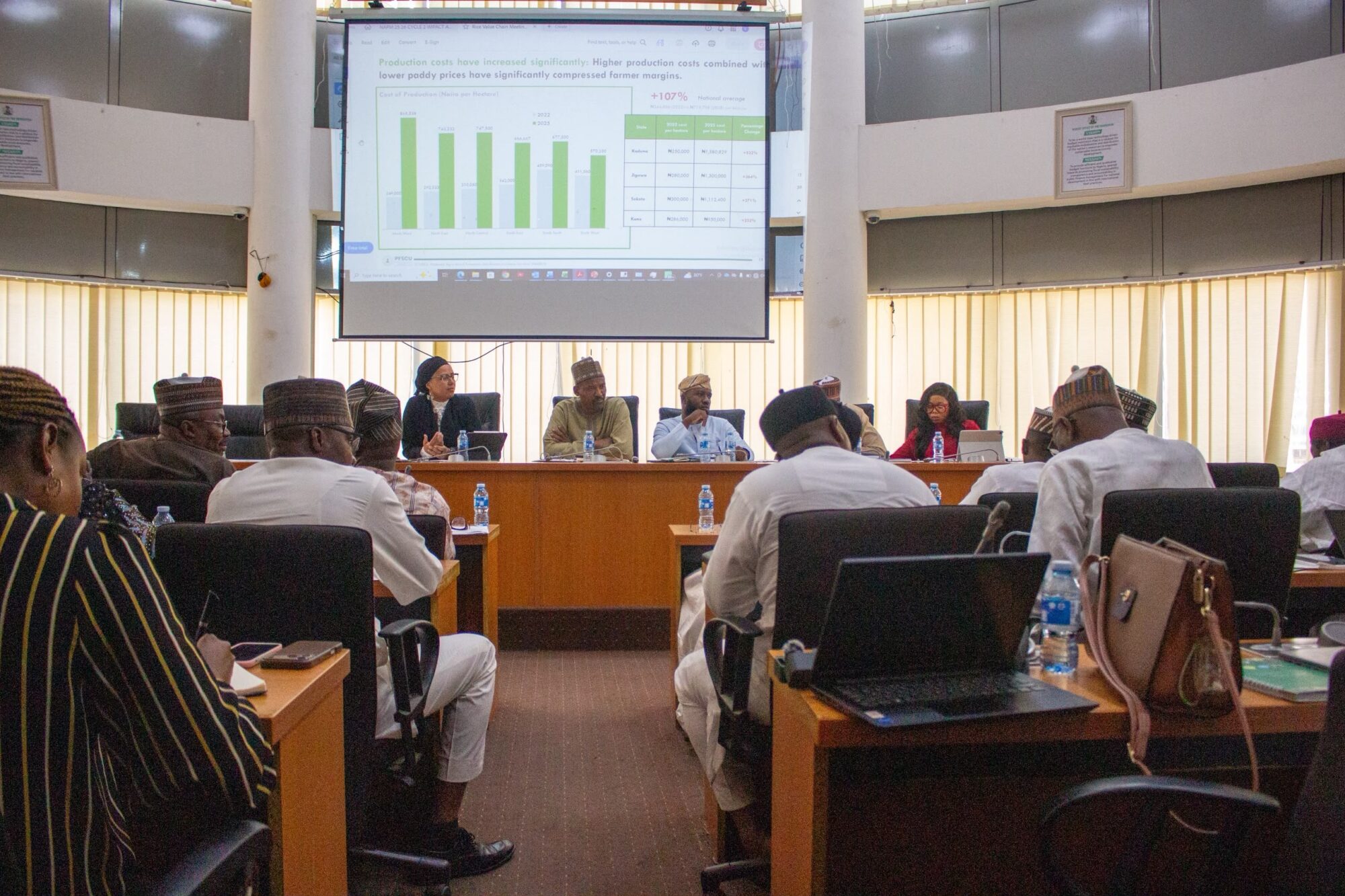
The Federal Government has convened federal and state institutions, farmers, and millers for a technical consultation on consumer affordability regarding the nation’s rice value chain.
This was disclosed in a joint statement signed by the Presidential Food Systems Coordinating Unit (PFSCU) and the Federal Ministry of Finance and shared with Nairametrics on Tuesday night.
The development is in furtherance of President Bola Ahmed Tinubu’s directive on strengthening food security, domestic production, farmer livelihoods, private-sector investment, and consumer affordability.
What FG says on rice affordability
According to the statement, the Minister of Finance, Taiwo Oyedele, who chaired the session, was represented by the Director of Technical Services, Bashir Abdukadir, while PFSCU’s Executive Secretary, Marion Moon, was the assistant chair.
Also Read
The Federal Government underscored the need for an integrated food-market data framework covering production, stocks, imports, consumption, and prices, as well as stronger food-safety, traceability, certification, and testing systems.
- “These measures are aimed at enabling timely policy decisions, protecting farmer and processor investment, improving consumer affordability and strengthening the competitiveness of Nigeria’s rice value chain,” the joint statement partly reads.
The consultation brought together key stakeholders to also examine the factors affecting production, investment, market conditions, and the affordability of rice for consumers.
The engagement also provided an opportunity for stakeholders to strengthen coordination around Nigeria’s food balance, especially domestic production, strategic reserves, imports, and exports, including market conditions, investment, and consumer needs.
The statement disclosed that the consultation will produce a consolidated technical report on the current dynamics and status of the rice value chain and priority actions for strengthening the sector.
Rice stakeholders highlight rising costs
According to the statement, stakeholders highlighted the high cost of production as a major constraint to competitiveness, reporting that rice production costs stood “at about N2.2–N2.3 million per hectare,” while fertiliser accounted for approximately 35 percent of production costs.
They also identified high energy and irrigation costs, limited access to appropriately priced long-term financing, post-harvest losses, and inadequate distributed storage as key pressures across the value chain.
Stakeholders called for greater investment in irrigation, including solar-powered water systems, to support year-round production.
They also called for stronger financing and refinancing options for viable mills and processors, improved storage and aggregation infrastructure, and measures to reduce production and logistics costs.
- Participants “stressed the importance of predictable trade and import decisions that reflect domestic production cycles, noting that persistent price differentials can create incentives for smuggling.”
The Vice President of the Rice Farmers Association of Nigeria (RIFAN), Mohammed Auwalu, welcomed the government’s continued engagement with stakeholders across the rice value chain.
Rice prices stabilize across markets
A market survey conducted by Nairametrics during the first week of May 2026 showed that the price of a 50-kilogram bag of rice in Nigeria ranged between N53,000 and N82,000, depending on location, transportation costs, supply chain efficiency, and regional demand.
The survey, which tracked prices of popular rice brands such as Big Bull, BUA Foods Rice, and Royal Stallion, revealed that prices continued to stabilize in several markets following improved domestic supply and relative stability in the foreign exchange market.
For instance, market traders in the Federal Capital Territory attributed the relative affordability to improved access to supply corridors from major rice-producing states such as Niger, Benue, and Kogi, as well as reduced transportation bottlenecks and improved availability of locally milled rice brands in the Abuja market.
Food inflation and rice market outlook
The development aligns with the Federal Government’s broader push to expand local content patronage while ensuring the availability of local produce.
Nairametrics earlier reported in November 2025 that there had been a decline in food inflation in the Federal Capital Territory (FCT).
Nigeria’s headline inflation rate slowed to 18.02 percent in September 2025, marking a decline from the 20.12 percent recorded in August 2025, according to the latest data released by the National Bureau of Statistics (NBS).
According to the report, the food inflation rate stood at 16.87 percent in September 2025 on a year-on-year basis, representing a sharp decline of 20.9 percentage points from the 37.77 percent recorded in September 2024.