Follow Us on Google Discover
Agriculture and exports remain critical to Nigeria’s efforts to diversify its economy and achieve sustainable economic growth, FirstBank Group Chief Executive Officer, Olusegun Alebiosu, has said.
Alebiosu made the statement during his opening remarks at the fifth FirstBank Agric & Export Expo 2026, themed “From Farm to Global Markets: Building Nigeria’s Export Value Chain,” held in Lagos on August 16 and 17, 2026.
The two-day expo brought together producers, processors, exporters, financiers, policymakers and investors to discuss opportunities and challenges across Nigeria’s agricultural and non-oil export value chains.
What they are saying
Alebiosu said agriculture and exports have significant potential to strengthen economic growth, create opportunities for businesses and entrepreneurs and support Nigeria’s diversification efforts.
Also Read
- “At FirstBank, we recognise that agriculture and exports remain critical to Nigeria’s economic diversification agenda. They hold tremendous potential for strengthening sustainable economic growth,” Alebiosu said.
He said the expo had evolved from an initiative focused on awareness and engagement into a platform connecting players across the agricultural and export ecosystem.
- “Our objective is not only to showcase opportunities within agriculture and exports but also to facilitate the connections, partnerships, financing solutions, market access opportunities, and knowledge exchange required to transform ideas into thriving enterprises,” he said.
He said stronger collaboration among stakeholders would be necessary to translate opportunities in the agricultural and export sectors into tangible economic outcomes.
During the expo, FirstBank also signed a Memorandum of Understanding with NEXIM Bank and Sapphital Limited to expand trade finance, strengthen value-chain collaboration and support non-oil exports. The agreement was signed by Alebiosu, NEXIM Bank Managing Director and Chief Executive Officer, Abubakar Abba Bello, and Sapphital Executive Director, Finance and Strategy, Chinedu Ogbeide.
Calls for stronger agricultural value chains
Lagos State Governor, Babajide Sanwo-Olu, called for more efficient agricultural value chains to move Nigeria from exporting raw commodities to value-added products.
Sanwo-Olu, represented by Commissioner for Agriculture and Food Systems, Abisola Olusanya, said Lagos was investing in infrastructure, cold-chain logistics, storage and agro-industrial development, citing the Imota Rice Mill’s production of more than 500,000 bags of Eko Rice in one year.
Niger State Governor, Mohammed Bago, said Nigeria imported more than $3 billion worth of food in 2026 and could reach $4 billion before year-end, stressing the need to strengthen domestic production.
Bago cited a $100 million Saudi-backed irrigation facility in Niger State and plans for export-oriented greenhouses, while calling for greater investment in agricultural research and local seed production.
Ondo State Governor, Lucky Aiyedatiwa, said the state was moving beyond primary production into processing, packaging, traceability and exports, including through the distribution of more than two million cocoa seedlings.
Aiyedatiwa also said Ondo had established a committee to support compliance with the European Union Deforestation Regulation and improve traceability in its cocoa value chain.
Brazil’s Consul General in Lagos, Ronaldo Vieira, said collaboration among government, the private sector, research institutions, universities, producers and financial institutions had supported Brazil’s agricultural development.
More details
Participants at the expo identified low fertiliser use, limited irrigation, poor infrastructure and inadequate financing as major constraints on agricultural productivity in Nigeria.
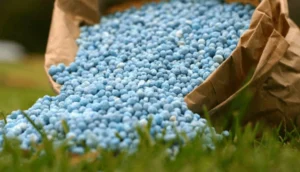
Vishwajit Sinha, Chief Executive Officer of Greenview Fertiliser Corporation, said fertiliser use in Nigeria stands at about 15kg per hectare, below the 50kg per hectare ECOWAS target.
- Sinha said yields for maize, rice, sorghum, cassava and yam remain at about 20% to 25% of comparable global levels, while poor roads, storage and logistics contribute to post-harvest losses of 40% to 50%.
- He said about 78% of farmers are financially included, but only around 2% of total agricultural loans reach farms.
Agboola Zubayr Belgore, Managing Director of Amo Byng Nigeria Limited, said Nigeria produces about 1 million to 1.3 million tonnes of soybeans annually against demand of roughly 2 million tonnes.
Belgore warned that rising demand for Nigeria’s non-GMO soybeans in export markets could further increase prices for domestic livestock feed producers.
What you should know
Nigeria’s non-oil exports rose to N3.19 trillion in the first quarter of 2026, according to data from the National Bureau of Statistics (NBS).
- The figure increased 1.31% from N3.15 trillion in Q4 2025 and 0.60% from N3.17 trillion in Q1 2025.
- Total non-oil exports stood at N12.36 trillion in 2025 and accounted for approximately 15.05% of total exports in Q1 2026.
- Leading Q1 non-oil exports included sesamum seeds at N153.78 billion, soya beans at N129.27 billion and cashew nuts at N119.76 billion.
Photovoltaic products generated N85.79 billion, while electrical products accounted for N75.16 billion.
In Q2 2026, the top 10 agricultural export products generated N747.54 billion, led by cashew nuts in shell at N268.62 billion, standard quality cocoa beans at N154.31 billion and sesamum seeds at N96.03 billion.