Follow Us on Google Discover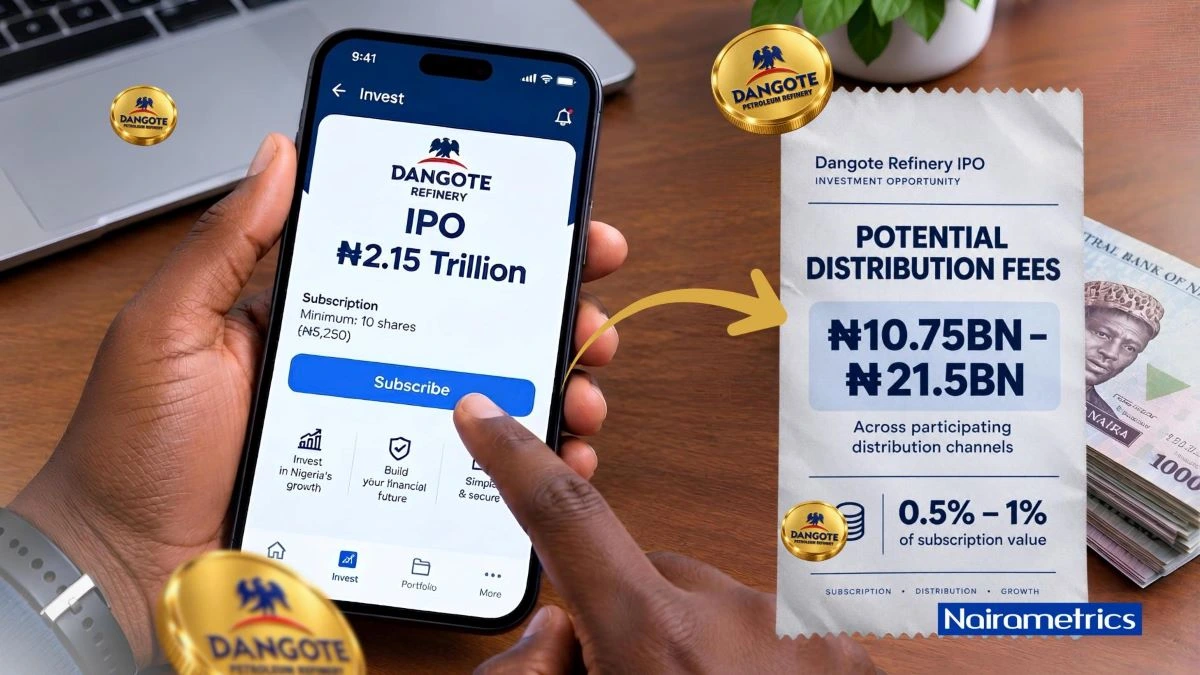
When the Dangote Petroleum Refinery IPO went live on the Nigerian Exchange on Monday, September 14, excitement among retail investors was enormous.
But that excitement was quickly followed by a problem for some of the digital platforms handling subscriptions. It was a crash.
Within minutes, Bamboo posted on X that it was “getting much higher than expected traffic” and working to get the app “up and running” again.
Cowrywise, another major digital investment platform, also reported difficulties as investors rushed to participate.
Also Read
This disruption offered an early glimpse of the scale of the subscription opportunity for fintechs and digital investment platforms distributing the offer.
The money sitting behind the subscriptions
Strip away the login failures and the rush by investors for the IPO points to something more important for these platforms: a potentially significant revenue opportunity tied to the value of subscriptions processed through their channels.
Nairametrics spoke to Sycamore, a digital financial services company and one of the approved distribution channels for the Dangote Refinery IPO, to understand this.
Sycamore said that fees for offers of this nature typically range from 50 to 100 basis points, or 0.5% to 1%, of subscription proceeds.
In other words, the fee is linked to the amount of money investors subscribe through a distribution channel, rather than being a fixed charge per investor.
Applied to the N2.15 trillion Dangote offer, that would imply between N10.75 billion and N21.5 billion in distribution fees could be shared across all the channels involved, if the same range applied across the full value of subscriptions.
That does not mean fintechs will collectively receive that amount, or that any individual platform will earn a particular sum. Actual earnings would depend on the value of subscriptions processed through each channel, and the commercial terms agreed for the offer.
Sycamore told Nairametrics that investors subscribing through its platform pay no charge.
- “Subscription done by investors through Sycamore is at no charge to the investor. However, we are eligible for a placement distribution fee on the IPO issue,” the company said.
Sycamore said the fee is based on the value of subscription proceeds rather than the number of investors using its platform.
- “The fees receivable on the IPO distribution is based on the value of the subscription proceeds,” it said.
It should not be treated as a confirmed industry-wide payout. Commercial terms can differ between intermediaries, while the amount any individual fintech earns would depend on the value of subscriptions processed through its channel.
The fee is the smaller story
But for the platforms, the direct distribution fee may not be the biggest commercial opportunity.
Sycamore said it expects significant retail participation through its mobile app and web dashboard, with a target of between 500,000 and 1 million users.
- “We’ve designed a simplified subscription flow to make it very easy for anyone to start a subscription from scratch and complete it within minutes,” the company said, adding that it had “optimized our platform to cater to these numbers comfortably.”
- “We believe the associated fees should adequately offset the technology investment and marketing/distribution expenses,” the company said.
But the bigger opportunity, in Sycamore’s telling, is what happens after the subscription confirmation screen.
- “An IPO of this scale is far more than a one off fee event for us at Sycamore. It is one of the strongest retail investor acquisition events a fintech can get,” the company said.
Sycamore said the long-term value of users acquired during a major IPO can outweigh the direct transaction fees because of the potential for cross-selling and deeper engagement.
The platform also expects the offer to attract younger investors who are beginning to understand stocks, arguing that greater participation could help strengthen long-term investing habits and deepen activity in the Nigerian capital market.
That makes the IPO commercially interesting to fintechs beyond the immediate distribution fee. A customer who joins a platform to subscribe for the Dangote IPO can potentially remain on the platform for other investments, trading products and financial services after the offer closes.
For digital investment companies, the IPO is therefore both a transaction to process and an opportunity to acquire customers whose value could extend beyond the offering itself.
What about tax?
The subscription itself is not subject to VAT, according to Kehinde Jones, Senior Investment Professional and Head of Research and Strategy at Anchoria Capital Group.
- “There is no direct tax charged on the amount an investor subscribes for in the Dangote IPO. The subscription, purchase and sale of the Offer Shares are exempt from VAT,” he told Nairametrics.
He added that taxes can arise elsewhere in the transaction chain, including on services provided during the IPO. Capital Gains Tax may also become relevant if an investor later sells the shares and makes a taxable gain, while dividends paid to investors are generally subject to 10% withholding tax.
This means the potential distribution fees earned by intermediaries should not be confused with the amount investors pay to subscribe for the shares. The two sit on different sides of the transaction.
How Dangote opened the IPO to retail investors
The Dangote Refinery IPO has been structured to make participation accessible to a broad retail audience, with a low minimum subscription and digital channels allowing investors to participate from across the country.
Earlier, at the signing ceremony for the IPO, Chuka Eseka, CEO of Vetiva Capital Management, said the Dangote Refinery IPO will be the first public offer in Nigeria that retail investors can subscribe to entirely through digital channels.
He said the digital distribution model would allow Nigerians across the country to participate through channels including bank and fintech apps as well as POS terminals.
The offer comprises 4.1 billion ordinary shares priced at N525 each, with a minimum subscription of 10 shares, or N5,250. It is being distributed through approved channels covering banks, fintech platforms, mobile operators and NGX Invest.
The target of up to 10 million retail investors further signals the ambition to expand participation in the capital market.
Early activity on digital platforms already points to significant interest. Bamboo said it opened more than 236,000 new accounts in the week leading up to the IPO, with about 152,000 of those accounts funded and trading within the same week.
There are also signs of interest beyond Nigeria. Ayinde Akinsola, Managing Director of TrustBanc Capital Management, said the firm received “overwhelming” expressions of interest from people across Africa after its investor-awareness sessions, partly driven by the appeal of participating in Africa’s industrial development.
The scale of the demand
The scale of the response became clearer when the IPO opened, as investors rushed to access the offer through digital platforms and some of the apps experienced disruptions under the traffic.
Bamboo said it had spent two to three months preparing its infrastructure for increased demand, but still experienced an outage when the IPO opened. Cowrywise similarly reported slower-than-usual response times as traffic surged.
- The pressure is notable given Bamboo’s existing position in Nigeria’s retail equities market.
- Data from the NGX Broker Performance Report for the seven months ended July 31, 2026, obtained by Nairametrics, showed that Bamboo accounted for about 3.8 million equity transactions, representing 22% of the 17.3 million equity deals recorded on the Exchange during the period.
- In other words, this was not a platform unfamiliar with high retail trading volumes. Yet the Dangote IPO generated a different kind of demand: a concentrated wave of users trying to access the same offer at roughly the same time.
The disruption therefore provides a useful indication of the intensity of the demand surrounding the offer. Digital platforms were not simply handling their normal flow of stock trades; they were dealing with a large number of existing and newly acquired users attempting to participate in the same IPO.
What the IPO means for fintechs
The Dangote Refinery IPO has created two commercial opportunities for digital investment platforms: immediate revenue from processing subscriptions and the potential to convert new retail investors into longer-term customers.
- Based on the 50–100 basis point range disclosed by Sycamore, the full N2.15 trillion offer would correspond to N10.75 billion to N21.5 billion in potential distribution fees if that range applied across the entire subscription value.
However, that is an illustrative industry-wide fee pool, not the amount available to any individual fintech.
For the platforms, the longer-term value may ultimately depend less on how much they earn from the IPO itself and more on how many of the investors they acquire remain active after the offer closes.