Follow Us on Google Discover
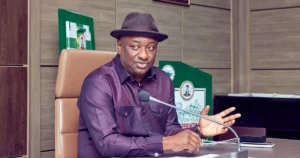
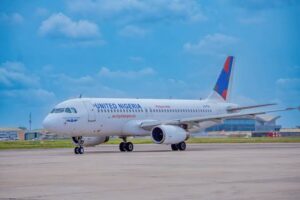
Airlines were servicing outstanding Ticket Sales Charge (TSC) debts under repayment plans agreed with the Nigeria Civil Aviation Authority (NCAA) before union action disrupted the process, United Nigeria Airlines Executive Chairman, Prof. Obiora Okonkwo, has said.
Okonkwo made the disclosure on Thursday while speaking at the 30th annual conference of the League of Airport and Aviation Correspondents (LAAC) in Lagos, themed “Towards a Sustainable Aviation Industry: Balancing government revenue demands with sector growth.”
His comments come weeks after aviation unions commenced industrial action over alleged non-remittance of the statutory 5% TSC by airlines, disrupting flight operations and renewing discussions over outstanding charges.
What Prof. Obiora Okonkwo is saying
Okonkwo said airlines had been meeting their TSC obligations before February 2026, when the Gulf crisis pushed aviation fuel prices to about N3,300 per litre and increased pressure on operators. The Airline Operators of Nigeria (AON) subsequently sought relief from the Federal Government, which approved a 30% waiver on the charges.
Also Read
- “Before February this year, there were no payment problems. All airlines were paying. The AON issue only became a problem because of the Gulf crisis. AON was the first to cry out.”
Following the waiver, Okonkwo said airlines met with the NCAA and the Ministry of Aviation to establish a structured repayment framework for outstanding debts, with operators required to pay 10% of legacy debts within a specified period and settle the balance through instalments.
- “The airlines complied with this directive. The airlines did this. The director met with operators in Lagos and Abuja, and we developed a payment plan. This plan was in place. We were making regular payments according to the agreement we had with the NCAA until we heard about the labour union problem,” he said.
He added that United Nigeria opened joint accounts with the NCAA at Nigerian banks to allow the authority to withdraw agreed payments directly, and questioned the description of airlines as non-compliant.
Okonkwo questions value of 5% TSC
Okonkwo also renewed his objection to the 5% TSC, arguing that airlines do not receive adequate value for the charge while facing multiple taxes and regulatory costs. He said the charge adds to the financial burden on operators and called for continued discussions on its removal.
- He noted that airlines pay 100% in advance when NCAA inspectors travel outside the country to inspect aircraft.
- He said airlines are among Nigeria’s better-paying sectors while acknowledging the unions’ responsibility to advocate for workers’ welfare.
- He described the airport picketing during the industrial action as a “shameful display.”
He called for greater dialogue between airlines, regulators and labour representatives.
He said the focus should be on resolving the dispute through engagement rather than actions that disrupt airline operations.
Backstory
The TSC dispute escalated in August after the National Union of Air Transport Employees (NUATE) and the Air Transport Services Senior Staff Association of Nigeria (ATSSSAN) commenced industrial action over alleged non-remittance by some airlines.
- The unions alleged that domestic airlines owed more than N25 billion in outstanding TSC, with Air Peace alleged to account for more than N17 billion.
- The action initially targeted Air Peace’s domestic operations at the General Aviation Terminal in Lagos and Abuja, disrupting flights.
- The unions also raised concerns about freedom of association, casualisation and collective bargaining.
- The NCAA urged the unions to halt the action and return to dialogue.
The Federal Government subsequently convened an emergency meeting involving airlines, unions and aviation agencies.
Following the meeting, the Minister of Aviation and Aerospace Development, Festus Keyamo, directed the NCAA and other agencies to obtain payment schedules from airlines and spread outstanding payments over a reasonable period, taking operating costs and economic conditions into account.
What you should know
The Ticket Sales Charge is a statutory 5% charge collected by airlines on behalf of aviation agencies on tickets sold for flights originating in Nigeria. The NCAA has opposed proposals to review the existing TSC structure, arguing that the charge is critical to funding aviation safety and regulatory activities.
- NCAA receives 56%, NAMA 22%, NiMet 9%, NCAT 7% and NSIB 6%.
- The NCAA has said the TSC accounts for about 85% of its revenue and funds safety oversight, certification, licensing and inspections.
- A proposal before the National Assembly seeks to increase NAMA’s share to 40% and reduce the NCAA’s allocation from 56% to 40%.
The dispute therefore covers outstanding remittances, the cost of aviation charges and how regulatory agencies are funded.
The controversy highlights the tension between maintaining funding for aviation regulation and reducing the financial burden on airlines operating in a challenging market.