Follow Us on Google Discover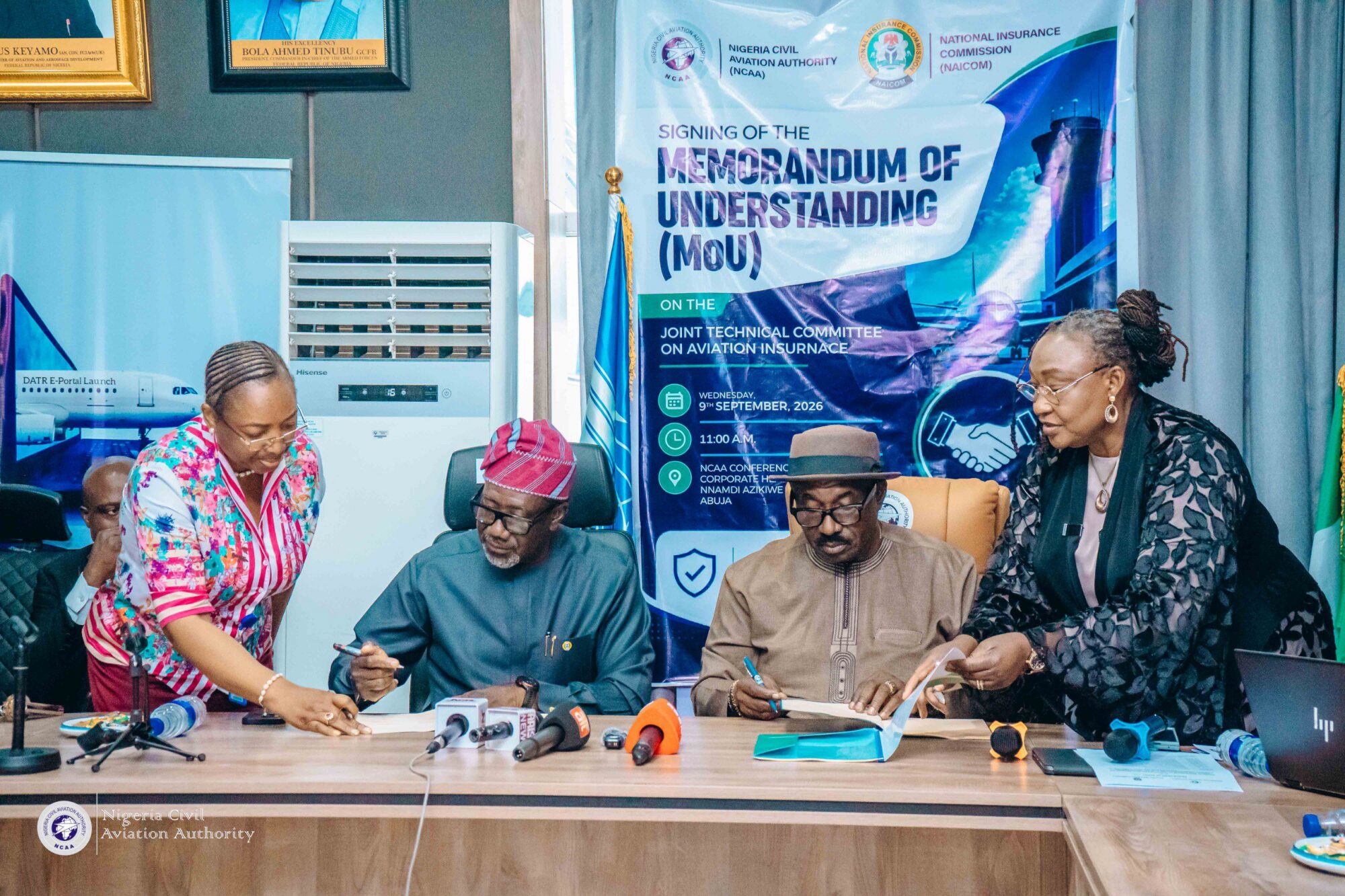
The National Insurance Commission (NAICOM) and the Nigeria Civil Aviation Authority (NCAA) have signed a Memorandum of Understanding (MoU) aimed at strengthening regulatory oversight and improving compliance with aviation insurance requirements across Nigeria’s aviation sector.
The agreement was signed on Wednesday by the Director-General of Civil Aviation (DGCA), Capt. Chris Najomo, and the Commissioner for Insurance, Mr. Olusegun Ayo Omosehin, representing the NCAA and NAICOM respectively.
The development was disclosed through separate posts published on the official X accounts of both regulatory agencies.
What they are saying
Speaking at the signing ceremony, Capt. Najomo said the agreement builds on the long-standing collaboration between the NCAA and NAICOM, particularly in assessing the adequacy and validity of insurance policies maintained by aviation operators in line with the Nigeria Civil Aviation Regulations (Nig. CARs) 2023.
Also Read
According to him, the partnership is designed to strengthen aviation safety, improve financial resilience within the industry, and ensure compliance with regulatory requirements.
- “Aviation remains a paradoxical industry that is globally recognised as the safest mode of transportation, yet characterised by high-impact operational risks.
- “Hence, the need to strengthen aviation safety, financial resilience, regulatory compliance as well as the protection of the travelling public and other stakeholders in the aviation ecosystem,” Najomo said.
The NCAA boss also commended members of the Joint Technical Committee (JTC) that developed the framework for the agreement, expressing confidence that the partnership would deliver measurable improvements in insurance compliance and regulatory oversight.
Effort to enhance safety
On his part, NAICOM Commissioner for Insurance, Olusegun Omosehin, described the MoU as a significant milestone in efforts to enhance the safety, resilience, and integrity of Nigeria’s aviation industry.
He noted that aviation insurance goes beyond regulatory compliance and serves as a critical risk-management tool for safeguarding lives, property, businesses, and the broader economy from aviation-related losses.
- “Aviation insurance is not merely a regulatory requirement but a critical risk-management instrument for protecting lives, property, businesses and the wider economy against aviation-related losses,” Omosehin stated.
Also speaking, the Director of Air Transport Regulation at NCAA, Mrs. Olayinka Babaoye-Iriobe, underscored the importance of aviation insurance in ensuring the safety, stability, and sustainability of the sector.
She reaffirmed NCAA’s commitment to ensuring that aviation operators maintain adequate insurance coverage to protect passengers, airlines, cargo owners, third parties, and other stakeholders against liabilities arising from aviation activities.
Get up to speed
The signing comes amid continued growth in Nigeria’s aviation industry.
- According to a recent Nairametrics analysis of OAG African Aviation Market Data for September 2026, Lagos’ Murtala Muhammed International Airport (MMIA) recorded the fastest growth in scheduled seat capacity among Africa’s ten largest airports.
- MMIA recorded 470,000 scheduled seats during the period, representing a 24.1% year-on-year increase and an additional 90,600 seats compared to the same period in 2025.
- The report showed that Lagos outperformed other major African hubs, including Casablanca’s Mohammed V International Airport, which recorded a 13.5% increase in scheduled capacity.
Cairo International Airport remained Africa’s largest airport by seat capacity with 1.79 million scheduled seats, followed by Addis Ababa Bole International Airport with 1.19 million and Johannesburg’s O.R. Tambo International Airport with 1.16 million seats.
What you should know
The agreement also comes shortly after the completion of Nigeria’s insurance industry recapitalisation programme under the Nigerian Insurance Industry Reform Act (NIIRA) 2025.
- NAICOM recently confirmed that 43 insurance and reinsurance companies successfully met the new minimum capital requirements before the July 31, 2026 deadline.
- The regulator disclosed that compliant operators comprise 23 non-life insurers, 10 life insurers, eight composite insurers, and two reinsurers.
- NAICOM has described the recapitalisation exercise as a major milestone for the industry, noting that the higher capital base is expected to improve insurers’ capacity to underwrite large and complex risks, strengthen policyholder protection, and enhance confidence in the sector.
The new partnership with the NCAA is expected to further reinforce risk management standards in the aviation industry by ensuring operators maintain adequate and compliant insurance coverage as the sector continues to expand.