Follow Us on Google Discover
Nigeria has historically been a challenging market for automotive companies, yet few markets in Africa offer the same scale of opportunity.
Millions of Nigerians depend on motorcycles and tricycles for daily transport, business, and their livelihoods, but building a successful mobility business in the country requires far more than simply bringing vehicles to market.
Distribution, spare parts availability, servicing, customer support, and local market knowledge often determine whether a brand succeeds or struggles.
This reality has become a strong determinant of how global manufacturers approach Nigeria and other African markets. It is one reason many global manufacturers are rethinking how they approach the Nigerian and other African markets. More international manufacturers are moving away from conventional distributor arrangements and working with local partners with the infrastructure, operational capacity, and customer reach needed to support long-term growth.
The partnership between TVS Motor Company and Enviable Tricycle Auto Ltd reflects that evolution. On the surface, it looks like another conventional dealership agreement, but the commercial logic goes much further, suggesting a strategy aimed at improving market access, expanding service infrastructure, and giving customers better support.
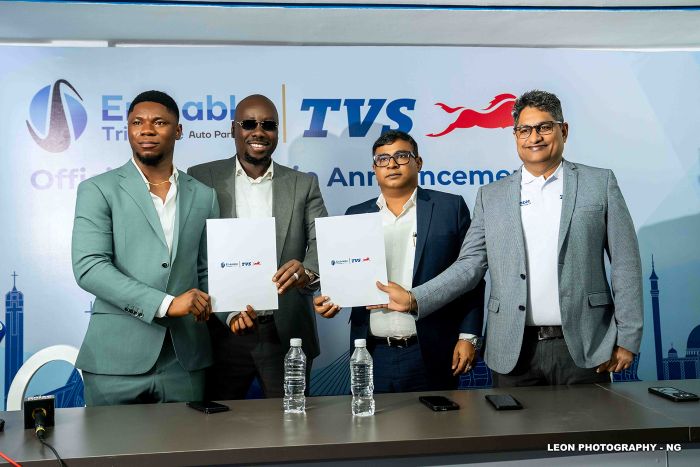
For TVS, the partnership offers an opportunity to deepen its footprint in one of Africa’s most important transportation markets, and for Enviable, it expands the company’s role within Nigeria’s automotive value chain while positioning it as a key player in the delivery and support of globally recognised mobility products. The partnership works because each company fills a gap for the other, with each side contributing something the other cannot easily build on its own.
As TVS contributes global manufacturing scale and engineering expertise to the partnership, Enviable brings local market knowledge and an established operational network and direct access to customers across the country.
For many vehicle owners, especially commercial operators, purchasing a motorcycle or tricycle is only the beginning of the ownership journey. The real test comes afterwards. Access to servicing, genuine spare parts, and technical support often determines how productive a vehicle remains and how much value it delivers over time. This is particularly true in a market where motorcycles and tricycles serve as critical economic tools. Across Nigeria, they support delivery services, logistics operators, traders, artisans, and small business owners.
For many households, they are not simply a means of transportation but income-generating assets. When a vehicle is off the road, earnings are affected. As a result, reliability and after-sales support carry significant weight in purchasing decisions. The growth of e-commerce and technology-enabled delivery services is also changing the dynamics of the sector. As more businesses depend on mobility solutions to move goods and serve customers, demand is expanding beyond vehicles themselves. Operators increasingly require access to financing, maintenance services, spare parts, technical expertise, and support networks that can keep vehicles running efficiently.
In many cases, these factors have become just as important as the product being sold. This is where strong local partnerships create value. While global manufacturers may possess the scale and expertise to produce quality vehicles, local partners often provide the market intelligence and execution capabilities needed to deliver a better customer experience.

Together, they can build systems that neither party could easily create on its own. For TVS, Enviable’s nationwide presence offers an opportunity to bring products and services closer to customers. On the other hand, for Enviable, the relationship provides access to one of the world’s leading two- and three-wheeler manufacturers while strengthening its position in a competitive market. A very clear example of this shared ambition is the newly commissioned mobility facility in Ikorodu, Lagos, which serves as a sales, service, and customer support centre, providing access to TVS motorcycles, tricycles, genuine spare parts, and after-sales services. Beyond its immediate commercial function, it represents a significant investment in the infrastructure that supports mobility businesses in Nigeria.
Such investments are becoming increasingly important. Over time in the past, many manufacturers measured success primarily through sales volumes, but currently, attention is shifting towards customer retention, service quality, and long-term market presence. Also, companies are recognising that sustainable growth depends not only on selling products but also on building the support systems that encourage repeat business and customer loyalty.
The TVS–Enviable partnership aligns with that thinking. It also comes at a time when Africa is playing an increasingly important role in the growth plans of global mobility companies. According to TVS Motor Company, the continent contributes more than half of its international business revenue and accounts for nearly 70 per cent of its export volumes. Nigeria and the wider African market represented roughly a quarter of the company’s overall sales in the last financial year, underscoring the region’s importance to its future ambitions.
For indigenous companies, the development is equally significant. Local businesses are no longer limited to serving as sales channels for international brands. Increasingly, they are becoming strategic partners that help shape market growth, support customer engagement and drive investments in infrastructure and service delivery. That evolution is likely to become more visible as Nigeria’s mobility needs continue to expand.
Population growth, urbanisation and the rise of digital commerce are creating new demands on transportation networks across the country. Meeting those demands will require more than quality products. It will require reliable service networks, stronger distribution systems, and partnerships capable of connecting global expertise with local execution.
Seen from that perspective, the TVS–Enviable collaboration is about more than expanding a dealership network but reveals a broader trend in how mobility businesses are being built in Nigeria. The companies that thrive in the years ahead are likely those that also invest in the infrastructure, customer support systems, and partnerships that make those products work for customers over the long term. That may be the most important takeaway from the TVS–Enviable partnership.