
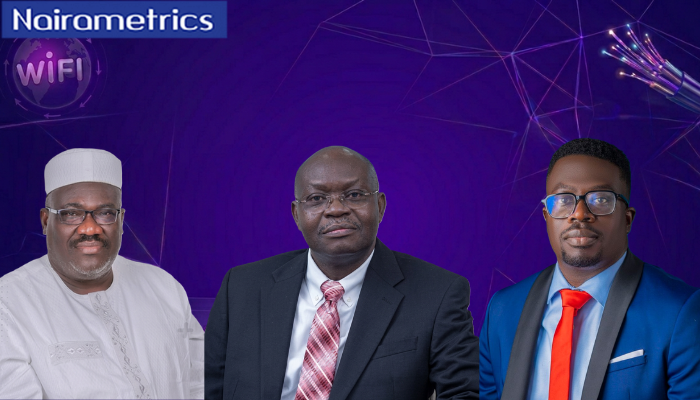
Beneath every bank transfer, remote job, and online stream lies a quiet but critical layer of infrastructure that keeps the country online, an often overlooked foundation where the real power of Nigeria’s digital economy resides.
Over time, Nigeria has shifted from a voice-driven telecommunications market to a data-first economy.
From the era of cybercafés in the early 2000s, the country has evolved into one defined by fiber optics, expanding 4G coverage, and the early foundations of 5G.


According to the Nigerian Communications Commission (NCC), Nigeria’s internet subscriber base reached 148.2 million as of December 2025, translating to a 68.3% penetration rate.
This growth has reshaped how millions of Nigerians work, learn, transact, and consume content, with broadband now serving as a critical utility across homes, businesses, and institutions.
While mobile network operators like MTN and Airtel continue to dominate the market, accounting for roughly 86% of total internet subscriptions, Nigeria’s internet service space includes 313,713 active subscribers spread across 133 licensed providers, supported by a combined 2,568 Points of Presence (PoPs) nationwide.
They provide fixed broadband, enterprise connectivity, and last-mile solutions that power homes, offices, financial institutions, and government systems.
This article highlights the architects of Nigeria’s connectivity, the decision-makers expanding access to keep Nigerians connected.
The ranking of the largest ISPs is based on the number of active customers they serve as of Q2 2025, as published by the Nigerian Communications Commission (NCC).
Here are the top 10 CEOs of Nigeria’s Internet Service Providers by active subscribers.

- 13,996 active subscribers
Kendall Ananyi is the Founder and Chief Executive Officer of Tizeti Network Limited, a Nigerian internet service provider focused on delivering affordable broadband using wireless infrastructure.
He founded the company in 2012 and has since led its growth as a key player in Nigeria’s last-mile connectivity space, particularly through fixed wireless broadband services.
Ananyi holds a Master’s degree in Electrical and Computer Engineering from the University of Victoria and a Bachelor’s degree in Electrical and Electronics Engineering from the University of Benin.
He brings over 18 years of experience in telecommunications and information technology, with previous roles at global firms including Microsoft, ExxonMobil, and PricewaterhouseCoopers.
Under his leadership, Tizeti has focused on leveraging wireless technology to deliver cost-effective internet services, particularly in underserved urban and peri-urban areas where fibre deployment remains limited.
The company has five network locations through which it delivers internet services and currently serves 13,996 active wireless users.