Follow Us on Google Discover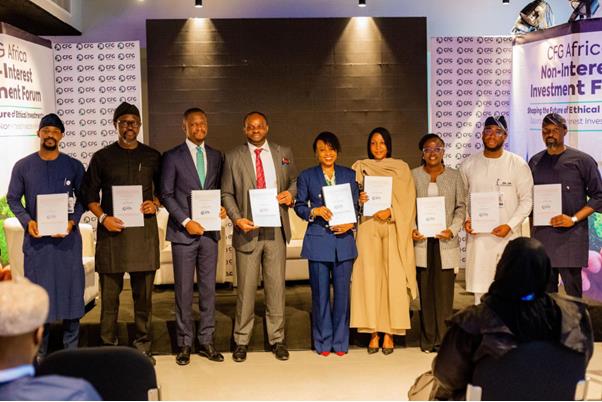
- CFG Africa has launched its ₦1 billionSECregistered Ethical Fund and expanded national engagement through Lagos and Abuja investor forums, signalling growing demand for non-interest, asset-backed instruments as investors hedge against 2026’s fiscal adjustments and a prolonged high-interest environment.
- The Ethical Fund is an open-ended unit trust with a minimum entry of ₦10,000, allocating 70–85% of assets to sovereign and subsovereign Sukuk, with the remainder in Shariah-compliant equities. Speakers including Prof. Bongo Adi and Dr. Basheer Oshodi highlighted why ethical assets are outperforming—citing strong macrohedging benefits and intense market demand reflected in the 735% oversubscription of Nigeria’s recent 10year Ijarah Sukuk.
- CFG Africa’s leadership emphasized a philosophy of “safety before profit,” positioning noninterest investing as a catalyst for financial inclusion and longterm stability. Backed by AVA Trustees, Rand Merchant Bank, and One17 Capital, the fund provides a robust fiduciary structure as Nigeria targets 5% GDP growth in 2026, making assetbacked instruments an increasingly preferred refuge for smart capital.
CFG Africa, a multi-asset investment firm, officially launched its N1 Billion Ethical Fund in 2025 and followed it up with a strategic Non-Interest Investment Forum in Abuja.
The move signals a broader market transition toward non-interest instruments as investors hedge against 2026’s projected fiscal adjustments and the lingering “higher-for-longer” interest rate environment.
Amidst a shifting macroeconomic landscape where the Nigerian equity market continues to navigate complex inflationary pressures, CFG Africa is positioning itself as a champion of Ethical Investments.
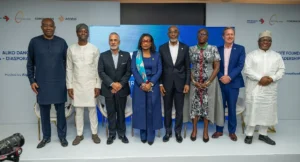
Following the high-level strategic unveiling in Lagos—as previously reported by Nairametrics—CFG Africa has now extended its national dialogue to Abuja…”
Also Read
- Young Nigerians in south-south can access free digital skills training and job opportunities through iDICE Programme
- ADF and WEF young global leaders convene in Lagos to advance continental investment and industrial scale
- Sahara Appoints Chidilim Menakaya Managing Director to Lead Sahara Beyond XXX Vision
The firm’s Lagos and Abuja client engagement forums served as the launchpad for the CFG Africa Ethical Fund, a SEC-registered N1,000,000,000 unit trust designed to capture yield from Shariah-compliant and asset-backed instruments.
The Lagos Macro Outlook: Aligning Fiscal and Monetary Levers
At the CFG Africa Client Engagement Forum 2025 in Lagos, the discourse focused on the urgent need for a “pro-growth” monetary pivot. Keynote speaker Prof. Bongo Adi of Lagos Business School delivered his assessment of current structural reforms, stating that the manufacturing sector would rebound significantly if interest rates were adjusted downward.
He argued that a downward review of the Monetary Policy Rate (MPR) is essential to introduce stability into the equity market and ensure that the gains from recent reforms filter down to the real economy. For institutional investors, the forum’s consensus was clear: keep a “hawkish eye” on the US yield curve—the spread between short and long-term treasury yields—as the definitive barometer for global recessionary risk in the coming quarters.
The Abuja “Alpha” Hunt: Why Ethical Assets are Outperforming
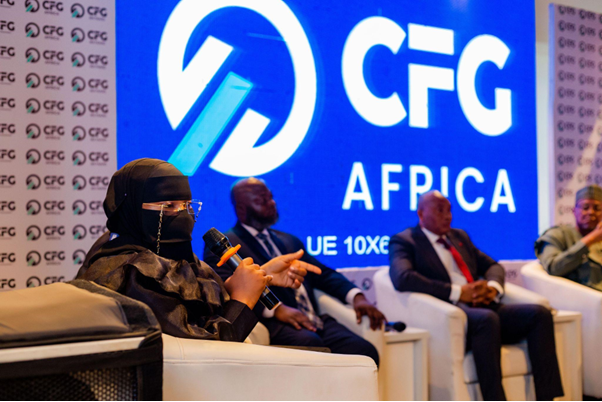
At the Non-Interest Investment Forum, the conversation pivoted from macro-risks to specific asset-class opportunities. A panel of sector heavyweights, led by Dr. Basheer Oshodi, CEO of TrustArthur and President of the Non-Interest Financial Institutions Association of Nigeria, challenged the myth that ethical investing requires a “performance sacrifice.”
Dr. Basheer Oshodi provided a data-driven justification for the shift into asset-backed instruments, noting that global economic uncertainty and geopolitical risks have made traditional assets harder to predict. He pointed to the 735% oversubscription of Nigeria’s recent 10-year Ijarah Sukuk as evidence of a “starved” market.
“One Sukuk a year is not enough,” Oshodi noted. “We should be issuing at least quarterly. With more Sukuk in circulation, it becomes easier to create smaller secondary instruments and develop a more active risk-asset market.”
The panel also addressed the structural gaps in the ecosystem. Oshodi highlighted that the combined assets of the entire non-interest banking sector currently remain smaller than those of a handful of digitally-enabled microfinance banks—a gap he described as a massive opportunity for technology-driven growth.
Inside the CFG Ethical Fund: Strategic Specifications
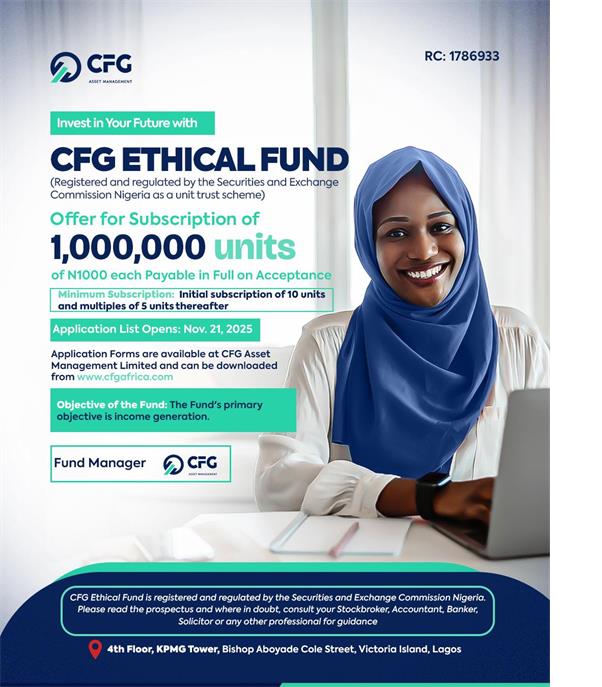
The launch of the N1 Billion Fund is a calculated response to a market now valued at N1.6 trillion, according to the SEC. Akindele Ogundepo (Head, Asset Management, CFG Africa), explained that the fund was specifically engineered to address the “shortage of investment options” for both retail and institutional players.
The fund is structured as an open-ended unit trust with an offer price of N1,000 per unit, requiring a minimum subscription of only 10 units (N10,000) to ensure retail accessibility.
The fund’s strategy is aggressively diversified, allocating between 70% and 85% of its portfolio to high-quality Sovereign and Sub-Sovereign Sukuk. The remainder is channeled into Shariah-compliant equities and other fixed-income instruments. To ensure maximum fiduciary oversight, the fund is supported by a robust framework involving AVA Trustees, Rand Merchant Bank as Custodian, and One17 Capital as Sharia Adviser.
Strategic Bottom Line: “Safety Before Profit”
Babajide Lawani, Group Managing Director of CFG Africa, emphasized that the firm’s entry into the non-interest space is a deliberate move to expand Nigeria’s investable capital base.
“We do not like to chase the traditional things other markets do,” Lawani said. “The non-interest space can drive massive inclusion by allowing people to live a wholesome life, investing according to their orientation without feeling they are losing out on competitive returns.”
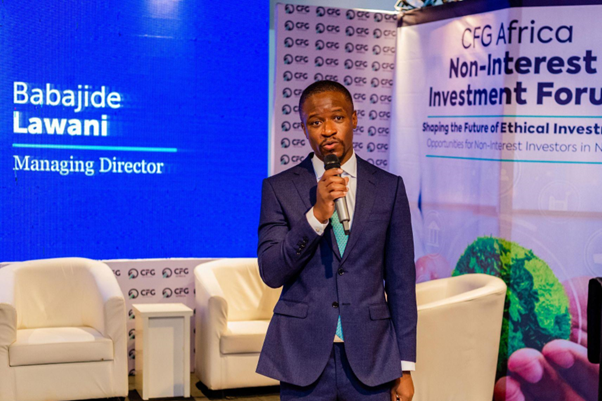
As Nigeria targets a 5% GDP growth rate for 2026, CFG Africa’s move underscores a vital trend for the year: asset-backed stability is becoming the preferred refuge for smart capital in an era of unpredictable global economics.
Investor Action: Detailed Prospectus and Subscription forms for the CFG Ethical Fund are available for download at www.cfgafrica.com.