Follow Us on Google Discover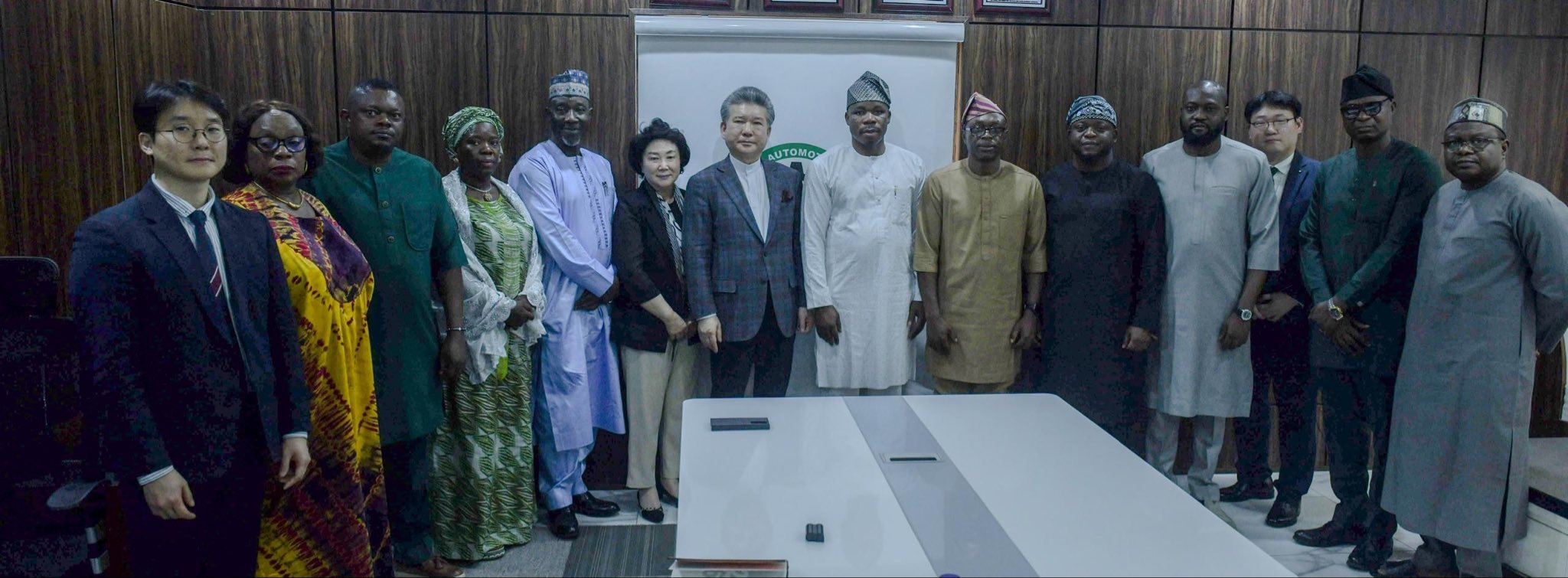
The Federal Government has moved to establish Africa’s first Electric Vehicle (EV) manufacturing plant and develop critical infrastructure nationwide with the signing of Memorandum of Understanding (MOU) with South Korea’s Asia Economic Development Committee (AEDC).
According to a statement on the official X (formerly Twitter) account of the National Automotive Design and Development Council (NADDC), the Minister of State for Industry, Senator John Enoh, signed on behalf of the Federal Government on January 30, 2025.
Meanwhile, the AEDC Chairman, Mr. Yoon Suk-hun, signed on behalf of the South Korean organization.
NADDC emphasized that this major partnership with the South Korean firm aligns strongly with Nigeria’s National Energy Transition Plan (ETP) and National Automotive Industry Development Plan (NAIDP).
What the NADDC is saying
The council noted that this project will be implemented in phases, starting with electric vehicle assembly and later expand into full local manufacturing, with an estimated capacity of 300,000 vehicles and creation of about 10,000 jobs.
It says, ‘’On January 30, 2026, the Federal Government of Nigeria, through Senator John Enoh, Hon. Minister of State for Industry at the Federal Ministry of Industry, Trade and Investment (FMITI), signed a Memorandum of Understanding (MoU) with South Korea’s Asia Economic Development Committee (AEDC) to establish an Electric Vehicle (EV) manufacturing plant and develop critical charging infrastructure nationwide.
‘’This landmark collaboration aligns strongly with Nigeria’s National Energy Transition Plan (ETP) and National Automotive Industry Development Plan (NAIDP).
‘’The project will be implemented in phases, beginning with EV assembly and expanding into full in-house production, with an estimated capacity of 300,000 vehicles and the creation of approximately 10,000 jobs.’’
The Director-General of NADDC, Otunba Oluwemimo Joseph Osanipin, reaffirmed that the initiative will accelerate technology transfer, investment promotion, human capital development, as well as research, design and innovation.
The Director-General, who was represented by NADDC’s Head of Policy, Planning and Statistics, Mr. Nura Sidi, stated that Nigeria is steadily building a sustainable automotive ecosystem that supports local manufacturing, green energy adoption, and global competitiveness.
More insight
There has been growing interest in electric vehicles in Nigeria over the past couple of years, despite doubts about whether it is viable for the Nigerian market, especially due to electricity supply challenges and terrible road networks.
The Federal Government had first mooted the idea of a Nigeria-made electric vehicle when, in April 2021, through one of its agencies, the Nigerian Institute of Transport Technology (NITT), Zaria set up a 22-member project team for the development of an electric vehicle.
The Federal Government, through the National Agency for Science and Engineering Infrastructure (NASENI), had, in August 2022, signed an MOU with Israeli and Japanese companies to commence assembling and manufacturing of electric vehicles in Nigeria.
According to Nigeria’s Energy Transition Plan (ETP), launched in 2022, the country is ambitious to have a 100% transition to EV by 2060, while Lagos pledged to achieve this by 2050.
Some of the top electric vehicle assembly plants in Nigeria include SAGLEV, Innoson Vehicle Manufacturing (IVM), Jet Motor Company, Spiro, NEV Motors, Electric Motor Vehicle Company (EMVC) among others.
What you should know
The Chinese government had, in May 2025, announced plans to establish electric vehicle factories and other manufacturing ventures in Nigeria as part of efforts to deepen economic ties between both countries.
The proposed establishment of EV factories would be a significant step toward unlocking Nigeria’s mineral potential and fostering local value addition.