 Follow Us on Google Discover
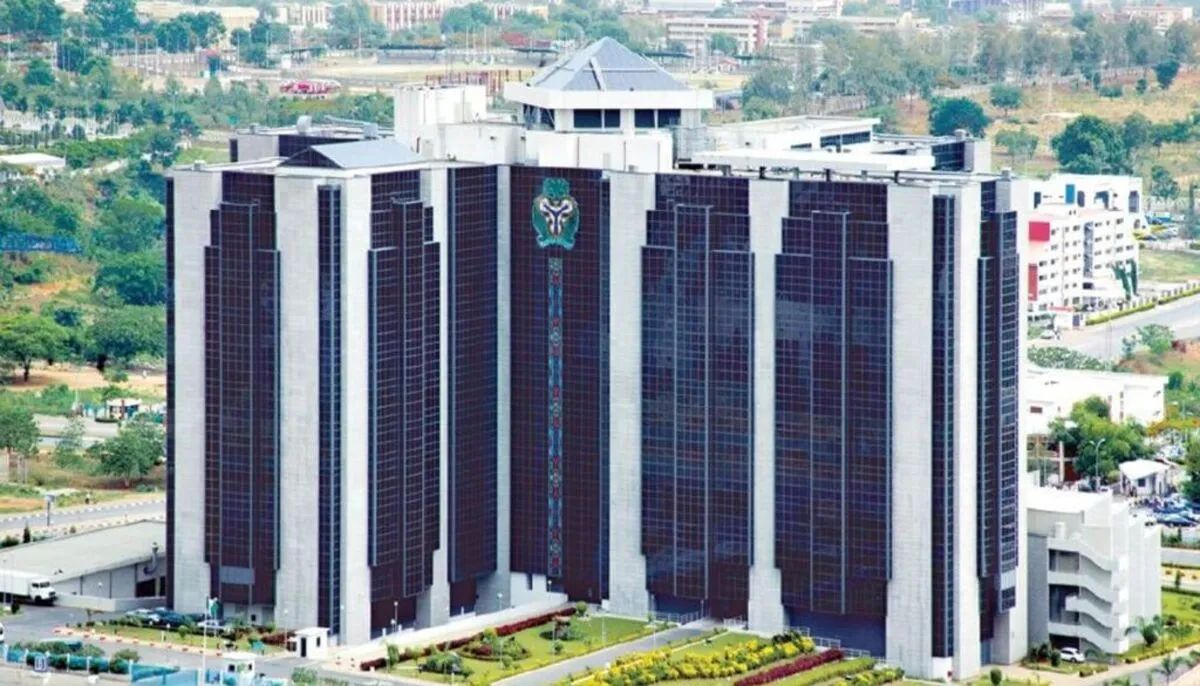
Over the past year, the Central Bank of Nigeria brought its policy rate down from 27% to 23%. Over the same year, the rate Nigerian banks charge their riskiest borrowers rose from 29.84% to 32.62%.
Policy fell by four points. The price of credit rose by nearly three. Both figures come from the same published table on the central bank’s own website, measured from September to September.
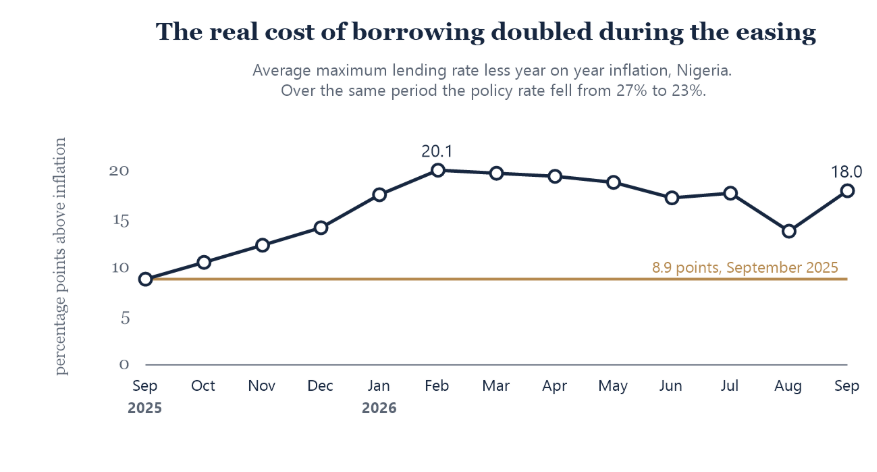
Inflation fell too, from 20.98% to 14.63% across those twelve months. That sounds like relief for a borrower and it is the opposite. A firm paying 29.84% when prices rose at 21% was paying about 9 points above inflation. A firm paying 32.62% when prices rose at 14.63% was paying about 18.
The real cost of money in Nigeria doubled in a year, during the year everybody called an easing.
Also Read
The bigger problem sits behind that arithmetic.
Look at the sequence again, slowly. Inflation at 21%, then 15%, then 14%. A policy rate of 27, then 26.5, then 23. A naira between about ₦1,314 and ₦1,465.
A real cost of borrowing that was 9 points a year ago, 20 points in February and 18 points now. Every one of those moved a long way in twelve months, and none of them moved in a straight line.
That unpredictability matters more than the level of any single rate.
A business deciding whether to grow commits money today against a return that arrives in three or five years. To make that decision it has to form a view of what money will cost across that period.
In Nigeria it cannot form one with any confidence. So it delays the decision, scales it down, or demands a payback short enough to see the end of.
An economy where nobody can price next year stops committing to the year after.
I see this from the investor’s side of the table. When we value a company we choose a discount rate, which is a formal way of asking what money costs over the life of the investment. In most markets that is a technical question with a dull answer. Here it decides whether anything gets funded at all.
Move it by three or four points and a sound business becomes unfinanceable. We have no reliable way to set it, so we set it high and we set it short. The business pays for our uncertainty, in a lower valuation and a shorter horizon. Nobody ever tells it that is what happened.
We are pricing the company, and we are pricing our inability to forecast the country around it.
Everybody knows credit costs too much in Nigeria. The harder problem is that nobody can say what it will cost long enough ahead for anything to be built.
No survey measures how far this has spread, and I am describing what I see rather than what has been counted. One part of it is not in doubt. Only about one in twenty five of Nigeria’s small and medium businesses has a bank loan, so growth funded from the owner’s own pocket is the normal case here.
The rest is pattern rather than proof. Firms take projects that pay back inside a year, buy a generator rather than sign a ten year power contract, and hold stock rather than commit to a supply agreement.
Each of those is a sensible response to not knowing. The generator in the yard is a refusal to depend on a supply nobody can promise.
I have been writing about those as separate problems across these articles. They are closer to one decision, taken by people who cannot see far enough ahead to choose otherwise, and together they are an economy that has stopped making long commitments, which is the only kind that compound.
Consider what has to be financed if Nigeria is going to double in size. A transmission line takes years to build and decades to repay. A gas processing plant, a grain silo, a cold chain, a rail link, a housing estate: every one of them is a bet on a decade.
Each requires somebody to name the cost of money over ten years and then believe their own answer. Nigeria cannot currently produce that number, so what gets built here is what pays back before the next surprise.
The policy rate came down twice this year: by 50 basis points in February, then by 350 in September. In that same September, the average rate Nigerian banks pay on savings deposits fell from 7.46% to 5.36%.
The September move reached the saver inside thirty days. It has yet to reach the borrower at all.
A saver earning 5.36% faced prices rising at 14.63% in the same month. Put that in money rather than percentages. A teacher who sets aside ₦500,000, if those rates held for a year, would have about ₦527,000 at the end of it, and the things she was saving for would cost about ₦573,000.
She did everything right and is roughly ₦46,000 poorer for it.
The International Monetary Fund described the pattern in June: Nigerian banks raise lending rates quickly when policy tightens and cut them slowly when it eases. The problem is speed, and a planner cannot work around it.
Nigeria is not flying blind. The central bank is moving to inflation targeting and it has published its targets: 16.5% for 2026 with a band of two points either side, 13% for 2027, and a medium term ambition of 6% to 9%.
Set that beside another number the same bank published in the same season. In its 2026 Macroeconomic Outlook it projected that headline inflation would average about 12.94% this year.
The forecast says plainly that it is an annual average. The target does not say what it is, which matters, so take it both ways. Measured as an annual average, inflation has run at 15.26% through October. Measured at the latest month, October came in at 14.06%, below the floor of the band.
On either reading the outturn sits under the target, and the target sits above what the bank itself told us to expect.
A target the bank is highly unlikely to miss asks very little of it.
The timing is vaguer still. In October, at an investor meeting on the sidelines of the IMF and World Bank annual meetings in Bangkok, Governor Olayemi Cardoso was asked when Nigeria would reach single digit inflation. TheCable reported his answer on 14 October: “the answer is we don’t know.”
The answer is honest. A firm planning a ten year asset cannot use it.
And the rate itself. At that same meeting the governor declined to call September’s 350 basis point move a cut. “Policy rate was reset,” he said. “What they put there is cut, that is not the right word.”
He has a case. Market rates had fallen below the policy rate, and the reset realigned the two so the benchmark could do its work.
Set the three together from where a borrower sits. A target the bank expected to beat. A timeline the bank will not give. And the largest rate move of the year, which the bank asks nobody to read as a rate move.
Each of those is defensible on its own. Together, they are the uncertainty problem, stated by the institution that exists to solve it.
Three things complicate this.
The disinflation is real, and it was expensive to buy. The naira was floated, the fuel subsidy went, and rates were held high long enough to be unpopular. The twelve-month average has fallen from 26.05% to 15.40%, reserves are the strongest in eighteen years, and the naira has held near ₦1,350 for weeks. The real cost of borrowing is off its worst too, down from a peak near 20 points above inflation in February.
Uncertainty is not the only thing priced into these rates. A Nigerian lending rate carries weak contract enforcement, the difficulty of realising collateral, thin credit information and a real risk of default. A central bank that became perfectly predictable tomorrow would not make Nigerian credit cheap. It would remove one of the reasons the price is unknowable.
And my measure is rough. Comparing a lending rate to inflation in the same month looks backwards, when what a borrower prices against is the inflation it expects. The maximum lending rate is an average of each bank’s top rate, and the prime rate tells a gentler version of the same story: 18.89% last October against 19.04% this September, flat while inflation fell six points. These figures illustrate the problem rather than measure what a typical firm pays.
So what would help?
A further cut next week would be defensible on the merits, with inflation at 14.06% and core inflation under 11%. On the evidence of the last year it will reach the savings rate within weeks and the lending rate barely at all. A new framework will not close the gap either, because Nigeria is already building one and the move to inflation targeting is the right move.
Nor will more disclosure, because the disclosure already exists. Every Wednesday the central bank publishes the prime and maximum lending rate of every deposit money bank, across 22 sectors. The Monetary Policy Committee decided that those rates “be made public to guide business decisions.”
Look at what the table shows. In the week to 9 October, 32 banks reported 519 maximum lending rates. In almost every sector, the rate runs from about 19% at the cheapest bank to about 46% at the most expensive, in the same week, for the same kind of borrower.
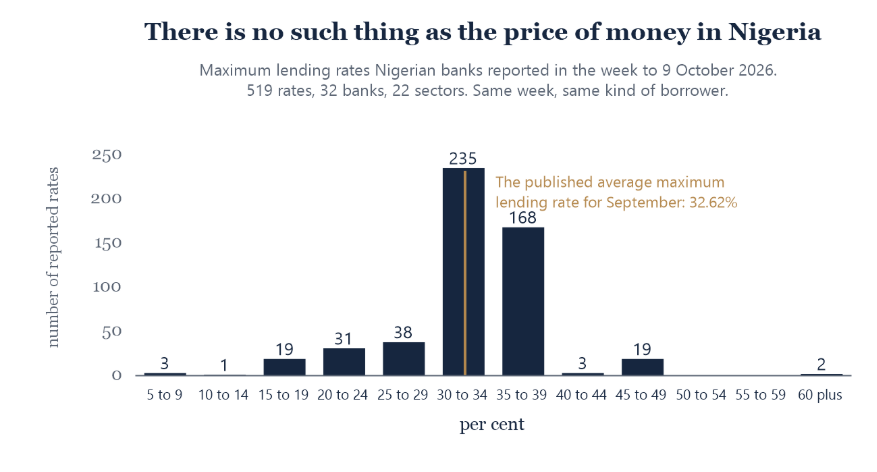
A firm cannot read a single price of money off that table. What it will be quoted depends on which door it walks through, and the doors are twenty-seven points apart.
The target is published. The forecast is published. The rates are published every week, by bank and by sector, to guide business decisions. Nigeria has disclosed everything and bound itself to nothing.
What is missing is a number somebody is answerable for. Three things would do more than another rate move.
Set the target where the bank actually expects inflation to land, so that missing it means something. Publish a forecast path for the next two years and revise it in public when it changes. And require the governor to account for the gap when the outturn misses, in a letter or a hearing that is on the record.
None of that is about punishing anybody. A number somebody must answer for is a number a business can believe, and a number a business can believe is one it can plan against.
Countries that have climbed out of high inflation did it the same dull way. They said where they intended to be, published how they would get there, and stayed consistent for years. A firm can plan against a boring central bank.
Nigeria has done the easy half. The hard half is being bound by what it published, and that is what turns a table of numbers into a future a business can price.
Nigeria has had a good year by the measures a central bank is judged on. Inflation is down a long way, the reserves are strong and the naira has held.
A Nigerian business still cannot get a credible view of what money will cost while something gets built.
A trillion-dollar economy is made of commitments that outlast a single year. Until the future can be priced here, too few people will make them.
One in a series exploring whether, and how, Nigeria can become a one-trillion-dollar economy.
- Frank Nnamka is a private equity and impact investor. He writes here in a personal capacity, and the views expressed are his own and do not reflect the position of his employer or any organisation he is affiliated with.