Follow Us on Google Discover
Behind the screens, lighting and sound systems at some of Nigeria’s biggest events is a business that has spent two decades navigating the commercial realities of an evolving industry.
For Mobile Screens and Sound Limited (MSS), building that business has involved identifying an underserved market, investing in expensive technical equipment, educating customers, and adapting to changing economic conditions.
For Tunbosun Kola-Daisi, Founder and Managing Director of Mobile Screens and Sound Limited (MSS), establishing the company was an opportunity to address a gap in Nigeria’s events industry; limited access to quality audio-visual equipment and professional production services.
Twenty years later, MSS has grown from a two-employee operation into a company with over 200 employees, handling an average of 50 to 60 events monthly. That growth, however, came with considerable financial and operational demands, reflecting some of the challenges of building a technology-intensive business in Nigeria.
Also Read
Recognizing an Opportunity
Before establishing MSS, Kola-Daisi spent 12 years in banking, working with institutions including First Bank London, Oceanic Bank and Fountain Trust Bank. His interest in music and entertainment eventually led him to identify an opportunity in event technology. At the time, LED screens and professional sound systems were relatively uncommon at Nigerian events.
However, introducing these technologies required more than making them available. MSS had to demonstrate their value to customers who were largely accustomed to traditional event production methods. Building demand for its services was therefore as important as investing in the equipment itself.
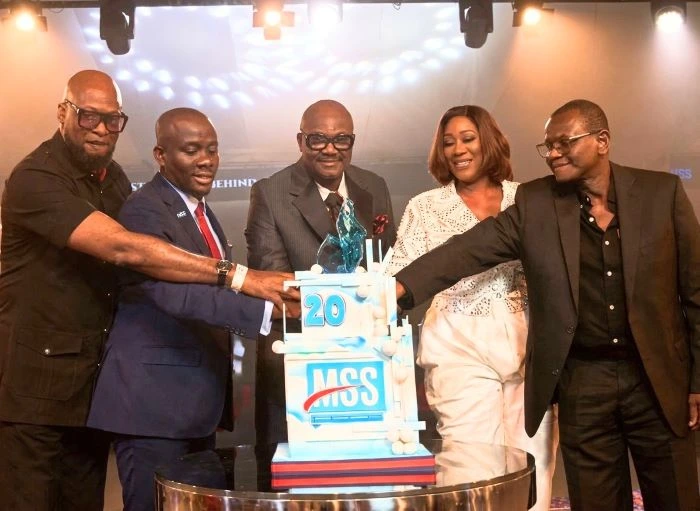
The financial demands were equally significant. During its 20th anniversary celebration in October 2026, Kola-Daisi revealed that it took the company nearly five years to break even. The extended period reflected the investment required to establish the business and build a market for its services.
Beyond the initial capital requirements, acquiring and maintaining specialised equipment presented ongoing financial challenges. Foreign exchange fluctuations, import duties and clearing charges increased the cost of bringing equipment into the country, placing additional pressure on a business that depends on technology to deliver its services. These costs also have implications for equipment upgrades and the ability to keep pace with changing industry requirements.
Over time, MSS expanded beyond equipment supply into installation, maintenance, repairs, training and integrated production services, allowing it to provide more comprehensive solutions to clients. This evolution broadened its role in the events industry, allowing the company to support different aspects of production rather than focusing solely on equipment provision.
Navigating Disruption and Scaling the Business
The COVID-19 pandemic presented another significant challenge. Restrictions on public gatherings brought concerts, conferences, weddings and other events to a halt, effectively disrupting the primary source of revenue for businesses operating within the events industry. For MSS, the impact was particularly significant because its financial obligations continued even as demand for its services declined.
In a New Telegraph news article, Kola-Daisi reflected on the financial pressures the company faced during the period. MSS still had outstanding bank and partner loans, alongside commitments associated with its equipment expansion. With business disrupted, the company had to restructure its loans, gradually reduce salaries and lay off some employees, with the intention of bringing them back as operations recovered.
The experience highlighted the financial vulnerabilities of operating a business built around expensive equipment and live events, where revenue can be affected almost overnight by external circumstances. It also required management to make difficult decisions around financial commitments, staffing, and the resources needed to sustain operations through an extended period of uncertainty.
The company has since grown considerably from its early beginnings. According to Kola-Daisi in an October 2026 Vanguard interview, MSS now employs more than 150 people and handles an average of 50 to 60 events monthly.
Its services span LED screens, professional sound systems, lighting, staging, equipment installation and maintenance, and end-to-end production management. Managing this volume of business requires significant operational capacity, from maintaining specialised equipment to coordinating technical personnel and delivering multiple productions across different locations. The expansion of its services has also allowed MSS to build a broader offering around event technology and production management.
Investing in People and Expanding Across Africa
As MSS enters its next phase, the company has announced plans to expand its operations across Africa. This ambition also brings attention to another requirement for growth: access to skilled technical professionals who can support increasingly complex productions and operations across different markets.
Through the MSS Event Tech Academy, the company introduced a free 10-week training programme covering six technical areas: LED screen engineering, sound engineering, lighting design, video production, event management and stage production.
More than 60 young Nigerians participated, with five graduating students subsequently offered employment by MSS. The initiative addresses the shortage of skilled technical professionals in the industry while helping develop the workforce required to support the company’s operations. As MSS looks towards expansion beyond Nigeria, developing local technical capacity will remain an important consideration in sustaining its growth.
Building Beyond 20 Years
MSS’s journey reflects some of the realities of building a business around an emerging market opportunity in Nigeria. From introducing unfamiliar technology and managing the cost of imported equipment to navigating financial pressures and developing the technical workforce required to sustain operations, its growth has involved adapting to the demands of an evolving industry.
What started with two employees has become an organisation with more than 150 employees and ambitions beyond Nigeria. As it enters its next phase, the challenge will be translating two decades of industry experience into sustainable expansion, while continuing to invest in the technology, infrastructure and people that underpin its business.