Follow Us on Google Discover

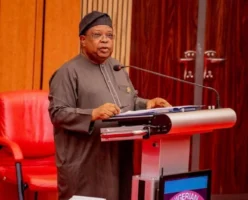
Flutterwave Founder and Chief Executive Officer, Olugbenga “GB” Agboola, has said Africa’s artificial intelligence future must be shaped by its cultural realities and local knowledge to ensure the technology addresses practical problems and delivers solutions suited to the continent’s needs.
Agboola made the remarks on Monday, November 9, while delivering special remarks at the launch of the Oxford Global Think Tank’s (OGTT) AI Virtual Centre and inaugural AI report in Abuja.
He also stressed the importance of developing practical AI applications that address local challenges, rather than adopting technology without clear benefits to people.
Africa must develop AI solutions for local needs
Explaining his position, Agboola said Africa’s growing role in artificial intelligence should be driven by its own knowledge, cultural context and capacity to develop solutions suited to local needs.
Also Read
- “Africa’s future in generative AI should be shaped by its own cultural realities, intellectual capacity, and local knowledge,” he said.
- “If technology does not solve a practical, human problem on the ground, it is just lines of code. The launch of this Virtual Centre and the AI Report represent a major milestone because they shift us from being mere observers of the technological revolution to active participants shaping it,” he added.
The Flutterwave chief executive also emphasised the importance of cross-sector collaboration and an enabling ecosystem in advancing Africa’s role in the global AI landscape.
OGTT launches AI centre and unveils inaugural report
The AI Virtual Centre was launched during a dedicated AI session at the 2026 OGTT Leadership Conference, held at the Transcorp Hilton Hotel in Abuja.
The digital platform is designed to break down operational silos by bringing research, public policy and market execution together to strengthen collaboration on AI development and deployment.
According to the organisation, the centre will facilitate collaborative data tracking and help ensure that regulatory frameworks support rather than stifle technological innovation.
The conference was convened by economist Arunma Oteh and co-chaired by the Emir of Kano, Muhammadu Sanusi II, and businessman Atedo Peterside.
It brought together public- and private-sector stakeholders to foster partnerships around three central pillars: resilience, innovation and dynamism.
Nigeria’s push to build local AI capabilities
The launch comes amid growing efforts by Nigeria and other African countries to strengthen local artificial intelligence capabilities, close infrastructure gaps and ensure they play a greater role in developing and shaping AI technologies.
- In August 2026, Nairametrics reported that Nigeria was adopting AI rapidly but risked becoming dependent on foreign technology. The report called for increased investment in indigenous AI models, local datasets and computing infrastructure.
- Also in August, Microsoft warned that Africa risked becoming primarily a consumer of AI rather than a creator or beneficiary of the technology, arguing that stronger partnerships should build lasting AI capabilities across the continent.
- Earlier, in July 2026, the Federal Government launched the ATLAS Network to accelerate the development of locally relevant AI language models across Africa.
Nairametrics also reported in August that NITDA had signed key regulatory documents under the National Sovereign Cloud Initiative, aimed at strengthening Nigeria’s cloud ecosystem, digital infrastructure and investment in areas including AI and data centres.