 Follow Us on Google Discover
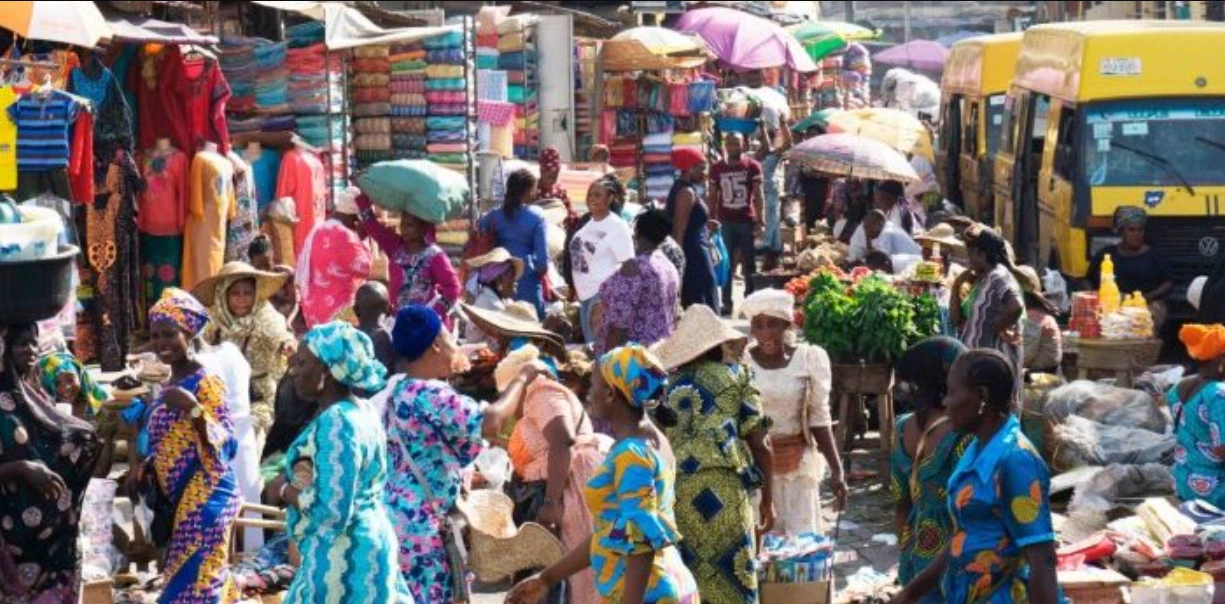
Walk down any busy Nigerian street, and you are walking through an economy. Someone is welding a gate. Someone is sitting behind a POS machine under an umbrella. Someone is running a kitchen out of a front room and feeding half the street by lunchtime.
The country’s reputation for enterprise is not flattery we pay ourselves. Nigeria has roughly forty million businesses. Only India and Indonesia are reckoned to have more. Whatever else has gone wrong here, Nigerians have not stopped starting things.
But sort those businesses by size, using the classes the national survey itself uses, and the picture turns strange. Of the 39.7 million enterprises in the last count, 33 million are nano businesses, meaning one or two people. Another 5.9 million are micro, with three to nine.
That leaves 617,248 small firms. And 53,199 medium sized ones, the sort with a real payroll and a balance sheet a bank could read.
Also Read
That is one business in every 745. Nigeria is a country crowded with businesses and nearly empty of companies.
The difference is not a matter of words. A business is one person’s living. A company is a thing that outlasts the week: it carries staff, buys machines, signs contracts it can be sued over, and keeps books that someone outside the family can check. Almost everything a trillion dollar economy is made of comes from the second kind.
The test is what a firm can do, not what it is called. A business can be perfectly well incorporated and still be one person’s living, and a great many Nigerian companies are exactly that.
You can see what the shortage costs us in a single comparison. Nigeria’s micro, small and medium firms provide about 88% of all employment and a little under half of national output. They account for roughly 6% of what the country sells abroad. So they carry nearly nine jobs in every ten, and almost none of what Nigeria sells to the world.
Medium-sized firms are where an economy learns to do things properly. They are large enough to buy a machine and keep it busy, to employ someone whose only job is quality, to meet a foreign buyer’s standard and then fill the repeat order that follows. A man selling from a tray cannot do any of that, however hard he works. There is no arrangement of forty million trays that adds up to an industry.
That is a claim about capability and not about virtue. Size does not make a firm good. It makes certain kinds of good possible.
The usual explanation for all this is money, and it is a good explanation as far as it goes. I have written here about a financial system that finds it easier to lend to the government than to a manufacturer. The newest World Bank survey of Nigerian firms bears it out: 28% of small firms say getting finance is the single biggest obstacle they face. That survey covers formal firms of five employees or more, so the firms from here on are the larger, countable sort.
But follow that number up the size ladder and it comes apart in your hands. Finance is the biggest obstacle for 28% of small firms, 16% of medium ones, and 1.7% of large ones.
Both things are true at once. The great mass of small and informal businesses is starved of credit. The few firms that reach size have largely solved it.
So credit explains why a Nigerian business struggles. It does not explain why so few of them ever cross over.
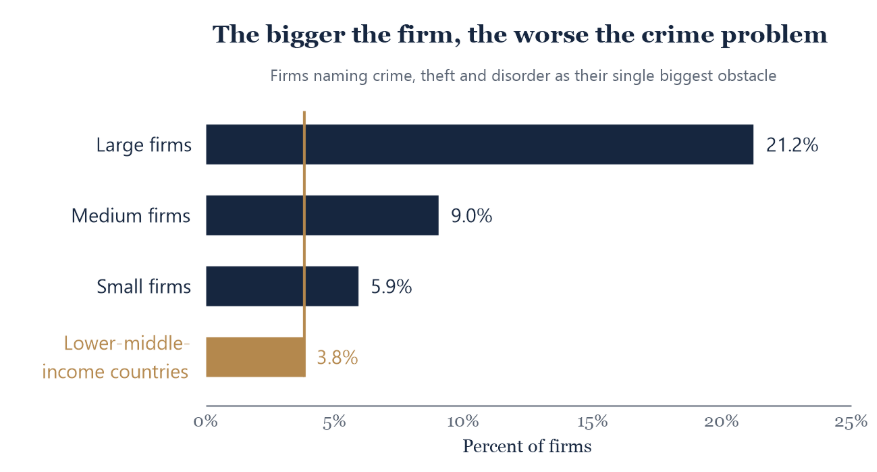
Something else is waiting on the other side. Ask Nigerian firms to name their single greatest obstacle and crime is chosen by 6% of small firms, 9% of medium firms, and 21% of large ones. Corruption climbs the same staircase, from 6% to 15%.
Growth does not lift the burden. It changes which burden you carry.
That question has a trap in it. It asks firms to rank their troubles, not to measure them. When finance stops being a large firm’s worst problem, something else takes the title.
So look instead at what firms spend. Spending is a measurement, not an opinion. The only Nigerian figures of this kind are old: they come from the survey round of 2014 and 2015, because the 2025 round stopped asking.
In that round, security cost small firms 3.9% of their sales, medium firms 4.8% and large firms 6.3%. Their losses to theft and vandalism ran the other way, falling from 1.8% down to 0.7%.
Larger firms buy more protection and are robbed less for it. That is the reading, not the finding: the survey records what firms spent and what they lost, and leaves the reason to us.
One in five large Nigerian companies now says crime is the worst thing it faces. In countries at a similar income level, fewer than four in a hundred say so.
Why should getting bigger attract trouble? Because bigger is visible, and in this country visibility is the thing that costs.
The same survey asked firms whether they were registered when they first opened. Among small firms, 47% were. Among large firms, 78% were.
Nigerian businesses do not generally start formal and then grow. They grow first and surface later, if they surface at all.
An unregistered business is harder to tax, harder to inspect, harder to levy and harder to find, and every one of those is worth real money to the person who owns it.
Nigerians already have a name for what comes next. Multiple taxation: the federal revenue service, the state, the local government, then the levies for signage and refuse and environment, then the collectors at the gate whose authority nobody can establish. Each one is survivable on its own. Together they are what it costs to be found.
Here is the part that matters most. Everything a firm pays for becoming visible arrives at once, and everything it was promised in return arrives later, if at all. The assessment comes this quarter. The credit, the protection, the court that will enforce your contract, those come in some other year.
Set against that sequence, staying small is not a failure of nerve. It is a correct reading of the terms on offer.
This series has made a version of that argument before, about traders who will not register and landowners who will not title. What the firm data adds is harder. The penalty does not stop at the door. It grows with you.
The government has improved those terms, and deserves the credit. Since January, under the new tax acts, a qualifying small company pays no company income tax, no capital gains tax and no development levy.
If tax were the whole of the problem, firms would now be surfacing in numbers. It is too early to know. But the reform reaches the part of the bill that was written down, and the rest of the bill was never on a form: the levies, the visits, the security bill. None of that has moved.
None of this displaces the problem Nigerian firms name most often, which is electricity. It leads the list at every size, and at 37% it weighs heaviest on the largest firms of all. That is the generator economy, showing the same gradient.
Power is the heavier burden. The difference is not weight but certainty: a firm can price a generator and the diesel to run it, and it cannot price the risk of being noticed.
The other side of this argument deserves its strongest form. Economists have argued for years about whether a missing middle exists at all.
Hsieh and Olken examined India, Indonesia and Mexico and found no gap in the middle of the firm size distribution. What they found instead was a smooth slope, running from very many tiny firms down to very few large ones. Work on African data has reached much the same conclusion about the shape.
They are right about the shape, and it does not rescue us. The sharper question was never whether there is a hole in a chart. It is whether medium sized firms carry the share of the work that an economy needs them to carry, and in Nigeria they plainly do not.
A World Bank study of four African countries found precisely that, and found something more useful besides. The shortage does not come from firms being born too small. It comes from firms not growing.
Nigerian enterprises are not failing to start. They are failing to get bigger.
What that costs is not abstract, and it does not fall on business owners. About 92% of employed Nigerians work informally, and among employed women it is 96%. Informal work means no contract, no notice, no pension and no claim on anybody if you fall ill.
A job inside a real company is the most ordinary form of security an economy can offer a household, and Nigeria has few of them to give. That is what the missing middle actually means. Not a curiosity about firm size. A working life with no floor under it.
The other side of the missing middle is what happens on the rare occasions a business does try to cross it. When a Nigerian company goes looking for serious money, somebody from outside finally examines it closely, often for the first time in its life.
I have spent most of my career being that person. The problem nearly always arrives in the same shape.
The accounts are audited and the auditor has signed them without reservation. That sounds like the end of the matter. It is not.
An audit checks that what the company says happened did happen. An investor is asking something different: how much of this profit will still be there after I have paid for it, and what debts am I about to inherit?
Those questions are settled by paperwork, and the paperwork is usually missing. Is the rent going to a landlord, or to another company the owner happens to own? Is everyone working on the premises actually on the payroll? The pension deducted from salaries every month, was it ever sent on, and is there a receipt to prove it?
Almost none of this is fraud. It is twenty years of small, sensible decisions taken by an owner with good reason to keep his head down. But an investor cannot take any of it on trust: anything that cannot be proved becomes an assumption, and the assumption never favours the seller. Every unanswered question comes off the offer.
The caution that kept the business alive is what costs it money the first time it tries to become something larger.
So the answer is not to lecture small firms about the virtues of formalising. They have done the arithmetic, and on the numbers in front of them they are right. The work is to change the arithmetic.
No amount of urging will fix the order in which the costs and the benefits arrive. Only a better bargain will.
A better bargain is specific, and I have argued parts of it here before: a collateral registry that genuinely lets a firm pledge its equipment and stock, credit bureaus a lender will act on, a title cheap enough to be worth obtaining. What the size data adds is the part aimed at growth rather than at entry.
Set a published limit on how many authorities may charge a business at all, so that getting bigger stops meaning being found by more of them. And watch the new thresholds carefully.
A relief that ends abruptly at a level of turnover is not an incentive to start. It is a wall across the path out. It should taper, not stop.
The harder half is not the owner’s job. Security is the one cost a firm cannot buy its way out of and cannot insure against at a sensible price. A country that wants medium sized companies has to make it safe to be one.
And some of it is ours, on the investing side. Patient capital, equity instead of more debt, guarantees that share the risk of growing rather than pricing it. The firms that ought to be crossing into the middle need money that is not frightened of what crossing involves.
The need is visible in our own numbers. Across Africa in the first half of this year, the money put into private companies rose by about two thirds while the number of deals fell by a sixth. More capital, chasing fewer companies that can survive an examination. That is the missing middle seen from the other end of the table.
Nigeria does not need forty million businesses. It already has them, and they are the proof that the ambition was never missing. It needs a few hundred thousand of them to find that becoming larger is worth the risk.
A trillion dollars will not come from forty million people trading harder. It will come when getting bigger stops costing a Nigerian business more than it returns.
One in a series exploring whether, and how, Nigeria can become a one trillion dollar economy.
- Frank Nnamka is a private equity and impact investor. He writes here in a personal capacity, and the views expressed are his own and do not reflect the position of his employer or any organisation he is affiliated with.