Follow Us on Google Discover
Food prices across major Lagos markets recorded a mixed but broadly easing trend in September 2026, with a larger share of staple food items posting month-on-month declines despite renewed increases in a number of key agricultural commodities.
While lower prices for grains, legumes and other household staples reflected improved harvest inflows and better supply conditions, commodities such as melon (egusi), tomatoes and vegetable oil recorded notable price increases.
The latest Nairametrics market survey of 67 food staples across Mushin, Daleko, Mile 12 and Oyingbo markets showed that 16 items increased in price in September, compared with 18 in August, while 36 items recorded price declines, up from 27 in August.
Another 15 items remained unchanged, compared with 17 in the previous month.
The September survey suggests that easing supply pressures, improving harvest arrivals in parts of the country and relatively stable transportation costs helped moderate prices for several staple foods.
What the traders are saying
Market operators said improved harvest inflows from producing states helped boost supply for cereals, legumes and root crop products.
Atinuke, a grains trader in Mushin market, told Nairametrics:
- “The pressure we had earlier this year has reduced. More maize, beans and garri are entering Lagos markets. When supply improves, traders are forced to compete for customers and that naturally brings prices down.”
Layo, a wholesaler at Daleko market, added that consumer resistance has also become more evident.
- “Many buyers now purchase smaller quantities because household budgets are still under pressure. Traders cannot keep increasing prices when demand is weak.”
Traders attributed the upward movement in the items to persistent insecurity in some major food-producing regions, supply disruptions along agricultural value chains, and increased bulk purchases by wholesalers and distributors positioning ahead of the festive season.
A major egusi trader, Mr. Onyeka at Oyingbo market explained that harvest output remains relatively available, but the challenge lies in accessibility and procurement.
- “People think there is no egusi, but that is not the issue. Some large buyers now move into producing areas and purchase harvests from several hectares at once. When one trader buys produce from five or six hectares before it enters the open market, it reduces supply available to smaller distributors and pushes up prices.”
Items that recorded the biggest increases
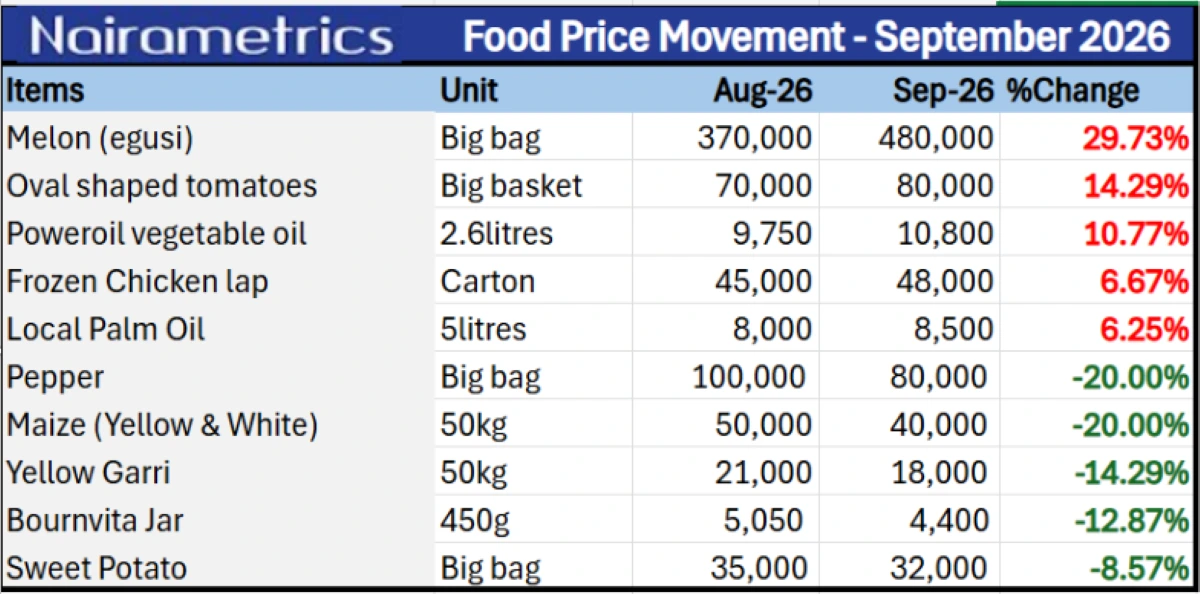
The most notable increase was recorded in melon (egusi), whose average market price rose from N370,000 for a big bag in August to N480,000 in September, representing a 29.73% month-on-month increase and an 118.18% increase compared to N220,000 recording in the corresponding period last year.
Beyond the immediate supply-and-demand dynamics, traders attributed the increase to the rising cost of producing and moving the crop from farming communities to urban markets, alongside insecurity in some producing areas.
- The average price of a big basket of oval-shaped tomatoes rose from N70,000 in August to N80,000, representing a 14.29% MoM increase and 77.78% YoY growth, while Round-shaped tomatoes also increased by 12.50%, from N40,000 to N45,000 per big basket.
- Power Oil (2.6 litres) increased from N9,750 to N10,800, representing a 10.77% MoM increase, while local vegetable oil rose by 4.76% for 5litres, from N10,500 to N11,000, and the 25-litre size increased by 1.84%, from N59,900 to N61,000.
- Local palm oil also recorded increases, with the five-litre size rising by 6.25%, from N8,000 to N8,500, while the 25-litre size increased by 2.13%, from N47,000 to N48,000.
- A carton of local frozen chicken lap increased by 6.67% to N48,000, while the imported brand decreased to N62,000 from N65,000 recorded in the previous month.
Sharp declines recorded across major staples
Despite the notable gains in some food categories, most staples became cheaper during the month.
- The average price of a big and medium bag of pepper decreased by 20% and 11.11% to sell for N80,000 and N40,000 respectively.
- A 50kg bag of white and yellow maize fell from N50,000 in August to N40,000 in September, representing a 20% decline.
- Yellow garri (50kg) declined by 14.29%, from N21,000 to N18,000, while 50kg bag of white garri dropped by 11.36%, from N22,000 to N19,500.
- Bournvita (450g) jar fell from N5,050 to N4,400, representing a 12.87% decline, while Ovaltine refill declined by 9.35%.
- Sweet potatoes fell by 8.57%, from N35,000 to N32,000, while Oloyin beans declined by 8.54%, from N82,000 to N75,000.
Other notable declines include:
- Royal Stallion short-grain rice dropped by 7.55% N49,000.
- 5kg Honeywell wheat dip 5.04% to N6,220
- 50kg Brown beans fell by 4.55% to N105,000
- 120g carton of Indomie noodle down 4.24% to N15,800.
Items that remained unchanged
A total of 15 commodities recorded the same price in September, down from 17 in August, indicating improving price stability across major staples.
Items that remained unchanged included ogbono, Kote fish, dry onions, milk, cocoa beverage, etc.
Backstory
The September market survey comes against a backdrop of moderation in Nigeria’s headline and food inflation.
- Nigeria’s headline inflation rate eased marginally to 15.39% in August 2026 from 15.43% in July, extending the country’s disinflation trend for a third consecutive month.
- While the nation’s food inflation moderated for the first time in six months to 19.57% in August, farm produce inflation accelerated to 21.99% YoY from 20.31% in July, its highest level in 2026.
At the state level, Lagos recorded significantly higher inflation pressure in August.
- Lagos’ headline inflation rose to 23.7% in August 2026, from 16.3% in July, while food inflation increased to 30.9%, from 26.8% in July.
- The NBS attributed the moderation to changes in the average prices of several food products, including palm oil, carrots, pepper, onions, cassava flour, beef, yam flour, water yam, melon, fresh ginger, fresh fish, Irish potatoes, wheat grain, frozen chicken and turkey.
- Lagos is a major consumption and distribution hub, meaning food prices are influenced not only by the cost of produce at the source but also by transportation, storage, distribution expenses, and market levies incurred before products reach consumers.
About the Nairametrics Food Price Survey
- The Nairametrics Food Price Watch is a monthly market survey tracking the prices of major food items across Nigeria.
- This report specifically covers four key markets in Lagos State: Mushin, Daleko, Oyingbo, and Mile 12 Market.
- The survey provides up-to-date insights into food price trends, helping businesses, policymakers, and consumers make informed decisions.