Follow Us on Google Discover
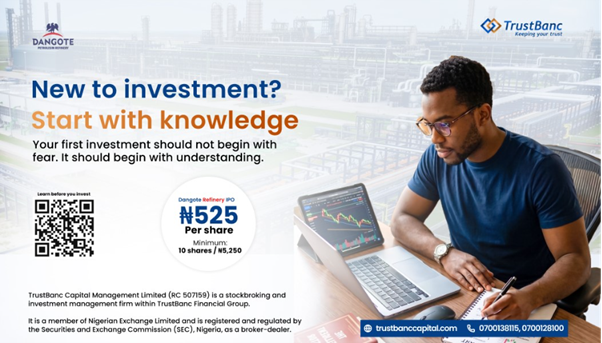
TrustBanc Capital Management Limited has urged prospective investors in the initial public offering of Dangote Petroleum Refinery and Petrochemicals Free Zone Enterprise to look beyond the ₦525 offer price and carefully assess the company’s earnings potential, cash-flow generation, growth prospects and risks before making an investment decision.
The call was made during the latest edition of TrustBanc’s Investor Education Series, held on Saturday, 26 September 2026, under the theme “Dangote Petroleum Refinery IPO: The Price or the Value? Knowing What Matters and Investing with Purpose.”
The session examined the refinery from three perspectives: its position in the global energy market, its significance to the Nigerian economy and the factors prospective investors should consider when evaluating the IPO.
Addressing the refinery’s global relevance, Mueez Jimoh of TrustBanc’s Investment Strategy Unit said its significance extends beyond its size to its potential to reshape refined-petroleum-product flows within Africa and across international markets.
Evidence of the refinery’s international impact is already visible. According to the U.S. Energy Information Administration, its opening and expansion helped increase Nigeria’s seaborne petroleum-product exports from 46,000 barrels per day in 2023 to 350,000 barrels per day in Q2 2026, while imports declined from nearly 400,000 to below 130,000 barrels per day.
Exports to Europe reached 130,000 barrels per day, while shipments to other African countries approached 120,000 barrels per day. Reuters also reported that Dangote Refinery supplied Europe with about 80,000 barrels per day of jet fuel in Q2 2026, meeting up to 13% of the shortfall caused by disruptions to Middle Eastern exports.
“The refinery’s capacity tells us how big the plant is, but consistent operations, competitive pricing and the ability to meet customers’ requirements are what will ultimately determine its influence in the global market,” Mueez said.
He noted that crude-oil prices, refined-product prices, shipping costs and geopolitical developments would continue to affect the refinery’s margins and competitiveness.
“Global events may create significant opportunities, but reliable operations and sound commercial decisions will determine how effectively the refinery captures those opportunities and performs across different market conditions,” he added.
Bringing the discussion to the domestic economy, Mary Adegbite of TrustBanc’s Portfolio Management Unit highlighted the importance of retaining more of Nigeria’s oil and gas value chain within the country.
For decades, Nigeria exported crude oil while importing a significant proportion of the refined petroleum products it consumed. Central Bank of Nigeria data show that refined-petroleum-product imports declined from US$18.31 billion in 2023 to US$10.00 billion in 2025. The goods-account surplus increased from US$8.08 billion in 2023 to US$14.51 billion in 2025, while the current-account surplus rose from US$6.42 billion to US$14.04 billion over the same period.
Nigeria’s gross external reserves also rose from US$33.22 billion at the end of 2023 to US$45.75 billion at the end of 2025 and reached US$55.25 billion as of 18 September 2026, their highest level in 18 years and sufficient to cover approximately 11.3 months of imports of goods and services.
Mary said the refinery’s wider economic importance lies in adding a major processing layer to Nigeria’s petroleum value chain. The oil and gas value chain spans exploration and crude production, transportation and trading, and the refining, distribution and sale of finished petroleum and petrochemical products.
For context, NNPC Limited operates across much of this value chain, although its refining activities have not contributed in recent years. The company reported groupwide revenue of ₦34.5 trillion in 2025. Dangote Refinery, meanwhile, added significant refining and petrochemical capacity, generating ₦18.74 trillion in revenue, equivalent to more than 54% of NNPC’s revenue and demonstrating the scale of additional economic activity it has brought to the value chain.
However, Dangote Refinery’s contribution extends beyond its reported revenue. By converting crude into higher-value fuels and petrochemical products locally, it reduces import-related costs and stimulates employment and activity across manufacturing, logistics, transportation, distribution and retail.
From an investor perspective, Mohammed Saidu, Head of Research, said prospective investors should focus on the economics of the business rather than relying solely on the Dangote name, the size of the refinery or the nominal share price. The IPO comprises up to 4.1 billion ordinary shares offered at ₦525 per share. According to the prospectus, the company reported approximately ₦19.13 trillion in revenue and ₦2.50 trillion in profit after tax for the first half of 2026.
Mohammed said the figures demonstrate the scale of the refinery’s operations, but investors must still determine whether its earnings and cash flows can be sustained across different refining and economic cycles.
“There is a difference between price and value. The question is not simply whether one share costs ₦525, but what that price represents in relation to the earnings, cash flows and future growth attributable to each share,” he said.
“The suitability of the IPO will differ from one investor to another, depending on investment horizon, liquidity requirements, risk tolerance and existing portfolio exposure,” he said.
“Investors should ask three questions: Do I understand what I am buying? Does the potential return justify the risk for me? And does the investment fit within my portfolio and investment horizon?”
The company’s Managing Director, Ayinde Akinsola, FCS, said The Investor Series is designed to help investors move beyond market excitement and make decisions based on a clearer understanding of the businesses and securities in which they are investing. The company plans to develop the programme into a regular investor education series addressing topical capital-market issues.
Interested investors can visit offers.trustbanccapital.com to access subscription information and apply through TrustBanc Capital Management Limited.
About TrustBanc Capital Management Limited
TrustBanc Capital Management Limited is a member of Nigerian Exchange Limited and is registered and regulated by the Securities and Exchange Commission (SEC), Nigeria, as a broker-dealer. The company is a member of TrustBanc Financial Group.
TrustBanc Financial Group is a fully integrated financial services group comprising four licensed subsidiaries: TrustBanc Capital Management Limited, TrustBanc Asset Management Limited, Mango Microfinance Bank Limited and WeFinance Solutions Limited. Together, they provide fund and wealth management, investment advisory, non-interest finance and investment, corporate finance, securities trading, microfinance, savings and lending services.
The Group holds a long-term rating of A+ with a Stable Outlook and a short-term issuer rating of A1 from DataPro. Earlier in the year, GCR Ratings and Agusto & Co. both upgraded its long-term issuer rating from BBB to BBB+ and its short-term rating from A3 to A2, with Stable Outlooks. These upgrades reflect the Group’s strengthening financial position, sound liquidity profile, robust risk management framework and expanding market presence.