Follow Us on Google Discover
The Central Bank of Nigeria (CBN) has raised questions over the growing use of “pay small small” schemes by non-bank businesses to offer credit to customers.
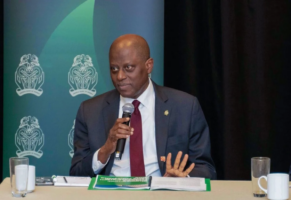
CBN Governor Olayemi Cardoso, represented by Abiodun Olalekan Okunola, Head of the Innovation Management Division at the CBN, raised the issue at Nigeria Fintech Week 2026 in Lagos.
He said the growing use of embedded finance, where non-bank businesses offer financial products to their customers, presents a regulatory challenge, particularly where companies that are not licensed to offer credit provide instalment payment options.
Embedded finance raises regulatory questions
Cardoso said embedded finance was gradually becoming mainstream as businesses use customer data to offer financial products.
Also Read
He cited Air Peace and Wakanow as examples of non-bank businesses offering customers the option to pay for services in instalments.
- “If you go to Air Peace and you try to book a ticket, you’ll see where they tell you where you want to pay ‘small small,’ right? And then if you go to Wakanow, Wakanow will say, ‘Oh, you want to go to Maldives or Bali,’ and it asks if you want to pay ‘small small,” he said.
The Governor said such arrangements raise questions about how the CBN should regulate non-bank businesses offering credit.
- “Now, think about it: they are offering credit. For us, they are non-bank, they are not licensed to offer credit. How do we regulate?,” he said.
Cardoso raises consumer protection concerns
Cardoso said the regulatory question also has implications for customers who have complaints about such services.
He said customers may not know where to seek redress if their rights are affected in transactions involving non-bank businesses that are not licensed financial institutions.
- “Because it means that when your rights are trampled there, if you come to CBN Consumer Protection and ask us, we’ll be like, ‘Who… are they even licensed?”, he said.
Cardoso said embedded finance was one of several developments changing Nigeria’s financial system, alongside artificial intelligence, open banking, digital money and cross-border commerce.
The rise of ‘pay small small’ schemes
Buy Now, Pay Later arrangements are becoming an increasingly significant part of Nigeria’s consumer-credit market.
- Nairametrics reported in June 2025 that Nigeria’s Buy Now, Pay Later market was projected to grow from $1.42 billion in 2024 to $2.61 billion by 2030, while more than 400 digital lenders were operating in the country.
- The model has been expanding beyond traditional financial institutions. In 2025, Kalabash, a fintech subsidiary of Wakanow Group, partnered with Outpayce from Amadeus to make its Pay Small Small travel-payment solution available through airline and travel platforms.
Regulation of digital credit has also tightened. Nairametrics reported in September 2026 that 525 digital lenders had been registered with the Federal Competition and Consumer Protection Commission (FCCPC), alongside 33 lenders operating under waivers because they were already licensed by the CBN.
The FCCPC has also been enforcing rules covering consumer protection, lending practices and debt recovery.