Follow Us on Google Discover
Nigeria’s economy is already broad, and its exports are shifting. But diverse is not the same as diversified, and for anyone deploying capital the difference is where both the risk and the opportunity sit.
For fifty years, one sentence has dominated Nigerian economic debate: the country must diversify away from oil. Lately, a hopeful new claim has appeared: Nigeria has already diversified, because oil is now only about five percent of the economy and its share of exports and government revenue is falling.
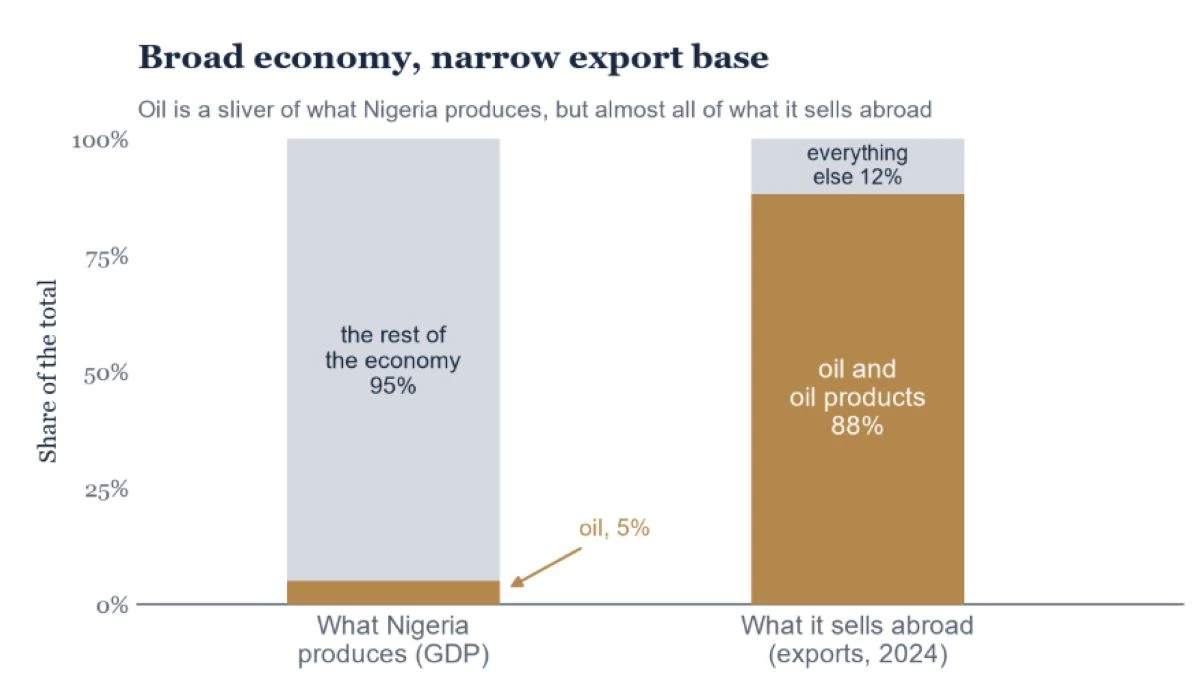
Both the old worry and the new optimism miss the same thing. A small oil share is not the same as a strong or a diversified economy. And on the measure that actually matters, Nigeria has barely begun.
Start with that five percent, because it is more slippery than it looks. Nigeria’s economy is not light on oil because it built great industries to dwarf it. It is light on oil because more than two hundred million people have to earn a living, and most of them do so informally: farming a small plot, trading by the roadside, driving, offering a service.
Also Read
By the International Monetary Fund’s estimates, well over half of Nigeria’s output is informal, and the national accounts capture much of it, so it sits inside the ninety five percent that is not oil. This is not an ambition deficit. For most, staying informal is a rational response to a simple calculation: formalising costs a great deal in paperwork, official attention and the power you must still generate yourself, while returning little in protection or public services.
Informality is a shelter, not a shortfall of enterprise. But a shelter, however vast, is not a diverse, sophisticated economy. It is a great many people each producing a little. Oil looks small beside it, which tells you about the size of the informal economy, not the strength of the formal one.
This is the difference between an economy that is diverse and one that is diversified. Diverse means many people doing many small things. Diversified, in the sense that builds lasting wealth, means producing a wide range of complex, valuable goods and services that others will pay for.
The standard global gauge of this is the economic complexity index, which ranks countries by the sophistication and range of what they export. On it, Nigeria sits near the bottom, in the lowest tenth of the economies ranked, because what Nigeria sells the world is, overwhelmingly, still oil. A country can have a huge, busy, mostly informal economy and still be one of the least complex exporters on earth. Nigeria is both.
And this is where the arithmetic of the trillion-dollar goal turns unforgiving. You do not reach a trillion dollars, spread across two hundred million people, by adding more of the same. A trader selling tomatoes by the roadside or a farmer working a plot by hand cannot double their output next year, or the year after; there is a low ceiling on the productivity of informal survival.
Large, sustained jumps in output come from formal firms that can invest, mechanise, specialise and scale. For an economy this large to grow substantially richer, output per person has to rise, and that comes from making more valuable and sophisticated things, not simply more of the same.
Which brings us to the export numbers everyone is now citing. It is true that crude’s share of Nigeria’s exports has fallen sharply, from about seventy percent in 2024 to around half by late 2025, and that other exports have risen. But read it carefully. A share can fall because the other side grows, or because the thing itself shrinks, and much of this is the second kind: crude simply earned less. Global oil prices softened, and Nigeria earned fewer dollars from crude in 2025 than in 2024 even as it pumped more.
A falling crude share driven by crude earning fewer dollars is not diversification; in the short run it is closer to trouble. And a good part of what is counted as beyond crude is refined fuel and gas rather than new industry. Some of it is produced by refining imported crude rather than Nigerian crude.
Genuine exports beyond the oil complex, farm goods, minerals, manufactures, are real and growing, but still only around six billion dollars a year. The direction is encouraging. The scale is small, and the headline flatters it.
There is one genuine, and genuinely important, piece of good news. For years the naira was held artificially strong, which quietly did more to block diversification than any failed industrial policy. An overvalued currency makes a country’s exports too dear to sell and its imports too cheap to resist, so Nigerians bought foreign and sold little but oil. Economists call it the Dutch disease.
When the naira was finally allowed to find its own level, painfully, that trap loosened, and for the first time in a generation Nigerian goods had a fighting chance abroad. That correction is the single most useful thing done for diversification in decades, and it deserves credit. But a cheaper currency is a door, not a destination.
It cannot, on its own, conjure what Nigeria does not yet have: reliable power, decent roads and ports, local inputs instead of imported ones, finance a factory can actually use. A weaker naira also raises the cost of every imported input, so for many producers competitiveness and costs climb together. Devaluation opened the way. It did not build the road.
For anyone deploying capital in Nigeria, this reframes where the opportunity actually sits. The naira correction has, for the first time in years, made exporting and import substitution genuinely attractive, a real tailwind for firms that produce tradable goods.
But the same reforms that open the door leave the hard constraints in place: power, logistics, imported inputs and thin local supply chains still decide who can compete. So the winners will not be whole sectors rising on a slogan; they will be specific firms that can build competitiveness despite the environment, and increasingly own the power and inputs they cannot rely on the state to provide.
And because Nigeria still earns its dollars from a commodity whose price it does not set, every business plan here should carry a serious view on the naira. The diversification opportunity is real. It is simply far more selective, and far more infrastructural, than the headline suggests.
So the honest task is neither the one the slogan describes nor the victory the optimists claim. It is not to shrink oil, which is already small, nor to declare the job done because a currency moved. Here is the uncomfortable asymmetry at the heart of it. Floating the naira was the easy reform: a decision, taken once, with a signature.
Building the industries that a floated naira makes possible is the hard one, the grinding administrative work of a decade: power and ports, making it cheap and simple to run a formal business, skills and supply chains, work with no ribbon to cut and no quick reward. It is the sum of almost every other article in this series. And it is precisely the work a country is tempted to abandon the moment the oil price rises again and the pressure lifts. The easy reform has been done. The hard one has barely started.
None of this is cause for despair. The economy is not fragile in the way the old fear imagined; it does not live or die on the oil price alone, and the currency reform has opened a real opportunity that an overvalued naira had kept shut for decades. But it is reason to be honest about what has, and has not, happened. A trillion-dollar economy is not one where oil is a small slice of a vast informal economy.
It is one that produces complex things formally, at scale, and sells them to the world. Nigeria is not there yet, and no exchange rate or export statistic should be allowed to suggest otherwise. The oil share was never really the problem. The problem is everything we have still not built. The good news is that, for once, the door is open. The work is walking through it.
This is part of a series exploring whether, and how, Nigeria can become a one trillion-dollar economy, and the numbers behind the claim.
Sources
Sources, accessed September 2026. Oil and gas were about 5 percent of Nigeria’s real GDP in late 2024; the rest of the economy made up about 95 percent (National Bureau of Statistics). The International Monetary Fund estimates that well over half of Nigeria’s economy is informal.
On the Harvard and OEC economic complexity index, which ranks countries by the range and sophistication of their exports, Nigeria ranks in the lowest tenth of the economies measured, with a score of about minus 1.6 and a position near 150th (Harvard Growth Lab, 2021); the exact rank varies by source and year.
Oil and oil products were about 88 percent of exports in 2024; crude alone fell from about 70 percent of exports in 2024 to around half by late 2025, in part because crude export earnings fell about 14 percent in 2025, to about 31.5 billion US dollars, on softer prices even as production rose (NBS, CBN). Exports beyond the oil complex were about 6 billion US dollars in 2025 (Nigerian Export Promotion Council). The naira was floated in 2023.
Frank Nnamka is a private equity and impact investor. He writes here in a personal capacity, and the views expressed are his own and do not reflect the position of his employer or any organisation he is affiliated with.