Follow Us on Google Discover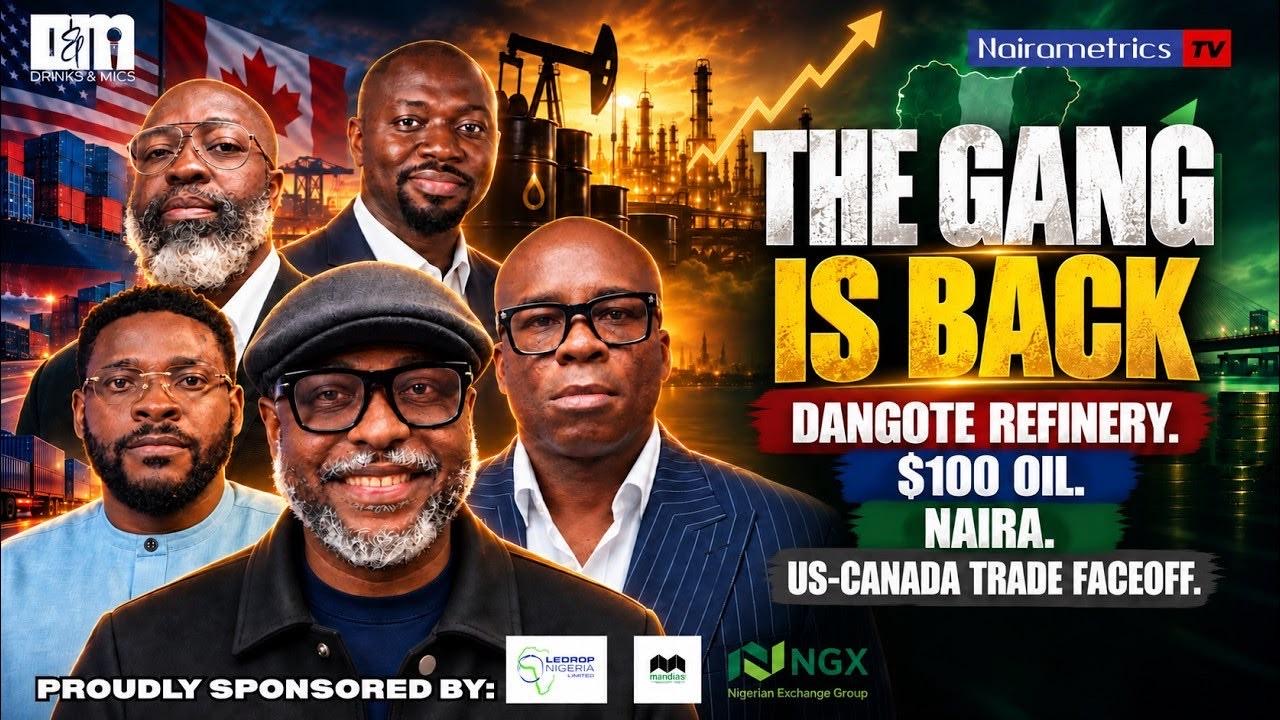
Financial market analysts have expressed differing views on the valuation of the Dangote Petroleum Refinery Initial Public Offering (IPO), while largely agreeing that the transaction is set to deepen Nigeria’s capital market and attract a new generation of investors.
The analysts shared their views during the Drinks and Mics podcast hosted by Nairametrics founder, Ugodre Obi-Chukwu.
Participants included Samson Esemuede, Chief Investment Officer at Zrosk; Tunji Andrews, Chief Executive Officer of Awabah; Arnold Dublin-Green, Managing Director and Head of Asset Management at Renaissance Capital Africa; and financial analyst Oluwapelumi Joseph.
The IPO, which opens on September 14 and closes on October 13, 2026, is expected to be one of the largest public offerings in Africa’s history and has already generated significant interest among local and international investors.
Also Read
What they are saying
Speaking on the likely market impact of the offer, Esemuede said concerns about a repeat of the liquidity squeeze witnessed during the refinery’s private placement may be overstated.
According to him, the IPO is smaller than many investors initially anticipated and has been extensively communicated to the market, giving investors sufficient time to plan their participation.
- “The sizing of the IPO is sort of smaller than people were anticipating. Less than 3%. And also the IPO was very well telegraphed… it’s not like the private placement that came as a big shock,” he said.
He noted that the month-long subscription period would enable investors to gradually raise liquidity without triggering widespread market disruptions.
- “I don’t think the destructive effects in the market that we saw in June are going to replicate in September,” Esemuede said, although he acknowledged that short-term volatility could still occur as investors reposition portfolios.
Esemuede described the Dangote Refinery as a transformational asset that has significantly altered Nigeria’s external sector dynamics and reduced pressure on the country’s balance of payments.
- “This asset has transformed the balance of payments of Nigeria… he can’t get enough credit,” he said.
However, he cautioned investors against conflating the refinery’s strategic importance with its equity valuation.
According to him, investment decisions must ultimately be driven by expected returns rather than market sentiment or scarcity value.
- “When I invest in companies, psychology is important, but I can’t bank on psychology. I have to think about how I’m going to make money and the scenarios that need to happen for me to be able to make money,” he said.
Esemuede added that sustaining the valuation implied by the IPO would depend on the refinery’s ability to maintain strong refining margins even as additional refining capacity enters the market.
Private placement investors still under pressure
The discussion also touched on the experience of investors who participated in the refinery’s earlier private placement.
Tunji Andrews noted that some investors had expressed concerns about aspects of the IPO process, particularly given recent market developments.
Oluwapelumi Joseph explained that private placement investors were currently facing paper losses because the premium many expected has yet to materialise and their shares remain subject to a one-year lock-in period.
- “With the private players, everyone thought the delta will be high… it’s slightly over 10 per cent, but you’re locked for one year. So you have minus 10 under the water,” Joseph said.
He noted that with funding costs estimated at roughly 20%, investors are effectively carrying a significant opportunity cost while waiting for the shares to become tradeable.
IPO could reshape the Nigerian capital market
Ugodre Obi-Chukwu argued that the listing has the potential to fundamentally change the Nigerian capital market by attracting millions of new investors.
He referenced disclosures made during the IPO signing ceremony indicating that organisers are targeting up to 10 million retail investors.
- “I was looking at 10 million new people, new investors, that suddenly are coming into this market that can now start to see other opportunities,” he said.
According to Obi-Chukwu, the broader significance of the IPO may lie not only in the capital it raises but also in its ability to increase participation in Nigeria’s equity market.
Andrews agreed, describing the heightened interest generated by the listing as positive for the entire market ecosystem.
- “The frenzy around the Nigerian stock exchange, the Nigerian capital market as a whole, because of this particular listing has been very good… net, net, it has been a good look for all of us,” he said.
Esemuede also revealed that the offering has attracted interest from foreign retail investors seeking ways to participate in the share sale.
- “Even on the global scale, the amount of foreign retail investors that are calling you, how can I get them to go and buy the IPO? I love it,” he said.
Get up to speed
The Dangote Petroleum Refinery IPO seeks to raise approximately N2.15 trillion and is expected to rank among the largest share sales ever undertaken in Africa.
Analysis of the refinery’s prospectus by Nairametrics shows that despite the public offering, Aliko Dangote’s beneficial ownership in the company will remain at 84.34%.
The prospectus indicates that Dangote’s economic interest is held through multiple corporate entities, including DORCL, DIL and Greenview, which collectively represent a single beneficial ownership structure.
Only 3.30% of the post-offer company is being made available to public investors after PanAfrican Refinery Investment SPV (Mauritius) acquired 1.04 billion shares valued at approximately $400 million through a subscription commitment agreement signed on August 28, 2026.
What you should know
The IPO represents the latest phase in Dangote Refinery’s transition toward public ownership.
In May 2026, Aliko Dangote disclosed that he rejected a proposal by the Nigerian National Petroleum Company (NNPC) to increase its stake in the refinery, citing plans to broaden ownership through a future public listing.
The company subsequently raised $2.5 billion through a private placement in July 2026, creating the 7.148 billion shares currently classified as “Others” within the refinery’s ownership structure.
With subscription set to open on September 14, market participants will be closely watching investor demand, valuation dynamics, and the potential long-term impact of the listing on the Nigerian Exchange and the broader capital market.