
 Follow Us on Google Discover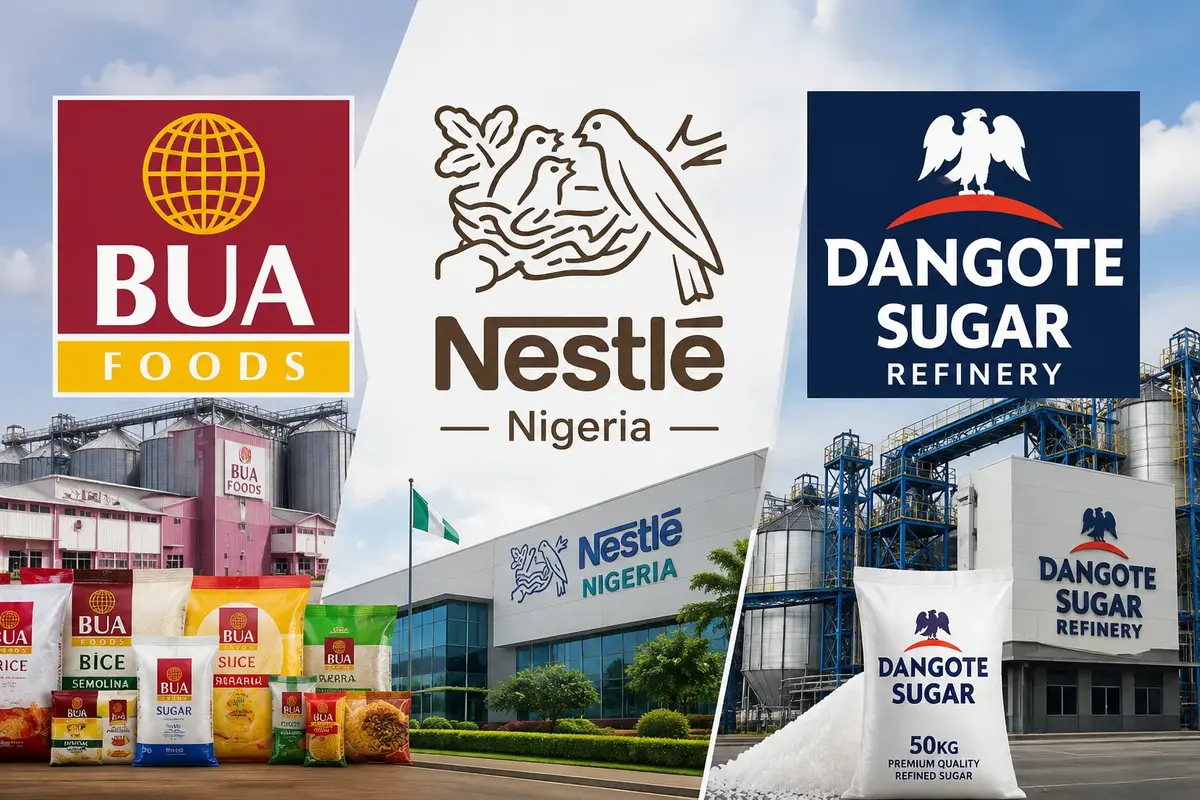
Nine of Nigeria’s ten largest listed consumer goods companies generated less dollar revenue in 2025 than they did in 2022, the last full year before Nigeria’s foreign exchange reforms, even as their combined naira revenue nearly tripled and all ten delivered real growth over the same period.
The ten companies generated a combined $4.85 billion in dollar revenue in 2025, down 22.0% from $6.22 billion in 2022, while their combined naira revenue rose 178.3% from N2.65 trillion to N7.37 trillion over the same three years.
Adjusted for inflation, combined real naira revenue grew 39.6% over the period, confirming that genuine volume and pricing growth occurred, but not at a pace sufficient to offset the naira’s 72% depreciation against the dollar.
Data and analysis were carried out by Nairametrics Research, drawing on audited annual financial statements filed by listed companies with the Nigerian Exchange (NGX), with exchange rate and inflation data sourced from the Central Bank of Nigeria (CBN) and the National Bureau of Statistics (NBS).
Also Read
The analysis covers the ten largest consumer goods companies by 2025-naira revenue for which 2022 data is available: BUA Foods, Nigerian Breweries, Nestlé Nigeria, Dangote Sugar Refinery, International Breweries, Guinness Nigeria, Honeywell Flour Mill, PZ Cussons Nigeria, Unilever Nigeria and Cadbury Nigeria.
Dollar conversions use average annual CBN exchange rates of N425.98 in 2022 and N1,520.11 in 2025. The most recent available period for Honeywell Flour Mill is the quarter ended June 2026, its first quarter of the financial year ending March 2027.
What the data is saying
The naira numbers are striking. Across the ten companies, the sector’s combined naira revenue grew at a compound annual rate of 40.66% between 2022 and 2025. After adjusting for inflation, the sector’s real compound annual growth rate was 11.77%, which is a meaningful genuine expansion in volume and pricing terms.
- But the naira depreciated by about 72% against the dollar over the same period, from N425.98 in 2022 to N1,520.11 in 2025, and that depreciation swamped the real growth. The result is a sector that grew in real naira terms but shrank in every dollar measure.
- Nine of the ten companies ended 2025 earning less in dollars than they did in 2022. Dangote Sugar recorded the steepest dollar revenue decline, falling 42.4% from $946.6 million to $545.5 million, despite growing naira revenue by 105.6% and real naira revenue by just 3.2% over the period, the smallest real gain among the ten, reflecting how much of its naira growth was more of a price inflation rather than volume expansion.
- Guinness Nigeria fell 36.2%, from $485.5 million to $310.0 million. PZ Cussons declined 36.0%, from $267.5 million to $171.3 million. Unilever Nigeria fell 32.2%, from $207.9 million to $141.0 million. Honeywell Flour Mill declined 31.4%, from $345.9 million to $237.4 million.
- Nigerian Breweries fell 25.3%, from $1.29 billion to $965.3 million. Nestlé Nigeria declined 24.3%, from $1.05 billion to $794.5 million. International Breweries fell 20.7%, from $513.3 million to $407.2 million. Cadbury Nigeria recorded the smallest dollar decline among the nine, falling 14.4% from $129.6 million to $111.0 million, supported by the strongest real revenue growth among the nine decliners at 53.3%.
- The one exception is BUA Foods Plc, which grew dollar revenue 18.9% from $982.1 million in 2022 to $1.17 billion in 2025, the only company in the group to have emerged from the reform period with more dollar revenue than it entered with.
BUA Foods also delivered the strongest real naira revenue growth of the ten at 112.8%, reflecting genuine volume expansion across its flour, pasta and sugar businesses that outpaced both inflation and the naira’s depreciation.
How the devaluation hit and what companies did about it
The 2023-naira devaluation hit consumer goods companies through higher imported input costs, more expensive foreign currency liabilities and large exchange losses.
- Nigerian Breweries’ Company Secretary, Uaboi Agbebaku, said the naira devaluation resulted in a N153 billion foreign exchange loss in 2023, contributing to the company’s N106 billion net loss for the year.
- Nestlé Nigeria also felt the impact through the revaluation of its foreign-currency obligations. Commenting on the company’s 2023 results, its then Managing Director and CEO Wassim Elhusseini said, “The devaluation of the Nigerian Naira in 2023, which led to a revaluation of our foreign currency obligations, undoubtedly impacted our financing cost and consequently the profit after tax.” Nestlé Nigeria ended the year with an after-tax loss of N79.5 billion.
- Guinness Nigeria reported a N49.1 billion unrealized foreign exchange loss in 2023. Dangote Sugar recorded approximately N209 billion in revaluation losses in 2024.
- PZ Cussons reported £104.1 million in foreign exchange losses in its financial year 2024, while BUA Foods, despite its stronger position, recorded N173.3 billion in unrealised foreign exchange losses in 2024.
To cushion the impact of the naira devaluation, the companies responded through deleveraging, pricing and localization.
- Nigerian Breweries raised approximately N600 billion through a rights issue. Commenting on their H1 2026 performance, the company’s secretary, Uaboi Agbebaku stated that they are “carrying zero borrowings,” with retained earnings back in positive territory and net finance expense down 61%.
- International Breweries undertook a roughly N588 billion rights issue in 2024 and by June 2026 had no outstanding loans or overdrafts.
- Nestlé began repaying parent company dollar loans, reducing interest-bearing borrowings from N653.7 billion to N476.0 billion by 2025, though Nestlé still carried about N445 billion in interest-bearing borrowings in June 2026, the bulk of which remained linked to its dollar-denominated intercompany loans, meaning its exposure to foreign-exchange and financing risk had not been fully eliminated.
- PZ Cussons Nigeria had significantly reduced its FX exposure by May 2026. Its net dollar liability position fell to $13.8 million from $67.6 million a year earlier, while borrowings dropped to N5.9 billion from N71.3 billion. Consequently, the estimated impact of a 10% increase in the dollar exchange rate fell to N1.9 billion from N10.7 billion.
- Guinness Nigeria announced plans to separate the importation and distribution of certain Diageo international premium spirits from its core business as part of a strategy to reduce FX requirements and exposure to exchange-rate volatility, and Diageo subsequently sold its 58.02% controlling stake to Tolaram while retaining the Guinness brand under license.
- By H1 2026, Guinness Nigeria had reduced total borrowings to N22.8 billion from N43.9 billion at December 2025, while a N1.44 billion foreign-currency remeasurement loss in H1 2025 had reversed to a N962 million remeasurement gain.
- BUA Foods combined pricing, volume expansion and localization to manage FX pressures. In 2025, it absorbed about N90.9 billion in unrealized FX losses while still earning N518.4 billion in profit after tax.
- By H1 2026, Dangote Sugar delivered the most striking individual turnaround, swinging from a N24.3 billion loss in H1 2025 to a N41.5 billion profit, with foreign exchange losses effectively eliminated and an N11.83 billion exchange gain recorded, though finance costs of N50.4 billion meant the balance sheet burden had not fully disappeared.
What you should know
In an earlier article published by Nairametrics, seven global companies that have pulled back from Nigeria since President Bola Tinubu assumed office in May 2023 were identified. Some of the companies that have fully exited or substantially scaled back include Equinor, Kimberly-Clark and Procter & Gamble.
Equinor, which sold its Nigerian assets to Chappal Energies in a transaction valued at up to $1.2 billion.
Kimberly-Clark, which closed its Lagos manufacturing facility in 2024 after almost 15 years.
Procter & Gamble, which wound down local manufacturing and moved to an import-only model citing the difficulty of operating as a dollar-denominated company in Nigeria.
GlaxoSmithKline stopped selling its pharmaceutical products directly in Nigeria in August 2023, transitioning to a third-party distribution model, while Shoprite’s franchise operations collapsed entirely by March 2026, ending a nearly two-decade presence that began in 2005.


This tells me less about Nigerian consumer companies shrinking and more about how absurdly overvalued the pre-2023 official naira was. Comparing 2022 revenues at ₦426/$ with 2025 at ₦1,520/$ treats the old official rate as economically real when a large part of the economy could not actually obtain dollars there.
Like why the increase in prices for no actual just reason. It’s so common like a normal. Only thing they know about business is increase in prices. How?