Follow Us on Google Discover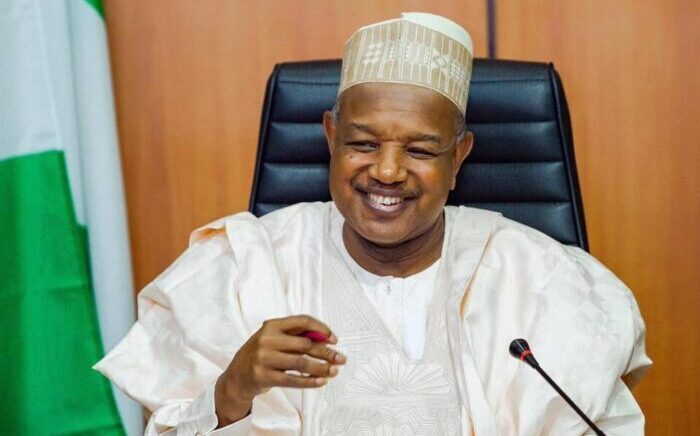
The Federal Government has disclosed plans for a bond issuance on the Vienna stock market to raise capital for investments in key sectors of the Nigerian economy.
The Minister of Budget and Economic Planning, Senator Abubakar Bagudu, disclosed this on Tuesday while addressing the GPF Global Vienna Meeting in Vienna, Austria, via video message.
According to a statement from the ministry, Bagudu said the Federal Ministry of Budget and Economic Planning, Ministry of Finance and Austrian officials collaborating with the Austrian Stock Exchange had established ESME Limited as a special purpose vehicle to fund investments in Nigeria.
According to him, the company will issue bonds on the Viennese stock market to finance investments by Austrian and other companies in green technology, waste-to-energy, textiles, pharmaceuticals, agriculture and water.
He added that ESME Limited has two representatives from the Ministry of Finance Incorporated and Austrian businessmen on its board.
Bagudu said the Tinubu administration welcomed the progress made by the company towards the forthcoming bond issuance and expressed confidence that it would strengthen business relations between Nigeria and Austria.
What the statement said
The statement read, “Bagudu argued that the successes of the economic reform were sufficient to incentivise Austrian investors, explaining that this was why his ministry, the Ministry of Finance, and Austrian officials collaborating with the Austrian Stock Exchange floated a company, ESME Limited, as a special purpose vehicle to fund investments in Nigeria.
- “He stated that the company has two representatives from the Ministry of Finance Incorporated and distinguished Austrian businessmen on its board, explaining that the company would issue bonds on the Viennese Stock Market to fund investments by Austrian and other companies in green technology, waste-to-energy, textiles, pharmaceuticals, agriculture, and water in Nigeria, and to scale up.”
The minister said Nigeria’s ambition to become a $1 trillion economy by 2030 had increased the need to attract foreign capital, with the government identifying the Austrian stock market as a potential source.
- Speaking on the theme, “Financing Africa’s Future: The Vienna Stock Exchange as a Gateway to European Capital Markets for African Government Projects,” Bagudu urged Austrian investors to explore opportunities in Nigeria.
- “We are confident that Nigeria is a proven market of choice with strong absorptive capacity, with over 200 million people. So, Austrian companies and businesses well-rooted in technology can operate profitably in Nigeria,” he said.
Bagudu said Nigeria and Austria share similar demographics and comparative economic advantages that make the Austrian stock market attractive to Nigeria.
He also argued that the Federal Government’s economic reforms had improved the investment environment by seeking to achieve macroeconomic predictability and removing distortions, including in the foreign exchange market.
According to him, the reforms have provided a rule-based playing field for the capital market and improved investor confidence.
- “The forex market has stabilised, with free entry and exit. Foreign reserves have risen significantly to over $50 billion, providing over 11 months of import cover,” he said.
Bagudu pitches investment returns
Bagudu also pointed to increased revenues across the three tiers of government as one of the gains from the reforms, saying the development had provided governments with greater opportunities to deliver services to citizens.
He said Nigeria’s bond spread reflected greater confidence in the economy and argued that the reforms implemented over the past three years had repositioned the country for investment.
The minister further sought to convince Austrian businesses of the potential returns available in the Nigerian market.
According to him, prospective investors would not regret doing business in the country, claiming that existing investors were earning more than 20% returns on their investments in US dollar terms.
What you should know
Nigeria attracted $10.37 billion in capital importation in the first quarter of 2026, marking an 83.8% increase compared to the $5.64 billion recorded in the corresponding period of 2025, as foreign investors ramped up purchases of money market instruments and bonds.
Data released by the National Bureau of Statistics (NBS) showed that capital inflows also rose by 61% quarter-on-quarter from $6.44 billion recorded in the fourth quarter of 2025, underscoring growing investor appetite for Nigerian financial assets.
Portfolio investment remained the primary driver of capital importation during the quarter, accounting for $9.86 billion or 95.1% of total inflows.
In contrast, Foreign Direct Investment (FDI) remained weak despite a marginal annual improvement. FDI inflows stood at $135.08 million, representing just 1.3% of total capital importation during the period.