Follow Us on Google Discover
Nigeria has set itself a fiscal target, and almost no one disagrees with it.
By the government’s own reckoning, the state collected tax worth about ten percent of the size of the economy in 2023, among the lowest shares anywhere, and the plan is to push that towards eighteen percent within a few years, closer to the level wealthy nations enjoy.
Collect more, catch up, fund the future. It sounds unarguable. But it hides a confusion that could quietly derail the whole trillion-dollar project: the difference between building a bigger tax state and building a bigger taxable economy. They are not the same thing, and only one of them makes a country rich.
Start with the target itself. Suppose Nigeria reaches eighteen percent. It would be hailed as a milestone, and understandably so. But that single number could describe four completely different countries. It might mean that far more Nigerians have become productive, formal and taxable, a genuine triumph. Or that the government has simply drawn more from the same narrow band of people it could already see, the salaried workers and the listed companies. Or that inflation has swollen tax receipts while real life stood still. Or that collections rose while the economy itself stagnated, which is arithmetic, not progress.
Also Read
Same headline. Four different economies, ranging from success to quiet failure. That is the trouble with a single, seemingly objective number: on its own it cannot tell you which of these four stories is true, yet we treat it as a simple scoreboard for the government.
History sharpens the point. The heavy tax take of rich countries is not how they became rich; it is what they became once they were. As Europe and North America industrialised in the nineteenth century, their governments collected less than a tenth of national income, much as Nigeria does now; the leap to a third or more came only in the twentieth century, long after the wealth.
In our own era, South Korea and China grew fastest while collecting far less, relative to their economies, than any Western state. In each case, a taxable economy came first: broad, formal and productive. The tax take rose to follow it. They did not become rich simply by raising the tax take. They grew a base worth taxing, and the revenue followed. The pressure on Nigeria now runs the other way: raise the tax take first, and hope the economy follows.
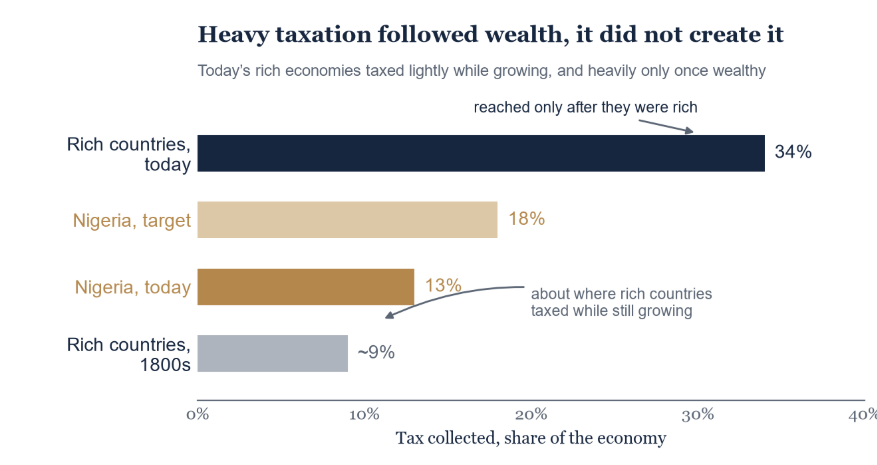
This is not to belittle what Nigeria has done, which is real. Tax collected has more than doubled in naira terms in two years. On the reform committee’s own figures, the share taken has climbed from about ten percent in 2023 to around thirteen percent by 2025. A sweeping reform took effect at the start of 2026, clearing away a jungle of overlapping taxes and lifting the lowest earners out of income tax.
More than three-quarters of tax collected now has nothing to do with oil. And here is the encouraging part: read the details, and the reform is not simply a blunt grab for more. It broadens the base, simplifies the code and lifts the lowest earners out of tax altogether, while raising rates only at the top, on the highest earners and on company capital gains.
Its thrust is to widen who pays, not to squeeze the same people harder. It is, in effect, trying to build a bigger taxable economy, not just a bigger tax state. The reform gets the deep thing right. It is the public scorecard around it, fixated on eighteen percent, that risks measuring the wrong success.
It helps to separate three claims that usually get bundled together. The first: Nigeria needs more revenue. True, plainly. The second: Nigeria must therefore extract as much as it can, as fast as it can. Not true, and possibly harmful. The third: Nigeria needs to expand the economy that can be taxed at all. That is the one that matters, and it is a different project entirely. The first two are about extraction. The third is about development. Confusing them, treating fiscal extraction as if it were economic progress, is the error this whole debate keeps making.
To see why it matters, run the target to its unhappy conclusion. Imagine Nigeria hits eighteen percent but gets there the easy way: by leaning harder on formal businesses, raising consumption taxes and placing more of the burden on salaried workers, while the informal majority stays informal, investment slips, productivity stalls and growth disappoints.
The scoreboard would read eighteen percent. The celebration would be real. And Nigeria would be no closer to a trillion-dollar economy than before, arguably further, having taxed its productive core harder while leaving the vast base untouched. The target would not have been wrong, exactly. It would have been an inadequate definition of success.
Because the real reason Nigeria collects so little is not low rates or lazy collectors. It is that most of the economy cannot be seen. You cannot tax a trade that leaves no record, a business with no registration, or a plot with no title. A low tax take is a symptom of an informal, uncounted, untitled economy, the very thing this series has diagnosed piece by piece. Which means the lasting way to raise the number is not to reach for it directly, but to cure what keeps it low: to formalise the trade, register the business, title the land, record the transaction. Do that, and the tax take rises on its own, because there is finally something there to tax.
There is a further prize in this, one that has nothing to do with the size of the treasury. A state that lives on oil answers, in the end, to the oil price. A state that lives on its citizens’ taxes has to answer to its citizens. Oil is money with no strings attached, which is exactly why it so rarely builds the habit of accountability.
Tax is money with a question attached: the taxpayer’s right to ask what it bought. As Nigeria shifts from being funded by crude to being funded by its people, it is not only changing its accounts. It is changing the relationship between citizen and state. But that bargain only holds if people can see what their taxes buy. Widen the net around a government people cannot see working, and every naira will feel like extraction, and be resisted. You earn a tax base. You do not simply enforce one.
For anyone deploying capital in Nigeria, this distinction is not academic. The reform’s direction, a broader base and a simpler code, is exactly what formal businesses have wanted for years: a more level field, fewer overlapping levies, and informal competitors slowly drawn into the same net. That is a tailwind.
But the risk sits on the other side of the same coin. If the pressure to hit a headline number ever tempts the state to lean harder on the visible and already compliant, the very companies an investor is most likely to back would carry the load. So the signal worth watching is not the tax take. It is the mix. Is the base widening, or is the same narrow pool simply being pressed harder? The first is an economy becoming more investable. The second is not.
So the number to watch is not the one everyone is watching. The goal was never a bigger tax state, which any government can build by extracting more. The goal is a bigger taxable economy: more businesses, more formal jobs, more titled assets, more recorded transactions, higher productivity, higher incomes. That is harder, slower and far less quotable than a rising ratio. It is also what ultimately carries any country to a trillion dollars. You cannot tax your way to a trillion-dollar economy. You have to grow the economy worth taxing, and earn, from your own people, the right to fund it.
This is part of a series exploring whether, and how, Nigeria can become a one trillion-dollar economy, and the numbers behind the claim.
- Frank Nnamka is a private equity and impact investor. He writes here in a personal capacity, and the views expressed are his own and do not reflect the position of his employer or any organisation he is affiliated with.