Follow Us on Google Discover
Ask what will decide whether Nigeria becomes a one trillion-dollar economy, and you will hear a familiar list.
More graduates.
More coding academies.
More vocational training. A skills gap, to be closed with the right programmes and the right budget.
It is a comforting diagnosis, because it is the kind you can fix in a single budget cycle.
It is also aimed at the wrong end of a person’s life. For most Nigerians, the trillion-dollar question is largely settled before they turn five, and before they can read a sentence.
Start with the most recent measure the World Bank has. In 2026 it set out what a Nigerian child born today can expect to earn across a working life, given the country’s current health, schooling and jobs, against what the same child could achieve with full health and a complete education.
Its verdict is blunt. Deficits in three areas, nutrition, learning and skills on the job, are costing a child born today about half of their future earnings. Put the other way, the Bank estimates that closing those gaps would raise future incomes by roughly 111 percent, close to double.
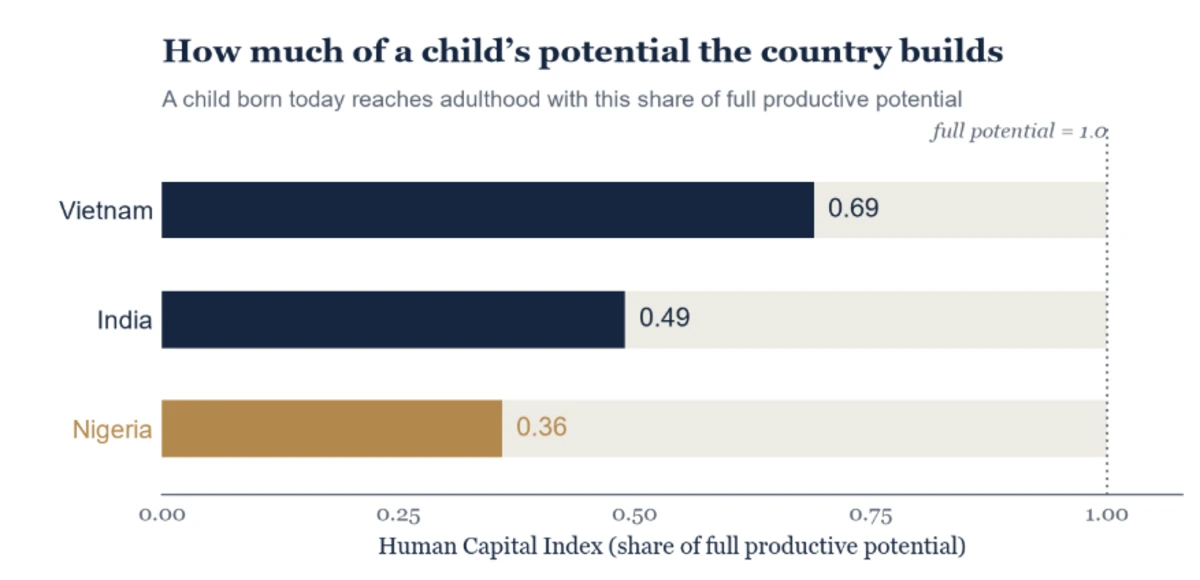
This is not a new or contested concern. The Bank’s original Human Capital Index had already put Nigeria at 0.36 in 2020, its last full round, meaning a child then could expect to reach adulthood with only about 36 percent of the productivity that full health and a complete education would allow.
The newer measure, using 2025 data, reaches the same conclusion and sharpens it. India and Vietnam, two countries that keep appearing in this series, both sit well above Nigeria. Human capital is not the only thing that decides growth; capital, infrastructure, institutions and technology all matter too. But it sets the ceiling on how productively a country can use any of them.
It begins with the body, the first of those three shortfalls. About one in three Nigerian children under five is stunted, the technical term for a child whose physical growth has been held back by poor nutrition and repeated illness in the first years of life.
Stunting is not only about height. The same early deprivation that stunts a body can also affect the brain that is developing at the same time. So a large share of Nigerian children reach the school gate after a start in life that can carry lasting consequences for cognitive development, schooling and later productivity, before a single lesson is taught.
Then comes learning, the second shortfall. About nine million Nigerian children of primary school age are not in school at all. And many of those who are in school are not learning as much as the certificate suggests. On the World Bank’s harmonised measure of what pupils actually know, Nigerian scores in 2025 sat a shade below where they were in 2010, essentially flat for fifteen years.
You can see the end result in one figure: about three in ten Nigerian adults still cannot read and write. For years we have counted enrolment and handed out certificates. We have been counting schooling. We have not always been measuring learning.
This is the same trap the whole series keeps returning to. We measure the thing that is easy to count rather than the thing that matters. With people, we count degrees rather than skills, and years in a classroom rather than what was learned there. That is why the common complaint that graduates are unemployable is both true and misdiagnosed.
Employers are right that a certificate no longer guarantees capability. But they blame the university, which is the last stop, when the gap opened decades earlier, in a malnourished infancy or an early classroom where reading never quite took hold. Training a young adult cannot put back what was never built into the young child.
Here is the part that should reshape where we put our money. Some of the highest return investments in Nigeria’s trillion-dollar future are almost certainly the least glamorous. They are not a new university or a gleaming technology hub.
They are a pregnant woman’s nutrition, a toddler’s meals, and whether a seven year old can actually read by the end of the year. These things are cheap. They are boring. They do not cut ribbons. And their benefits compound for decades. We tend to invest from the top down, in the visible and the late. Human capital compounds from the bottom up, in the invisible and the early.
For anyone deploying capital in Nigeria, this reframes the workforce. The talent pool is thinner in real capability than the raw headcount suggests, and that gap, not a shortage of degrees, is what employers actually feel when they say graduates are unemployable. In practice this changes the investment thesis itself.
Labour is not the cheap, plentiful input the demographic story assumes, so any business model that leans on a large pool of ready, capable workers deserves a harder look, and the cost of training belongs in the numbers from the outset.
The firms that compound here tend to treat capability as something they build and retain, not something they can hire off the shelf, and they treat fully formed talent as scarce and mobile rather than abundant. It also points to where durable demand sits: in child health and nutrition, in early education that produces learning rather than certificates, and in the basic services that turn a large young population into a productive one.
Human capital is not the cheap, abundant input the demographic story assumes. It is one of the binding constraints on the trillion dollar economy, which is exactly why it is also one of its largest opportunities.
None of this means the raw material is poor. The opposite is true. Nigerians who get the full foundation compete at the very top of the world, in medicine, in technology, in finance, on every continent. The ceiling is extraordinarily high. The problem is not the potential of Nigerian children. It is how much of that potential the system currently manages to build before adulthood, and for how many of them.
The previous article in this series asked whether Nigeria can even count its people. This one asks a harder question: whether we are building them. A trillion-dollar economy is, in the end, the sum of what its people can actually do. The most powerful economic policy Nigeria has may not look like economic policy at all.
It may look like a well fed toddler and a child who can read. If we measure learning honestly, and invest at the foundation rather than only at the finish line, the dividend compounds on its own. An asset is not what a country is born with. It is what it chooses to build. And the best time to start building is very, very early.
This is part of a series exploring whether, and how, Nigeria can become a one trillion-dollar economy, and the numbers behind the claim.
Frank Nnamka is a private equity and impact investor. He writes here in a personal capacity, and the views expressed are his own and do not reflect the position of his employer or any organisation he is affiliated with.