Follow Us on Google Discover
Nigeria’s cost of living crisis has deepened over the past decade as inflation, naira depreciation, fuel subsidy removal and stagnant incomes eroded household purchasing power.
In this part 4 of the Comercio Partners report: ‘10 Years of Money Market and Living Costs’, the report examines how rising costs of housing, food, transport, data, education and healthcare have stretched household finances, with the burden falling even more heavily on the 87% of workers in the informal economy who have no minimum wage protection.
It also highlights how higher living costs have delayed homeownership, reduced emergency savings and forced Nigerians to adopt survival strategies such as moving to cheaper locations, deferring healthcare and cutting back on consumption.
The Pocket Impact Income vs. Cost of Living in Nigeria: A Decade of Structural Erosion
Nigeria’s cost-of-living crisis is not the story of a single economic shock. It is the compounded result of naira devaluation, fuel subsidy removal, food supply deficits, and stagnant formal wages, forces that converged to produce one of the most severe collapses in household purchasing power of any major economy this century.
Also Read
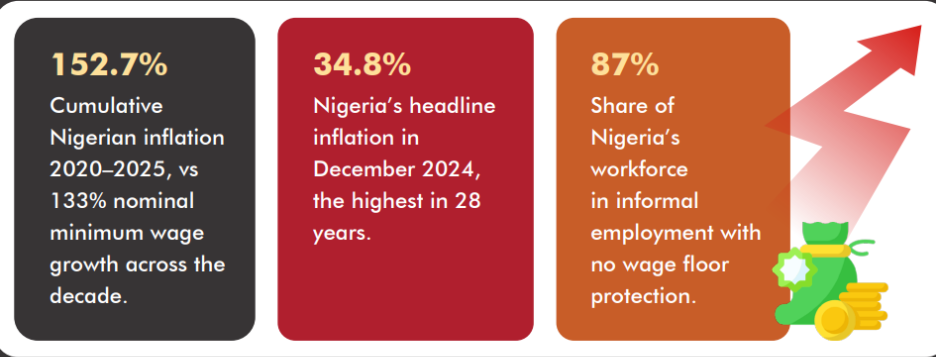
Between 2015 and 2025, headline inflation averaged above 16% annually. In 2024 alone, it hit a 28-year high of 34.8%. The naira, which traded at approximately ₦197/$ in 2015, had weakened to ₦1,500 by 2024 and averaged around ₦1,377 as of May 2026. For the average Nigerian household, the arithmetic of survival changed fundamentally.
The Wage-Inflation Divide
Nigeria’s minimum wage rose from ₦18,000 in 2015 to ₦70,000 in July 2024, a 133% nominal gain. Against that, cumulative inflation in the five years to December 2025 alone reached 152.7%. Every year from 2019 to 2024, the real minimum wage declined in purchasing power.
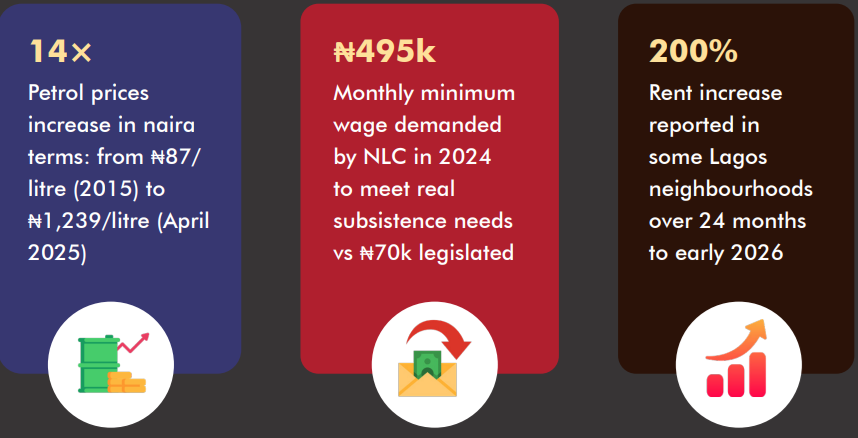
The NLC demanded ₦494,000 during the 2024 strike, nine times the negotiated settlement, as their estimate of what genuine subsistence required. The gap between what labour demanded and what was granted is itself a data point: it quantifies the distance between nominal wage policy and economic reality.
The formal wage debate, however, reaches only about 12.7% of Nigeria’s workforce. The remaining 87% of informal traders, artisans, smallholder farmers, and transport operators have no wage floor at all. Their income is set entirely by market forces that, over this decade, moved decisively against them.
Six Pressure Points
The weight of Nigeria’s inflation landed hardest on essentials, the six categories that households cannot cut. Prior to the NBS CPI rebase in January 2025, food alone accounted for 51.8% of the household basket. Below, the data on each front.
1. Rent and Housing
Rents in Lagos have surged 50–200% over the 24 months leading to early 2026. The income-to-rent ratio has climbed to approximately 70%, more than double the widely accepted 30% affordability threshold recommended by the United Nations.
A one-bedroom apartment in Yaba (mainland) now costs between ₦700,000 and ₦1.2 million per year, while a two-bedroom apartment in Ikeja ranges from ₦1.5 million to ₦2.5 million per year. At Nigeria’s minimum wage of ₦840,000 per year, decent housing remains mathematically unaffordable for a single earner without income pooling or family support.
2. Food
Food inflation peaked at 40.87% year-on-year in June 2024, one of the highest readings for a major economy globally. Fuel subsidy removal drove up logistics costs, which were transmitted directly into market prices. Prices of rice, beans, cooking oil, and tomatoes more than doubled in the 2023– 2024 period.
3. Transport and Fuel
Petrol stood at approximately ₦87/litre in 2015. By July 2023, the removal of subsidies pushed it from ₦195 to ₦617 overnight, a 217% jump. By April 2025, NBS recorded the national average at ₦1,239/litre. In naira terms, petrol now costs over 14 times what it did in 2015. Lagos commuters saw daily transport costs double in months.
4. Data and Connectivity
Mobile data shifted from optional to essential for payments, remote work, and commerce. In early 2025, the NCC approved a 50% tariff increase, the first since 2013. MTN attempted a 200% hike on its 15GB weekly bundle (from ₦2,000 to ₦6,000), triggering uproar before a partial reversal.
The price of a gigabyte doubled from ₦287 to ₦575 between 2024 and 2025. According to a data analysis by TechCabal, Nigerians now spend an estimated ₦7.62 trillion ($5.58bn) annually on mobile data, driven by rising unit costs, even as quality remains inconsistent.
5. School fees
A minimum-wage earner is unlikely to enroll a child in a mid-range private school, making the comparison less appropriate. Mid-range private school fees in Lagos range from ₦600,000 to ₦1.8 million per child per year, excluding uniforms and books.
For a household earning the minimum wage of ₦840,000 annually, even one child’s tuition would absorb about 70% to 200% of total income. The naira’s depreciation has pushed up fees at schools with dollar-linked costs.
6. Healthcare
According to the WHO, Nigeria’s out-of-pocket health spending exceeds 70% of total healthcare expenditure in many states. Inflation and naira depreciation have driven up the cost of imported pharmaceuticals and diagnostics, which are mostly priced in dollars. The WHO threshold for ‘catastrophic’ health spending, over 40% of disposable income after food and housing, is increasingly reached by low-income Nigerian families.
The Purchasing Power Equation
Chatham House analysis from March 2025 framed the outcome plainly: by early 2025, food prices were more than 80% higher than at the 2023 election, petrol had quadrupled, and poverty, already affecting over half the population, had risen further. The NBS CPI rebase of January 2025 reduced the official headline rate from 34.80% to 24.48% overnight, not because prices fell, but because basket weights changed; prices remained elevated; the metric changed; the reality did not, and by Dec 2025, inflation had reduced to 15.15%.
Time to Milestones: The Deferred Life
The most human measure of a decade’s economic cost is time. How long does it now take to save for rent, fund a child’s schooling, or build an emergency buffer? In Nigeria, all three timelines have extended sharply, and for millions, previously achievable milestones have become indefinitely deferred.
Saving for rent: Lagos landlords now demand 1–2 years’ rent upfront, a structural burden that has become harder to meet as renewals bring 50–120% hikes. Tenants hit with a 100% rent increase in a country where GDP per capita is $835, according to the IMF, face the choice of paying or moving further out, adding commute costs that extend the financial squeeze.
Path to property: Homeownership has effectively become inaccessible to the middle class. CBN’s Monetary Policy Rate stood at 26.5% in May 2026, down from a high of 27.5% for all of 2025, making mortgage finance a luxury for the wealthy. Construction cost inflation, driven by dollar-priced materials, raises the floor on what new properties can sell for. Demand grows; supply does not.
Emergency buffer: With essential spending consuming most of the income, the margin for precautionary saving has compressed to near zero for a large share of the population. According to a Piggvest report, 6 in 10 Nigerians (60%) currently have no emergency funds at all. Among those who do have emergency savings, most can cover only 1–3 months of expenses (15% have 6 months or more).
How Nigerians are coping
Nigerian households are not passive in the face of cost pressures; they adapt. But the adaptations are survival manoeuvres, not lifestyle choices. Urban displacement, ‘affordability migration’, is accelerating. Mainland Lagos neighbourhoods such as Ikeja and Magodo recorded rent increases of up to 30% over a 12-month period, as affordability pressures increase.
This intensified competition as midmarket housing squeezed the middle tier of the rental market. Medical care is being deferred. The choice between food and medication is not rhetorical for lowincome households. Informal businesses are ‘shrinkflating’, reducing product sizes to maintain affordable nominal price points while managing margin, a pervasive distortion invisible in headline statistics.
- “Nigerians adapted by cutting back, repricing their lives and businesses, and lowering expectations. 2025 was the year more predictability came, but that stability came at a price.”
To be continued…