Follow Us on Google Discover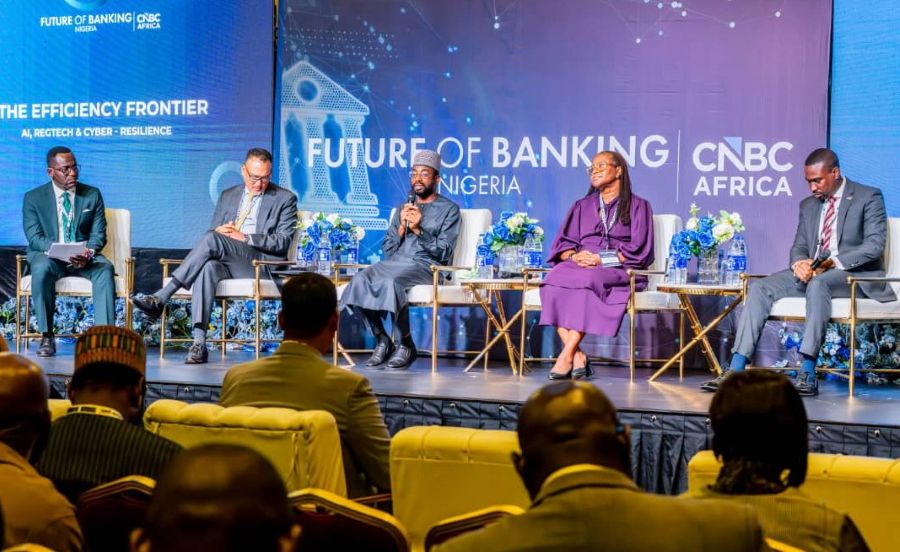
The Director General of the National Information Technology Development Agency (NITDA), Kashifu Inuwa, has said the future growth of Nigeria’s banking industry will depend less on capital accumulation and more on the ability of financial institutions to build digital trust through artificial intelligence (AI), regulatory technology (RegTech), and cyber resilience.
The NITDA DG stated this while speaking during a panel session titled “The Efficiency Frontier – AI, RegTech and Cyber Resilience” at the Future of Banking Nigeria Summit organised by CNBC Africa in Lagos.
Inuwa said the country’s banking sector has entered a new phase where technology resilience and customer trust have become critical drivers of competitiveness.
According to him, while the industry has successfully navigated major reforms over the past two decades, emerging digital risks now require banks to rethink how they protect assets, customers, and financial systems.
Also Read
What the NITDA DG is saying
Inuwa noted that Nigeria’s banking sector has demonstrated resilience through major milestones, including the 2005 banking consolidation, the 2009 banking reforms, and the ongoing recapitalisation exercise.
He said the industry’s challenge has evolved from raising capital to safeguarding and growing it in an increasingly digital economy.
- “Today’s question is no longer whether we can raise capital, but whether we can protect, preserve and grow that capital in the digital era. Trust has become the foundation of modern banking, and that trust must be built on resilient digital infrastructure and effective regulation,” he said.
According to him, with digital channels now serving as the primary interface between banks and customers, uninterrupted service delivery, cybersecurity, and resilient technology infrastructure have become essential for maintaining confidence in the financial system.
More insights
The NITDA boss described artificial intelligence as a strategic technology that can significantly improve banking operations by enhancing productivity, strengthening decision-making, increasing revenue, and enabling more personalised financial services.
He also highlighted the growing role of regulatory technology, saying RegTech solutions can simplify compliance processes, reduce operational costs, improve transparency, and strengthen corporate governance across financial institutions.
Inuwa stressed that regulators must adapt quickly as technology continues to evolve.
- “Technology evolves much faster than traditional regulation. Regulators must work closely with innovators to create enabling frameworks that encourage innovation while protecting consumers and maintaining market confidence,” he said.
Using Nigeria’s expanding fintech ecosystem as an example, Inuwa said technology has fundamentally changed how financial services are delivered, allowing customers to open accounts, access banking products, and complete transactions remotely without visiting bank branches.
He added that closer collaboration among regulators could also improve access to finance for small and medium-sized enterprises (SMEs).
According to him, AI-powered credit assessment tools and digital financial management platforms can help banks better evaluate business performance, reduce lending risks, and expand financing to underserved businesses.
NITDA developing AI, cloud standards
On responsible AI adoption, Inuwa disclosed that NITDA’s National Artificial Intelligence Strategy provides a framework for deploying AI across critical sectors in collaboration with relevant regulators, including the Central Bank of Nigeria (CBN) for financial services.
He added that the agency is also developing National Standards for Sovereign Cloud infrastructure and data classification to strengthen Nigeria’s digital sovereignty and ensure that sensitive national and financial data are adequately protected.
Inuwa said stronger collaboration among regulators, technology innovators, and financial institutions would be essential to building a secure, resilient, and globally competitive financial ecosystem capable of supporting Nigeria’s long-term economic growth.
What you should know
Last year, the Minister of Communications, Innovation, and Digital Economy, Dr. Bosun Tijani unveiled Nigeria’s National Artificial Intelligence (AI) Strategy to accelerate AI development, productivity, and economic growth across sectors.
According to the Minister, the country’s model involves identifying and engaging with Nigerian researchers and experts in AI, both locally and internationally, to develop a comprehensive strategy that addresses the nation’s specific needs and challenges.
He added that the government was already funding research and partnering with private sector players to enable growth in the sector