Follow Us on Google Discover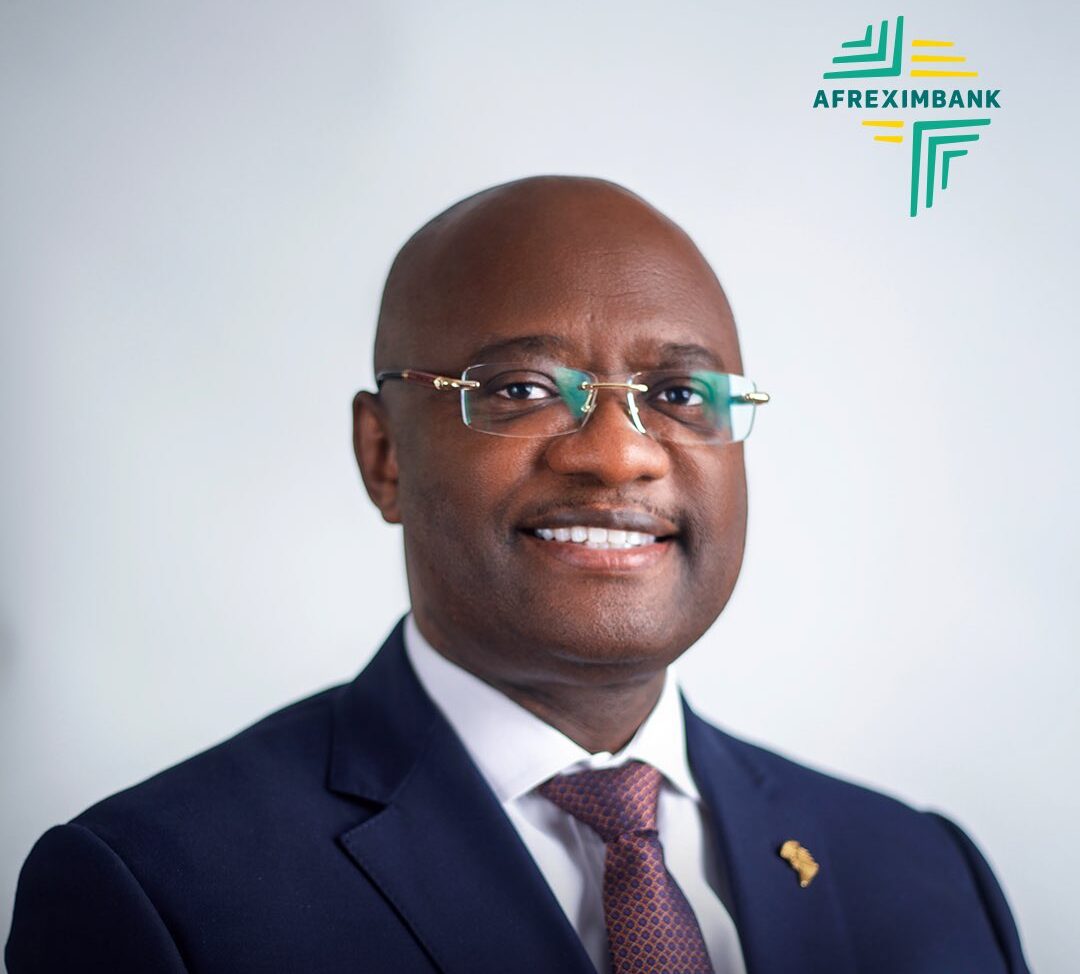
The President and Chairman of the Board of Directors of African Export-Import Bank (Afreximbank), Dr. George Elombi, has said that fair and evidence-based credit ratings are critical to Africa’s industrialisation agenda.
Speaking during a media briefing in Abuja, Elombi said the continent’s economic sovereignty depends on its ability to industrialise, process its own resources, and build strong financial institutions capable of mobilising capital for long-term development.
His comments come shortly after S&P Global Ratings assigned Afreximbank an investment-grade BBB+ long-term and A-2 short-term issuer credit rating, reinforcing investor confidence in the pan-African lender.
What the Afreximbank President is saying
According to Elombi, Africa can no longer rely on an economic model centred on exporting raw materials while importing finished products.
Instead, he said the continent’s next phase of growth must be driven by manufacturing, value addition, regional trade, and stronger African institutions.
- “Africa’s sovereignty will not be secured by exporting more of what we do not process. It will be secured when we build the industries that turn African resources into African value.
- “But industrialisation requires capital, and that capital must be accessible on terms that are fair, evidence-based and reflective of Africa’s true potential,” he said.
He noted that Afreximbank’s mandate is to support the continent’s transition from commodity dependence to industrial production by financing projects that strengthen manufacturing and intra-African trade.
More insights
Elombi argued that international credit ratings play a significant role in determining the cost of borrowing for African institutions and countries.
He said ratings influence investor confidence, access to international capital markets, and the affordability of financing needed for infrastructure, trade, and industrial development.
- “Fair credit assessment is part of Africa’s sovereignty agenda. When African institutions are assessed properly, they can raise capital more competitively.
- “When they raise capital more competitively, they can finance Africa’s industrial growth and accelerate African trade and job creation,” he said.
He added that Afreximbank’s recent investment-grade rating by S&P demonstrates the importance of evaluating African institutions within their proper operational and institutional context.
Elombi attributed the latest S&P rating to Afreximbank’s strong financial position, which saw total assets and contingencies rise to $49.4 billion in the first quarter of 2026.
During the period, the bank also recorded shareholders’ funds of $8.6 billion, maintained a capital adequacy ratio of 23%, and posted a non-performing loan ratio of 2.4%.
He said rating agencies should adequately recognise Afreximbank’s treaty-based structure, preferred creditor status, shareholder backing, and strategic role in financing African trade.
According to him, shareholders’ confidence in the institution is rooted in their belief in its long-term mandate rather than solely in external credit assessments.
Bank expands investments in industrial parks
Elombi said the bank, directly and through its equity investment arm, the Fund for Export Development in Africa (FEDA), is supporting the development of industrial parks and special economic zones across the continent.
Working with industrial partners, including ARISE Integrated Industrial Platforms (ARISE IIP), Afreximbank is investing in projects covering mineral processing, agro-processing, automotive manufacturing, textiles, and pharmaceuticals.
According to him, these investments are intended to build competitive manufacturing hubs and deepen regional production linkages.
Despite global economic uncertainty, Elombi said Afreximbank has continued to attract strong investor interest across international markets.
He cited the bank’s successful Samurai and Panda bond issuances, as well as a $2 billion equivalent dual-tranche syndicated facility secured during the first quarter of 2026 from 31 lenders spanning Europe, Asia, the Middle East, and Africa.
The transactions, he said, demonstrate continued confidence in the bank’s financial strength and development mandate.
Calls for a stronger African financial architecture
Elombi stressed that industrialisation alone would not deliver economic transformation unless African goods can move efficiently across the continent.
He said Afreximbank would continue investing in trade-enabling infrastructure, logistics corridors, digital payment systems, and the implementation of the African Continental Free Trade Area (AfCFTA).
- “Capital, industry and trade must work together. Africa must finance its production, process its resources and move its goods across its own markets. That is how we create value, retain value in Africa and build sovereignty that is practical, not theoretical,” he said.
He also welcomed ongoing discussions around establishing a New African Financial Architecture (NAFA), saying the continent must strengthen its capacity to mobilise domestic resources to finance its own development priorities.
What you should know
Afreximbank recently reported a Q1 2026 profit of $268.9 million, up from $215.4 million in Q1 2025, amid its drive to advance Africa’s economic development.
The profit for the three months ended March 31, 2026, came as net interest income increased by 24% to $510.0 million, compared with $411.2 million in the first quarter of 2025, according to the bank’s statement on Friday.
According to the bank, average loans and advances for Q1 2026 stood at $32 billion, up 8% compared to the same period in the previous year, driving the growth in interest income.