Follow Us on Google Discover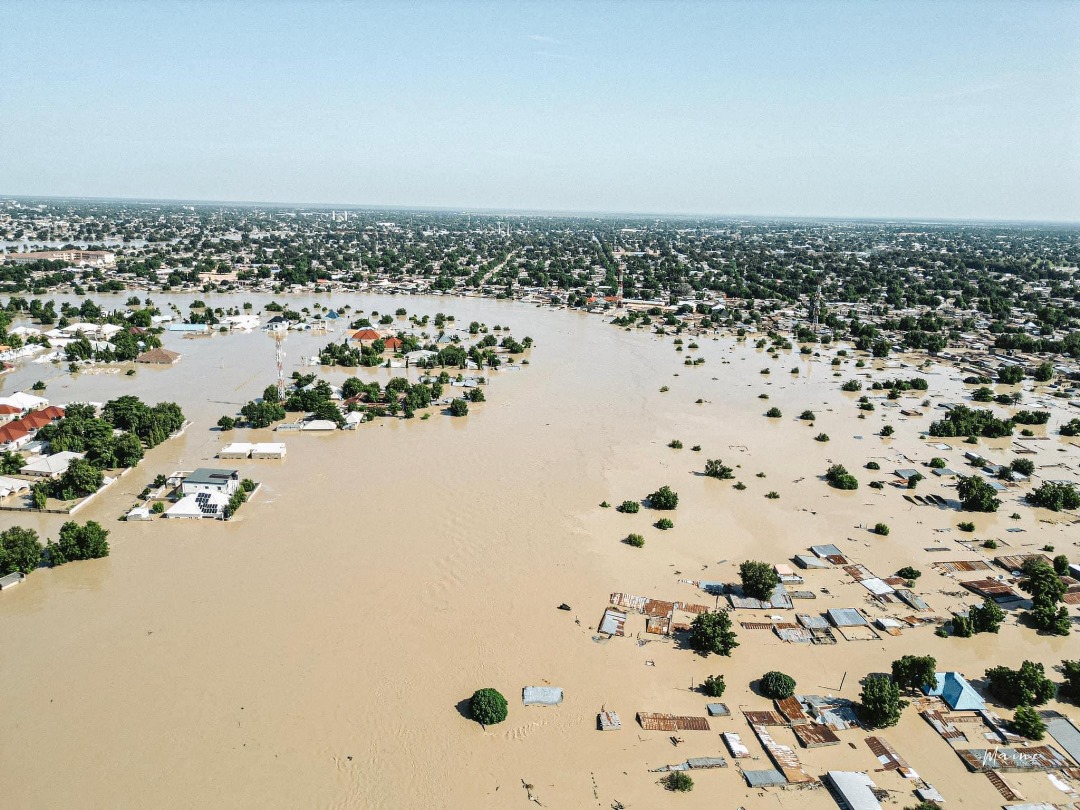
On the night of 31 August 1980, the Ogunpa River in Ibadan finally kept its oldest promise.
Swollen by hours of unrelenting rain, it burst its banks with a low, gathering roar that grew into a monstrous bellow, tearing through Mokola, Oke-Padi, and the crowded markets of Oja-Oba.
By morning, nearly 250 people lay dead, thousands were rendered homeless, and decades of illegal, incremental settlement had been swept away like driftwood.
In their characteristically unsparing manner, the news of the devastating flood occupied the front pages of national dailies like the following day. Popular musician Ebenezer Obey turned the horror into a lament and President Shehu Shagari walked among the ruins to offer condolences. And the government, as governments do, promised salvation in the form of a channelisation project for the Ogunpa River.
Also Read

You see, to write about anticipatory actions in Nigeria is to confront an architecture of deliberate neglect, a cynical ritual of political promises without political will, where nothing of permanence is ever built to address our ecological and hydrological problems.
This article is an attempt to do that necessary labour, so that our country might stop paying annual offerings in blood and treasure and cease to be surprised when the river returns to collect what it is owed.
NEMA, a short history
Organised disaster management in Nigeria dates back to 1906, when the Fire Brigade was established in Lagos with functions that extended beyond firefighting to the saving of lives and property. Over the next seven decades, this systematic approach was gradually replaced by ad hoc arrangements housed in the offices of the Head of State and state governors.
The devastating drought of 1972-1973, which laid waste to agricultural communities across northern Nigeria, exposed the inadequacy of this arrangement and led to the establishment of the National Emergency Relief Agency (NERA) in 1976, with a mandate limited to collecting and distributing relief materials. NERA provided relief, as its name suggested. It did not prevent, prepare for, or mitigate disasters. Rather, it waited for them to happen and then handed out supplies.
In 1993, recognising the limited scope of NERA, the government expanded the agency’s mandate through Decree 119, elevating it to an independent body under the Presidency. But it was not until 1999, with the passage of Act 12 as amended by Act 50, that the National Emergency Management Agency (NEMA) was formally established under the Office of the Vice President, with the broad mandate to formulate policy on disaster management, coordinate national response, and promote research.
On paper, the 1999 Act offered a genuine opportunity to break the cycle. A prevention-first NEMA would have been built around a technical directorate for nationwide risk mapping and floodplain zoning, statutory authority to veto unsafe developments and enforce building codes, binding early warning systems linked to state and local governments, and ring-fenced funding for structural defences.
Its performance would have been judged by measurable reductions in casualties and economic losses. Instead, the agency retained the old relief-oriented DNA while adopting the vocabulary of modern disaster management. What we have today is an institution that speaks prevention but practises response.
Three presidents, one pattern
Nigeria has turned the formation of flood committees into a national tradition. Every major inundation is met with the same ritual. A high-level body of experts assembled into yet another committee, charged with producing a report fit only for an archive of official forgetfulness.
The waters eventually recede, taking the latest recommendations with them into that same dusty repository where all the earlier plans have long since gathered dust.
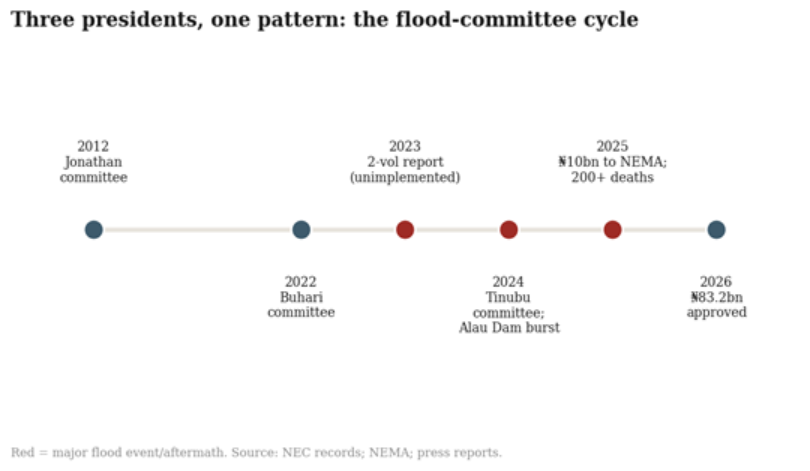
In 2012, floods killed 363 people, displaced over two million, and affected 30 of Nigeria’s 36 states. President Goodluck Jonathan responded by setting up a National Committee on Flood Relief and Rehabilitation. The committee produced recommendations that were promptly filed away.
A decade later, the floods returned with greater fury, killing more than 600 people, displacing about 1.4 million, and 332,000 hectares of farmland were submerged. Economic losses were estimated at between $3.79 billion and $9.12 billion (World Bank GRADE report). In response, President Muhammadu Buhari inaugurated a Presidential Committee on Flood Prevention and Management. In May 2023, it delivered a comprehensive two-volume National Strategic Plan. Seven days later, Buhari left office. To this day, none of its key recommendations has been implemented.
A few days ago, on 18 June to be precise, the National Economic Council approved N83.2 billion for the Anticipatory Action Task Force, half of the N166 billion originally proposed (Federal Ministry of Information). Governors described the move as a shift toward proactive risk reduction. Three presidents. Three major committees. Countless reports, frameworks, and strategic plans.
The language of prevention has circulated since at least 2012. Each new administration treats the previous government’s committee as sufficient proof of effort, allowing the cycle of disaster, committee, report, and forgetting to continue uninterrupted. The uncomfortable truth is that the only consistent policy Nigeria has pursued across three presidencies is the one that costs the least political effort in the short term and the most in lives and money over time.
Too much to ask for?
Tell people Nigeria should build permanent flood defences, enforce building codes, and maintain its dams, and they will quickly remind you of our numbers. Some will counter with the familiar complexity narrative that Nigeria is simply too large, too diverse, and too underfunded to build the kind of disaster management infrastructure that works in smaller, more homogeneous countries. 200 million people. 250 ethnic groups. 774 local governments. So?
Bangladesh has 170 million people packed into a landmass smaller than Oyo and Osun states combined, on a floodplain so low-lying that a third of the country goes underwater in a bad monsoon year. It is poorer than Nigeria by virtually every per capita measure.
And yet, over the past 25 years, it has reduced deaths from cyclones and coastal flooding dramatically, even as the number of people exposed to these hazards increased by 50%. It did this not through wealth but through a decision to build systems that work at the community level and to fund them consistently over decades. Its Cyclone Preparedness Programme operates with more than 76,000 trained volunteers who go door to door before every storm to evacuate households to designated shelters. In the 1970s, Bangladesh had fewer than 100 cyclone shelters. Today, it has more than 5,000, housing nearly five million people during emergencies.
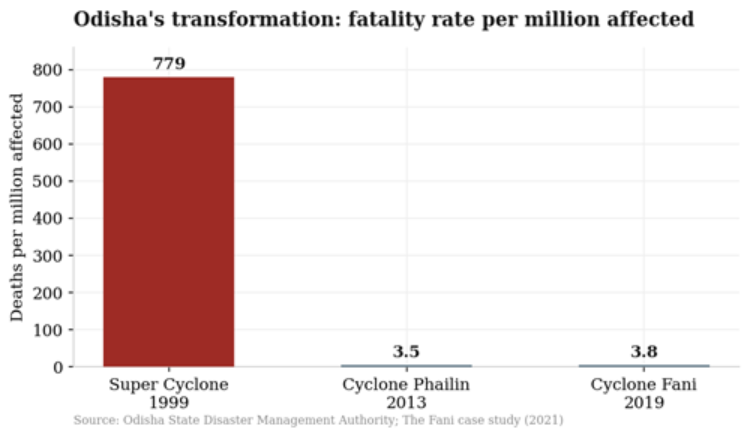
India’s state of Odisha offers an even more precise comparison, because the transformation happened within a single generation. In 1999, a super cyclone struck its coastline with no coordinated warning system, no resilient shelters, and no effective relief mechanism. Around 10,000 people died.
Two months later, the Odisha State Disaster Management Authority was established. Over the next two decades, the state built over 900 multipurpose cyclone and flood shelters, trained more than 100,000 volunteers, and established a command structure capable of evacuating hundreds of thousands within 24 hours. When Cyclone Fani struck in 2019, 64 people died. The fatality rate had dropped from 779 per million affected to 3.82 per million. The World Bank, the United Nations, and the World Economic Forum have all cited Odisha as a global model for anticipatory disaster governance.
None of these places had advantages Nigeria does not possess. What they had, and what Nigeria has so far refused to build, is a political commitment to treat disaster prevention as infrastructure, not as an annual emergency allocation. They built shelters, trained volunteers, enforced building codes, and maintained their drainage systems with disciplined consistency. The result is that people stopped dying in the staggering numbers they once did.
The annual offering
The N83.2 billion the National Economic Council approved on 18 June 2026 should not become another ritual payment made to the same cycle that has consumed every allocation before it. Maybe it will be disbursed. Maybe some will reach NEMA’s zonal offices, and some will be distributed to state emergency management agencies that lack the capacity to deploy it.
The annual performance of concern, the rotating committees, the billions approved and absorbed without a single permanent structure to show for them, is abandonment dressed in the language of fiscal responsibility.
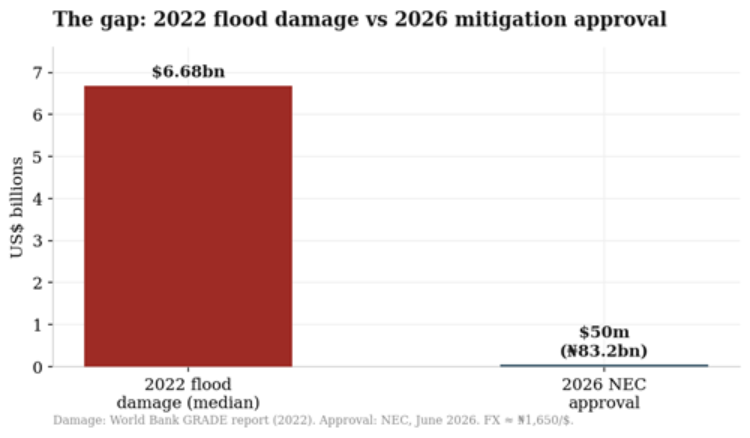
That sum may not be enough to solve Nigeria’s flooding problem entirely, but it is more than enough to begin real change. It could fund flood shelters in the high-risk communities identified in the government’s own flood outlook. It could train thousands of community volunteers in early warning and evacuation.
It could finance the urgent rehabilitation of dams that engineers have repeatedly flagged. It could enforce building codes in the floodplains where millions have built homes the state already knows will be underwater by September. It could do any of these things. It will likely do none of them.
The rain does not negotiate nor wait for committees to produce reports or for reports to be carried over between administrations. It arrives on schedule, finds the same unprotected communities, the same unmaintained dams, the same unbuilt shelters, and does what water does. Will Nigeria ever build something that is still standing when the water recedes, or is the annual offering all we are prepared to give?
- Dauda Abiola Sulaimon is the ESG Compliance and Sustainability Lead at Oko-Oba Clean Energy Limited, Nigeria.