Follow Us on Google Discover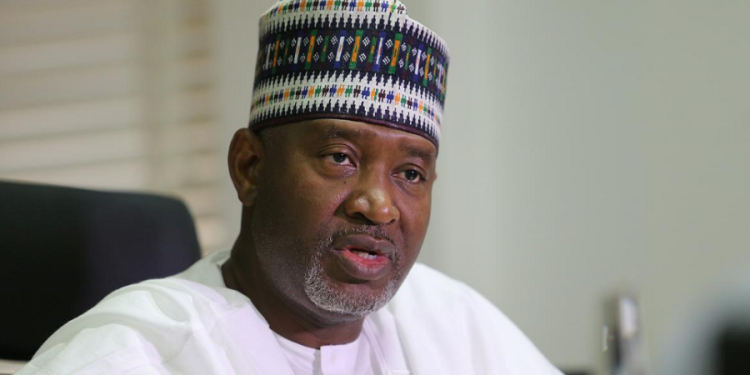
A prosecution witness has told a Federal Capital Territory High Court in Abuja that former Aviation Minister, Hadi Sirika, allegedly used an Ethiopian Airlines aircraft to stage the launch of the Nigeria Air project.
The testimony was given during proceedings in the ongoing trial involving Sirika and other defendants before Justice S.C. Oriji, according to a statement issued by the Economic and Financial Crimes Commission (EFCC) on Wednesday.
The witness, an investigator with EFCC, said the aircraft was temporarily repainted and displayed in Nigeria Air livery to create the impression that the national carrier had been launched.
What they are saying
The prosecution witness told the court that the aircraft used for the Nigeria Air unveiling did not belong to the Nigerian government or the proposed national carrier. Instead, it was operated by Ethiopian Airlines under a short-term charter arrangement.
Also Read
The EFCC investigator, Christopher Odofin, also provided details of how the aircraft was brought into Nigeria and used for the unveiling event.
- “The 12th Prosecution Witness, PW12, Christopher Odofin, in the trial of the former Minister of Aviation, Hadi Abubakar Sirika, on Wednesday, June 10, 2026, told Justice S.C. Oriji of the Federal Capital Territory, FCT, High Court Abuja, how Sirika allegedly passed off an aircraft belonging to Ethiopian Airline as that of the promised Nigeria Air by the government of the late President Muhammadu Buhari,” the EFCC statement read in part.
- The witness added that the aircraft was temporarily repainted in Nigeria Air livery and displayed at the Nnamdi Azikiwe International Airport, Abuja, in what he described as a “static display” meant to present the impression of a launched national carrier.
He further told the court that the aircraft was returned to Ethiopia after about two days, following the conclusion of the unveiling activities.
The testimony also indicated that the arrangement included ceremonial elements such as photo sessions and coordinated branding to support the public presentation of Nigeria Air as operational.
Investigations presented in court suggested that the aircraft used for the unveiling remained under full ownership and operational control of Ethiopian Airlines throughout the period it was in Nigeria.
More insights
The EFCC witness also said documentation reviewed by investigators showed that the agreement for the aircraft display was signed just days before the end of Sirika’s tenure as minister. He further noted that once the aircraft returned to Addis Ababa, the Nigeria Air branding was removed.
The EFCC has continued to prosecute Sirika alongside his daughter, son-in-law, and other entities on amended charges involving alleged abuse of office and misappropriation of public funds running into over N2 billion. The trial remains ongoing, with further evidence expected to be examined in subsequent hearings.
Backstory
The Nigeria Air project was introduced under former President Muhammadu Buhari’s administration as an effort to revive the defunct Nigerian Airways and establish a new national carrier for the country. The initiative has since been surrounded by multiple controversies and policy shifts.
- The project was first announced on July 18, 2018, with initial estimates placing setup costs at $8.8 million and full take-off costs at $300 million.
- It was suspended just months later due to concerns over its financial viability and structure.
- In 2022, Ethiopian Airlines emerged as the preferred bidder to manage the airline, holding a 49% stake in the proposed structure.
- In May 2023, Nigeria Air was publicly launched under then-Aviation Minister Hadi Sirika, though questions were later raised about its operational readiness and structure.
The project later faced criticism from lawmakers and stakeholders, with calls for review and suspension of its implementation.
What you should know
The Nigeria Air arrangement has remained controversial due to concerns over its ownership structure, financial commitments, and operational control.
- The deal reportedly required Nigeria to commit about $112 million over three years for aircraft usage under the arrangement, according to Keyamo.
- Ethiopian Airlines held a 49% stake in the proposed national carrier structure, giving it significant influence.
- Key leadership positions, including CEO and CFO roles, were reportedly to be controlled by Ethiopian Airlines under the agreement framework.
- Critics, including the current Minister of Aviation and Aerospace Development, have argued that the structure could have shifted disproportionate financial and operational risks to Nigeria.
Meanwhile, the Federal Airports Authority of Nigeria (FAAN) has indicated plans to support the emergence of two to three local airlines as potential flag carriers, though no specific airlines have been named.