Follow Us on Google Discover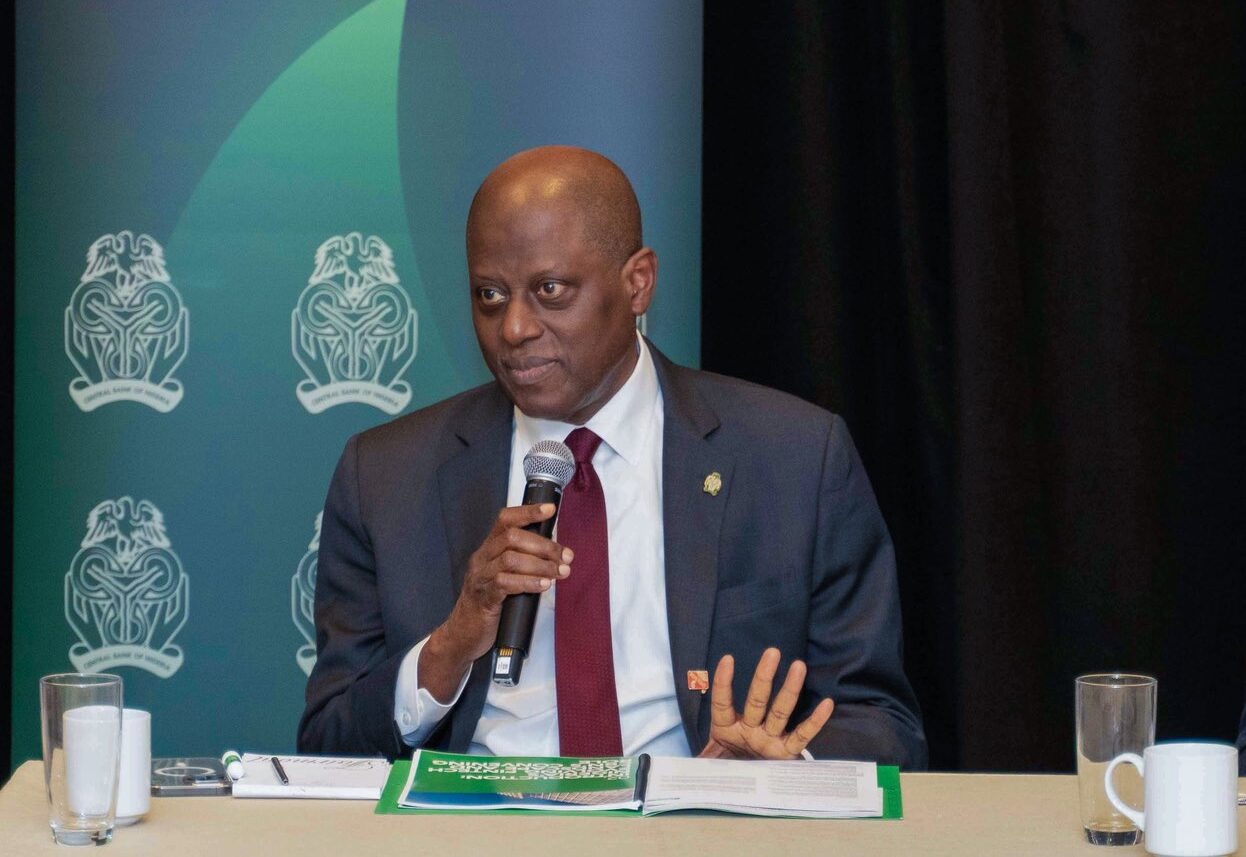
The Governor of the Central Bank of Nigeria (CBN), Olayemi Cardoso has said that the recent decline in Nigeria’s external reserves should not be a cause for concern, noting that the country remains in a strong and comfortable position despite the fluctuations.
The CBN Governor disclosed this on April 17 during a press briefing at the end of the International Monetary Fund (IMF) spring meeting.
He explained that Nigeria’s reserve levels remain well above critical thresholds, noting that the country currently has about 13 months of import cover, far exceeding standard benchmarks, and stressing that such movements are normal and not a source of worry.
What Edun is saying
Cardoso said he is not particularly concerned about the decline in external reserves, but rather about how Nigerians react to minor fluctuations in the figures, which he suggested are often overinterpreted.
Also Read
- “In fact, what concerns me is not so much the decline in reserves, but the reaction to relatively small swings in the numbers, which in today’s market environment should not trigger anxiety,” he said, adding that such responses reflect outdated perceptions of how the foreign exchange system operates.
He further emphasized that Nigeria remains in a comfortable reserve position, noting that its current levels significantly exceed the minimum benchmark recommended by the International Monetary Fund, which typically advises about three to six months of import cover.
- “These levels are well above what the IMF recommends as a minimum. With around 13 months of import cover, Nigeria is in a very comfortable position. Such fluctuations are normal, and there is no cause for concern,” he added.
Backstory
In January 2026, Nairametrics reported that Nigeria’s external reserves crossed the $46 billion mark for the first time in about eight years, highlighting the steady accretion in reserve levels since 2025.
Data tracked by Nairametrics shows that Nigeria’s last recorded reserves at this level was on August 27, 2018, when they stood at $45.9 billion.
By March 11, 2026, reserves climbed further to $50.03 billion, although subsequent data showed a downward trend from that peak.
However, on March 26, 2026, figures published by the Central Bank of Nigeria indicated that within a 15-day period, Nigeria’s foreign reserves declined by about $547 million to $49.48 billion, reflecting renewed pressure on the country’s external buffers.
More so, a recent projection by Fitch Ratings paints a more cautious outlook, as the agency projects that Nigeria’s foreign exchange reserves will decline to $47 billion by the end of 2026.
More insights
Despite these developments, Cardoso maintained that attention should not be fixated on short-term fluctuations, explaining that Nigeria’s foreign exchange system has evolved significantly.
- “The foreign exchange system that used to exist is very different from what it is now,” he said.
- “Then we had a central bank that was primarily determining the market. That is no longer the case. It is now market-driven, with more liquidity and stronger investor confidence.”
He added that the role of the Central Bank of Nigeria in intervening in the market has reduced significantly, as the system is now sufficiently liquid to function independently.
- “So in a situation like that, the reserve level is a great thing to have, but honestly, focusing on that when you have such huge liquidity in the market is less relevant than it was maybe about three years ago,” he said.
What you should know
Prior to the reforms introduced under Bola Tinubu, Nigeria operated a tightly managed foreign exchange regime in which the central bank played a dominant role in supplying foreign currency and maintaining multiple exchange rate windows.
- However, following the liberalisation of the FX market and the removal of fuel subsidies, the government shifted toward a more market-driven framework aimed at improving transparency, boosting liquidity, and attracting investment inflows.
Speaking earlier during a media briefing of the G-24 on the sidelines of the IMF’s April 2026 Global Financial Stability Report, Edun ruled out reversing these reforms, warning that doing so would undermine economic stability and reiterating the need for targeted interventions instead.