Follow Us on Google Discover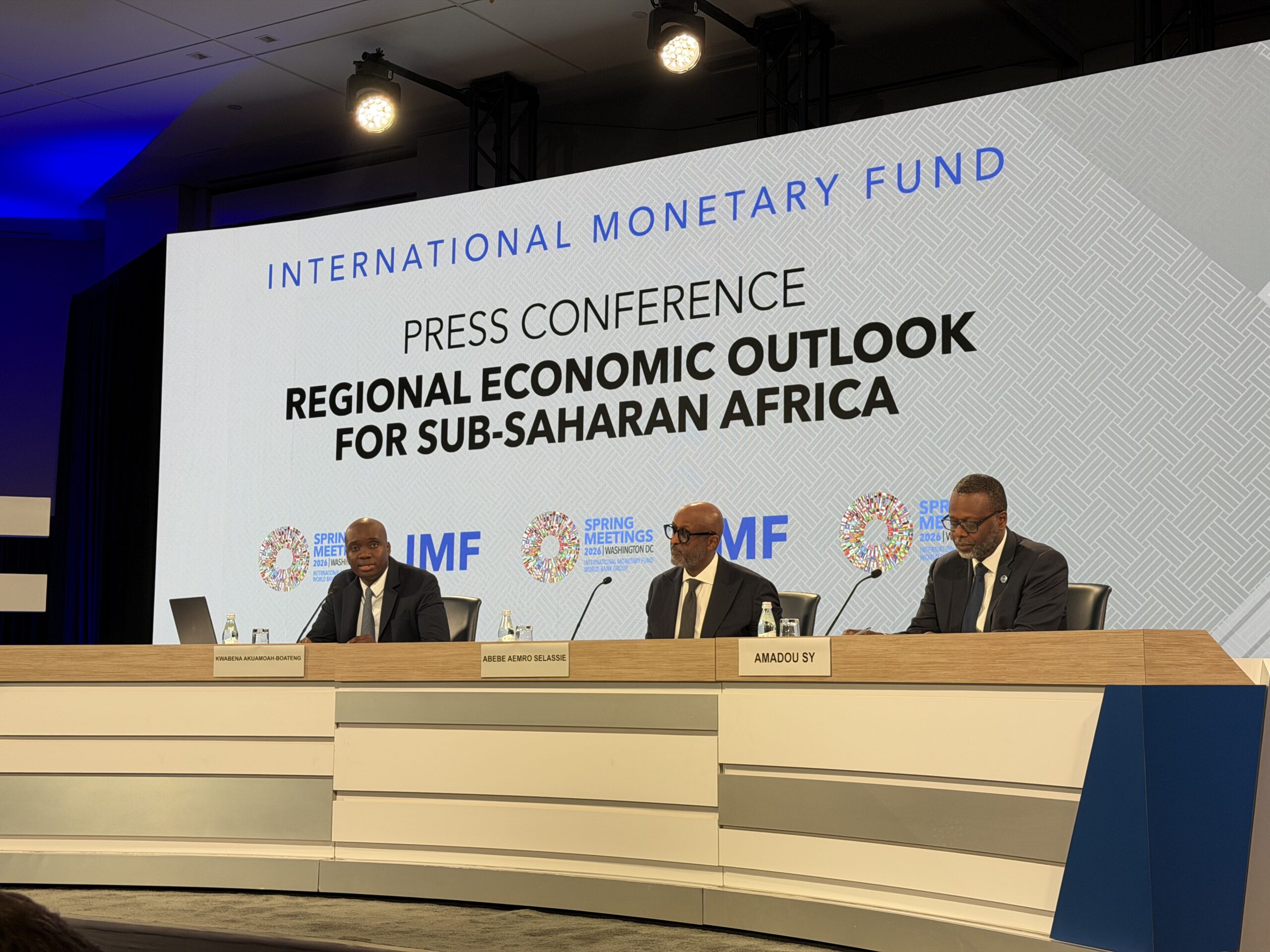
Sub-Saharan Africa’s fiscal position is expected to weaken in 2026, even as improved commodity prices offer some relief to external balances across parts of the region.
This is contained in the International Monetary Fund’s April 2026 Regional Economic Outlook titled “Hard-Won Gains Under Pressure.”
The Fund projects that the median fiscal deficit for Sub-Saharan Africa will widen to 3.2% of GDP.
This represents a slight deterioration compared to 2025, demonstrating continued pressure on public finances despite pockets of economic improvement.
What the IMF is saying
The IMF’s projections point to a mixed macroeconomic picture, where external gains are not translating into stronger fiscal outcomes.
- “Fiscal deficits are projected to worsen in most countries. Median fiscal deficits would reach 3.2 percent of GDP in 2026, higher by 0.2 percent of GDP compared to 2025,” the organisation stated.
- The median current account deficit is projected to narrow to 3.5% of GDP, an improvement of 0.3 percentage points from 2025.
- “Current account balances are expected to vary across countries. The median current account deficit is projected to narrow by 0.3 percentage point of GDP to 3.5 percent of GDP in 2026,” the IMF noted.
- Oil-exporting countries are expected to record stronger external positions, supported by higher crude prices.
- Non-resource-intensive economies are likely to see little improvement or further deterioration in their external balances.
Overall, the data highlights an uneven recovery, with external accounts improving modestly while fiscal deficits continue to widen.
Get up to speed
Fiscal and external balances in Sub-Saharan Africa have long been shaped by commodity cycles, subsidy policies, and limited revenue mobilisation capacity.
- Oil-exporting economies typically experience short-term fiscal relief during periods of high crude prices, but often struggle to contain spending pressures.
- Many governments in the region continue to rely on fuel price controls, which shield consumers but increase fiscal exposure when global energy prices rise.
- Structural weaknesses in tax systems and narrow revenue bases have historically constrained fiscal consolidation efforts across non-resource-intensive economies.
These longstanding issues continue to shape the region’s fiscal trajectory in 2026.
More Insights
The IMF notes that even where external conditions are improving, fiscal vulnerabilities remain widespread due to spending pressures and policy constraints.
- Oil-exporting countries are projected to see fiscal deficits widen despite higher revenues, suggesting increased spending is offsetting income gains.
- Non-oil resource-intensive economies may record only marginal fiscal improvements, while others remain largely unchanged.
- Controlled fuel pricing continues to pose a major fiscal risk, as governments absorb the cost of global price fluctuations.
These dynamics highlight the tension between short-term economic support measures and long-term fiscal stability.
What you should know
Nairametrics previously reported that the Federal Government had increased its planned borrowing for 2026 to N29.20 trillion following an expansion in the proposed budget size and fiscal deficit.
The new borrowing figure represents an increase of N11.31 trillion compared to the earlier projection of N17.89 trillion contained in the 2026 Abridged Budget Call Circular issued in December 2025.
Nigeria recorded a fiscal deficit of about N5.7 trillion in the first six months of 2025.