Follow Us on Google Discover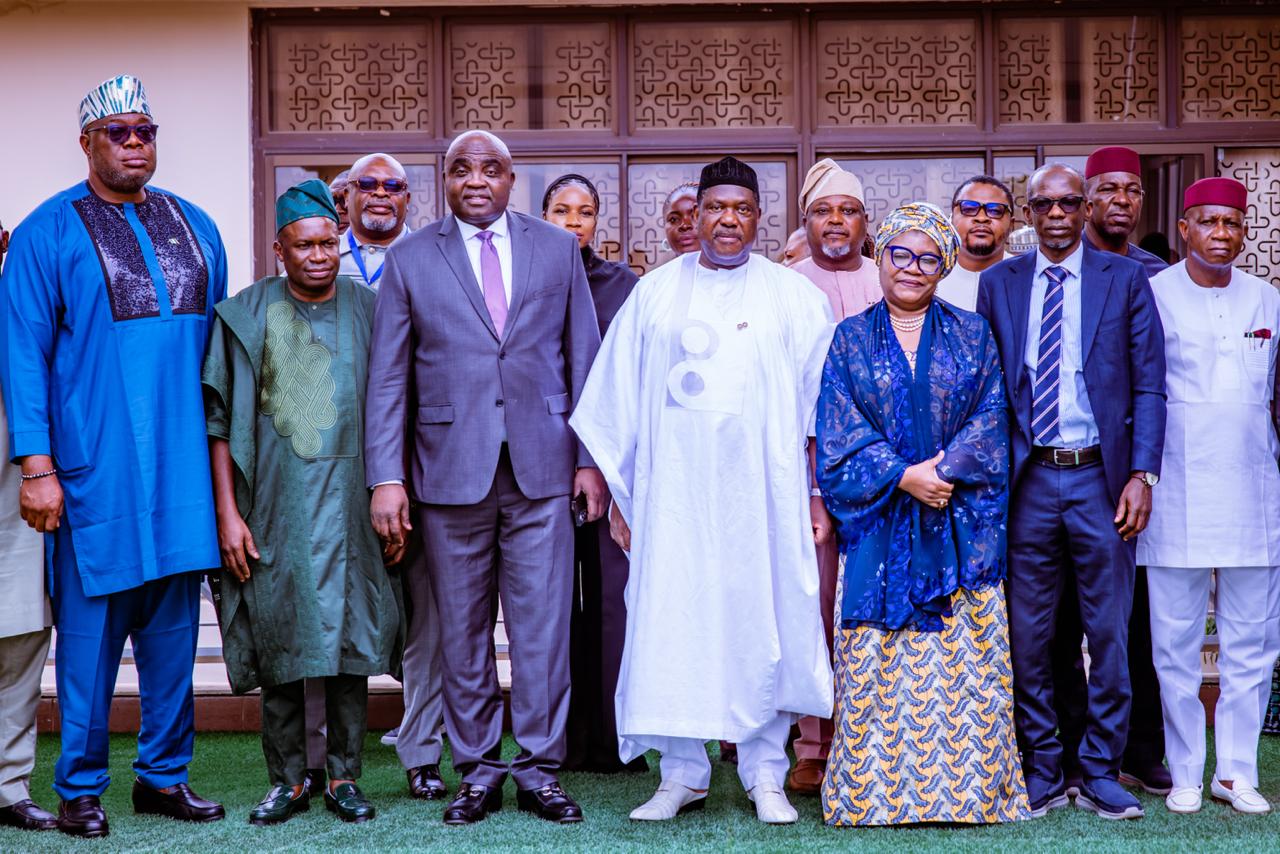
The Federal Government has inaugurated a technical committee to review a proposed $200 billion integrated gas, power and high-speed rail project submitted by De-Sadel Nigeria Limited.
The disclosure was contained in a statement issued by the Office of the Secretary to the Government of the Federation on Thursday.
The proposal outlines a multi-phase infrastructure initiative combining gas development, power generation and transmission, alongside a 4,000-kilometre high-speed rail network.
The committee has been tasked with assessing the feasibility and overall viability of the proposal before any government decision is made.
What they are saying
According to the statement, the high-speed rail component will span approximately 4,000 kilometres on a dual-track system connecting major cities, including Lagos, Abuja, Kano, and Port Harcourt. The rail network is expected to significantly reduce travel time between key economic hubs.
- “The proposed project, which is estimated at Two Hundred Billion United States Dollars (US $200 Billion) is envisioned as a multi-phase programme that integrates gas development, power generation and transmission, and the construction of a 4,000-kilometre high-speed rail network connecting major economic corridors of the country, including Lagos, Abuja, Kano and Port Harcourt.”
- “The project has the potential to significantly transform Nigeria’s transport infrastructure, strengthen energy security, stimulate industrial growth and deepen national integration’’ Secretary to the Government of the Federation, George Akume, said.
The Managing Director/Chief Executive Officer of De-Sadel Nigeria Limited, Samuel Ukoh, said the project is capable of transforming Nigeria’s transport infrastructure and reducing travel time by up to 75%.
The proposal also aims to connect all 36 states and the Federal Capital Territory, positioning the rail system as a backbone for national mobility and economic integration.
More insights
The broader project goes beyond transportation, incorporating gas infrastructure and power generation to support operations and industrial growth. It is designed as an integrated system to ensure sustainability and efficiency.
- The project includes plans to generate about 3,500 megawatts of electricity to power the rail network and surrounding industries.
- The committee has been mandated to examine all documentation, verify claims, and assess technical, legal, and environmental viability.
- Members are expected to engage relevant stakeholders and ensure alignment with international best practices in infrastructure development.
The outcome of the committee’s review will guide the Federal Government’s decision on whether to proceed with the project.
Get up to speed
Nigeria has continued to pursue multiple rail and transport infrastructure projects in recent years as part of efforts to improve connectivity and economic development. These projects span feasibility studies, funding initiatives, and rehabilitation of existing rail lines.
- In February 2025, the Federal Executive Council approved a $45.3 million contract for feasibility and engineering design of a rail line linking major western seaports to the hinterland.
- In September 2025, the Federal Government secured about N250 billion for light rail projects in Kaduna and Kano States, but work has yet to start.
- In November 2025, the Nigerian Railway Corporation confirmed plans to reactivate Osogbo-Dagbolu-Erunmu and Idogo railway lines in the Southwest for freight movement.
The government has also proposed N102.3 billion as counterpart funding for the Lagos Green Line rail project in the 2026 budget, although work on the project is yet to commence.
What you should know
Nigeria’s rail sector recorded steady growth in 2025, reflecting rising demand for transportation services despite infrastructure gaps.
- A total of 3,888,661 passengers were transported by Nigerian Railway Corporation-managed lines in 2025, generating N7.77 billion in revenue.
- Quarterly performance showed mixed trends, with Q2 recording the highest revenue of N2.28 billion from 989,793 passengers, while Q3 and Q4 saw moderate declines in revenue and ridership.
- Freight operations also contributed significantly, with cargo volumes peaking at 210,570 tons in Q2, before declining to 110,480 tons in Q4.
Freight revenue followed the same pattern, rising to N775.75 million in Q2 before falling to N397.82 million in Q4.