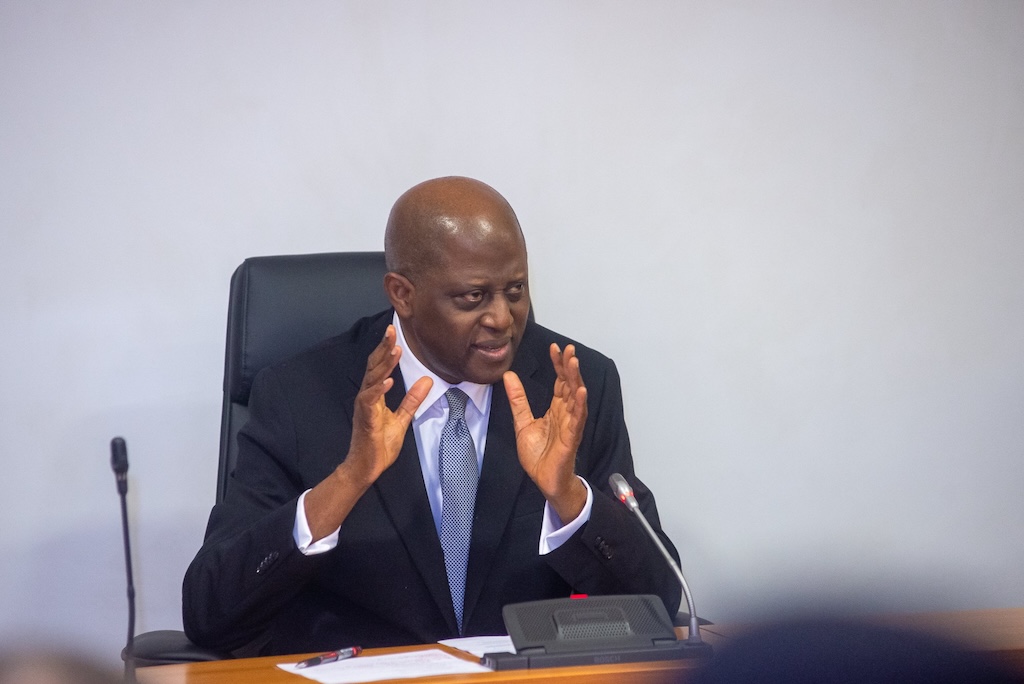
The Governor of the Central Bank of Nigeria (CBN), Olayemi Cardoso, has disclosed that 32 banks in Nigeria have already met the revised minimum capital requirements under the ongoing recapitalisation programme, marking a major milestone in efforts to strengthen the financial system.
Speaking at the Monetary Policy Forum held in Abuja on Thursday, Cardoso said the progress reflects “commendable” industry compliance and positions the banking sector to better support long-term investment and economic growth.
He added that the programme is central to building a more resilient financial system capable of driving Nigeria’s ambition of becoming a $1 trillion economy.


What the CBN governor said
- Cardoso said, “The banking sector recapitalisation programme has recorded commendable progress, with 32 banks having already met the revised capital requirements. This achievement has significantly strengthened the resilience and capacity of the Nigerian banking system, positioning it to effectively mobilise long‑term capital, support productive investment, and play its critical role in enabling the transition towards a $1.0 trillion economy.”
He noted that the recapitalisation exercise is part of a broader set of reforms aimed at strengthening governance and risk management across the banking system.
He listed key measures to include the introduction of a risk-based capital framework, a phased exit from regulatory forbearance, stricter enforcement of insider lending rules, and restrictions on credit access for major non-performing obligors.
According to him, supervisory capacity has also been upgraded through digital tools such as enhanced early warning systems and improved off-site surveillance, alongside stronger cross-border supervision of Nigerian banks operating internationally.
Inflation drops sharply after aggressive policy tightening
The CBN governor said monetary tightening played a decisive role in reversing inflation trends, noting that headline inflation fell significantly from 34.8% in December 2024 to 15.06% in February 2026.
He explained that the Monetary Policy Committee raised rates aggressively by 875 basis points in 2024 to rein in inflation before initiating gradual easing, with the policy rate cut to 26.5% in February 2026 after earlier reductions.
Cardoso noted that internal simulations showed inflation would have worsened without these measures, stressing the importance of disciplined policy execution and coordination with fiscal authorities.
FX reforms restore confidence, diaspora inflows surge
On the foreign exchange market, Cardoso said the apex bank cleared over $7 billion in verified FX backlogs and introduced a rule-based willing-buyer willing-seller system to improve transparency.
He added that tighter reporting standards, improved market surveillance, and reforms in interbank trading helped stabilise the market, narrowing the parallel market premium to below 2%.
Cardoso also revealed that diaspora remittances have emerged as one of Nigeria’s most stable sources of foreign exchange, with monthly inflows rising from about $200 million to $600 million following recent reforms.
He said the CBN is targeting $1 billion monthly remittances by the end of 2026, describing the growth as a structural shift supported by improved settlement systems and stronger regulatory controls.
The CBN governor also said gross external reserves rose to $50.12 billion in February 2026, up from $38.34 billion a year earlier, while net reserves climbed sharply from $3.99 billion at the end of 2023 to $34.80 billion in 2025.
He attributed the improvement to better reserve management, diversification strategies including gold integration, and strengthened external asset management frameworks.
Monetary-fiscal discipline restores policy credibility
Cardoso said one of the earliest reforms was curbing excessive Ways and Means financing, which dropped from N26.95 trillion in May 2023 to N2.84 trillion by January 2026.
He said the move restored compliance with statutory limits, strengthened central bank independence, and signalled an end to fiscal dominance.
He noted that Nigeria’s reform progress has gained international recognition, with sovereign rating upgrades from Fitch and Moody’s, and the country’s exit from the FATF grey list in October 2025.
The IMF also acknowledged improvements in transparency and discipline in its 2025 Article IV consultation.
Cardoso also said the CBN has modernised the payments system through migration to ISO 20022 standards, improved fraud management, and enhanced oversight of service providers.
He added that financial inclusion efforts have expanded through initiatives such as the Women’s Financial Inclusion Dashboard and upgraded consumer protection systems.
Outlook: single-digit inflation, stable naira in focus
Looking ahead, the CBN governor said the next phase of reforms will focus on consolidating gains by targeting single-digit inflation, sustaining exchange rate stability, and strengthening reserves.
He projected Nigeria’s growth at 4.49% domestically in 2026, while warning of global risks, including geopolitical tensions and oil price volatility.
Despite these risks, Cardoso said improved policy coordination and stronger macroeconomic fundamentals position Nigeria for more stable growth.
- “The most challenging phase of macroeconomic adjustment is now behind us,” he said, adding that continued collaboration across stakeholders remains critical to sustaining the gains.
What you should know
The CBN earlier said that Nigerian banks mobilised a total of N4.61 trillion in fresh capital under its ongoing recapitalisation programme, reflecting strong investor appetite and growing foreign participation in the sector.
The CBN noted that the recapitalisation exercise is already yielding measurable outcomes, particularly in terms of improved investor confidence and regional expansion by Nigerian banks.