Follow Us on Google Discover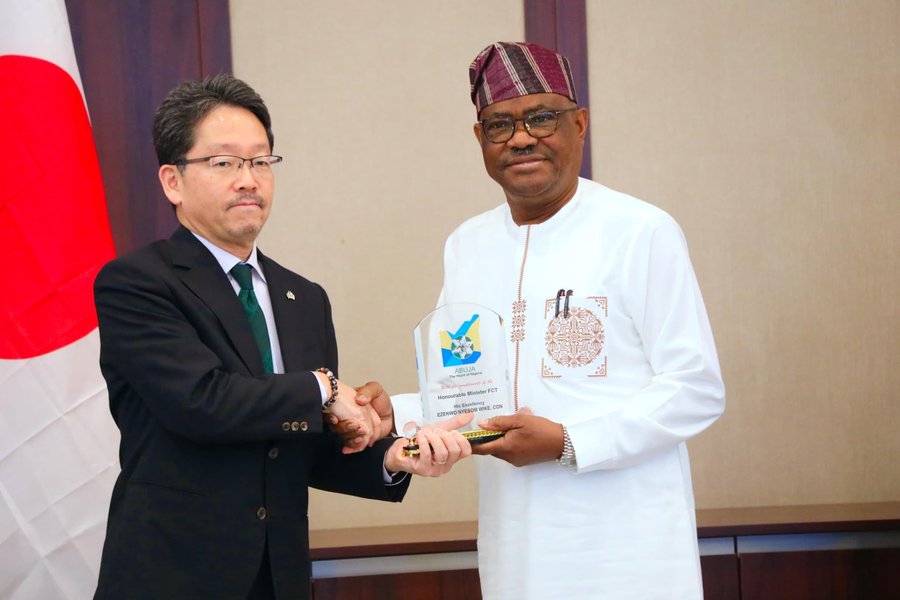
The Federal Capital Territory Administration (FCTA) has partnered with the Japanese International Cooperation Agency (JICA) to review and upgrade the Abuja master plan.
This was disclosed in a statement by Rabi Musa Umar, Deputy Director, Press, Office of the Honourable Minister.
The partnership is expected to drive infrastructure improvements, enhance urban mobility, and support the broader development of Abuja as a smart city.
What they are saying
The Minister of the Federal Capital Territory, Nyesom Wike emphasised that Japan’s earlier involvement in designing Abuja positions it strategically to contribute to the city’s modernisation.
- “The Minister of the Federal Capital Territory (FCT), Barr. Ezenwo Nyesom Wike, has lauded the Japanese International Cooperation Agency (JICA)’s ongoing collaboration with the Federal Capital Development Authority (FCDA) to review and upgrade the Abuja Master Plan.”
- The minister further stressed that sustained collaboration with JICA would ensure that new developments align with the original vision of Abuja while supporting broader government objectives.
Meanwhile, JICA’s Chief Representative, Mr. Ishigami Keiji, noted that the review process has reached a critical stage and reaffirmed the agency’s commitment to a sustainable and resilient capital city.
Backstory
The development of Abuja as Nigeria’s capital began in 1976 following a decree by the Federal Military Government to relocate the capital from Lagos.
- Planning efforts were initiated under General Murtala Mohammed and Olusegun Obasanjo, while significant progress was made during the administration of Shehu Shagari.
- The International Planning Associates (IPA), a consortium of three American firms, was commissioned in 1977 to produce the Abuja master plan.
- The detailed design of the central district was later handled by Japanese architect Kenzo Tange and his team.
Construction of the city began in 1979 but faced delays due to economic and political instability, with major milestones only achieved in the late 1980s.
Abuja has since witnessed rapid population growth.
What you should know
The FCTA has, over time, carried out various enforcement exercises aimed at ensuring compliance with the Abuja Master Plan, with a renewed emphasis on safeguarding the city’s layout and preventing unauthorised developments.
- Under the land use blueprint for Phase I of the Garki District, certain areas fall within a transitway corridor reserved for future transportation projects, stretching from UTC past the Abuja Municipal Area Council Secretariat and the Ministry of Defence toward Wuse Zone 3.
- Although the corridor has not yet been developed, FCTA took steps to prevent encroachment by land grabbers and informal settlements, protecting critical transport alignments.
- In addition, the administration has conducted demolitions of illegal structures, clamped down on unauthorised land allocations, and tightened monitoring of building approvals across the FCT.
These measures aim to curb distortions to the city’s design, restore compliance with the master plan, and create space for future infrastructure development.