Gold and silver soared to unprecedented highs on Monday, driven by escalating geopolitical tensions and expectations of further U.S. interest rate cuts.
The rally marks the strongest annual performance for both metals in more than four decades.
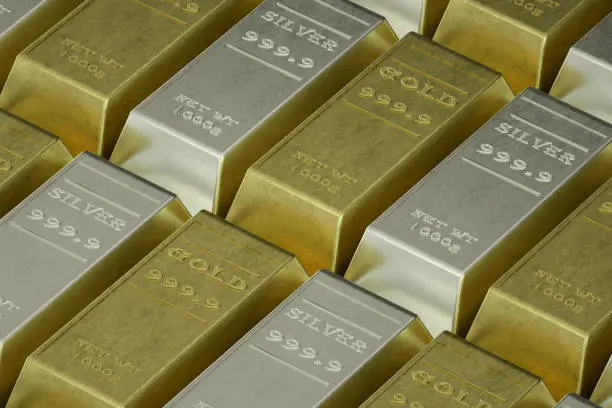
Bullion climbed more than 1.5% to $4,412.94 an ounce, surpassing the previous record of $4,381 an ounce set in October, while silver surged as much as 3.4%, closing in on $70 an ounce.


Both metals are firmly on track for their best yearly performance since 1979.
Rate cuts and policy signals boost rally
The latest surge comes as traders anticipate that the U.S Federal Reserve will cut interest rates twice in 2026.
U.S. President Donald Trump has also advocated for looser monetary policy, a move that typically benefits precious metals, which do not yield interest.
Heightened geopolitical risks have further strengthened the appeal of gold and silver. The U.S. recently intensified its oil blockade against Venezuela, increasing pressure on President Nicolás Maduro’s government. Meanwhile, Ukraine launched its first attack on a Russian shadow fleet oil tanker in the Mediterranean Sea.
Also in Africa, persistent military takeover of government, particularly in West Africa, has increased tension between ECOWAS and breakout countries like Mali, Burkina Faso, and Niger, who are now known as the Alliance of Sahel States (AES).
Nicholas Frappell, global head of institutional markets at ABC Refinery in Sydney, noted that “geopolitical concerns, particularly around Ukraine and the Trump administration’s recent national security strategy,” are supporting gold prices. He added that tensions between Japan and China, as well as the situation in Venezuela, are also contributing factors.
Central banks and investors drive demand
Gold has surged nearly 70% this year, supported by increased central-bank purchases and inflows into bullion-backed exchange-traded funds (ETFs).
Trump’s aggressive trade policies and challenges to the independence of the U.S. central bank added momentum earlier in the year.
Investor sentiment has also played a key role, with many turning to the so-called “debasement trade” — a retreat from sovereign bonds and currencies amid concerns over ballooning debt levels.
Gold-backed ETFs have recorded inflows for four consecutive weeks, with World Gold Council data showing holdings increased every month this year except May.
The rally extended beyond gold and silver. Palladium rose more than 4%, while platinum advanced for an eighth straight session, trading above $2,000 for the first time since 2008. Platinum has gained around 125% this year, with recent momentum fueled by tightening supply in London markets and robust exports to China.
Market outlook
Gold rebounded strongly after cooling in October, when the rally was seen as overheated. Analysts now expect the momentum to continue into 2026.
Goldman Sachs projects a base-case scenario of $4,900 an ounce, with risks skewed to the upside, noting that ETF investors are increasingly competing with central banks for limited physical supply.
Silver’s advance has been supported by speculative inflows and supply disruptions across major trading hubs, following a historic short squeeze in October. Trading volumes for silver futures in Shanghai spiked earlier this month to levels near those seen during the crunch.
As of 9:21 a.m. in London, spot gold rose 1.7% to $4,412.94 an ounce, silver advanced 2.6% to $68.88, palladium climbed more than 3%, and platinum gained 4.3%. The Bloomberg Dollar Spot Index fell 0.2%.
What you should know
Earlier in December, a new outlook released by the World Gold Council projected gold to maintain its upward trajectory, surging by 15-30% in 2026.
The precious metal delivered a standout performance in 2025, recording more than 50 all-time highs and generating returns of over 60%.
This surge was driven by heightened geopolitical and economic uncertainty, a weakening US dollar, and strong positive price momentum.
The report noted that both institutional and retail investors, alongside central banks, boosted their exposure to gold as they sought diversification and stability.