Follow Us on Google Discover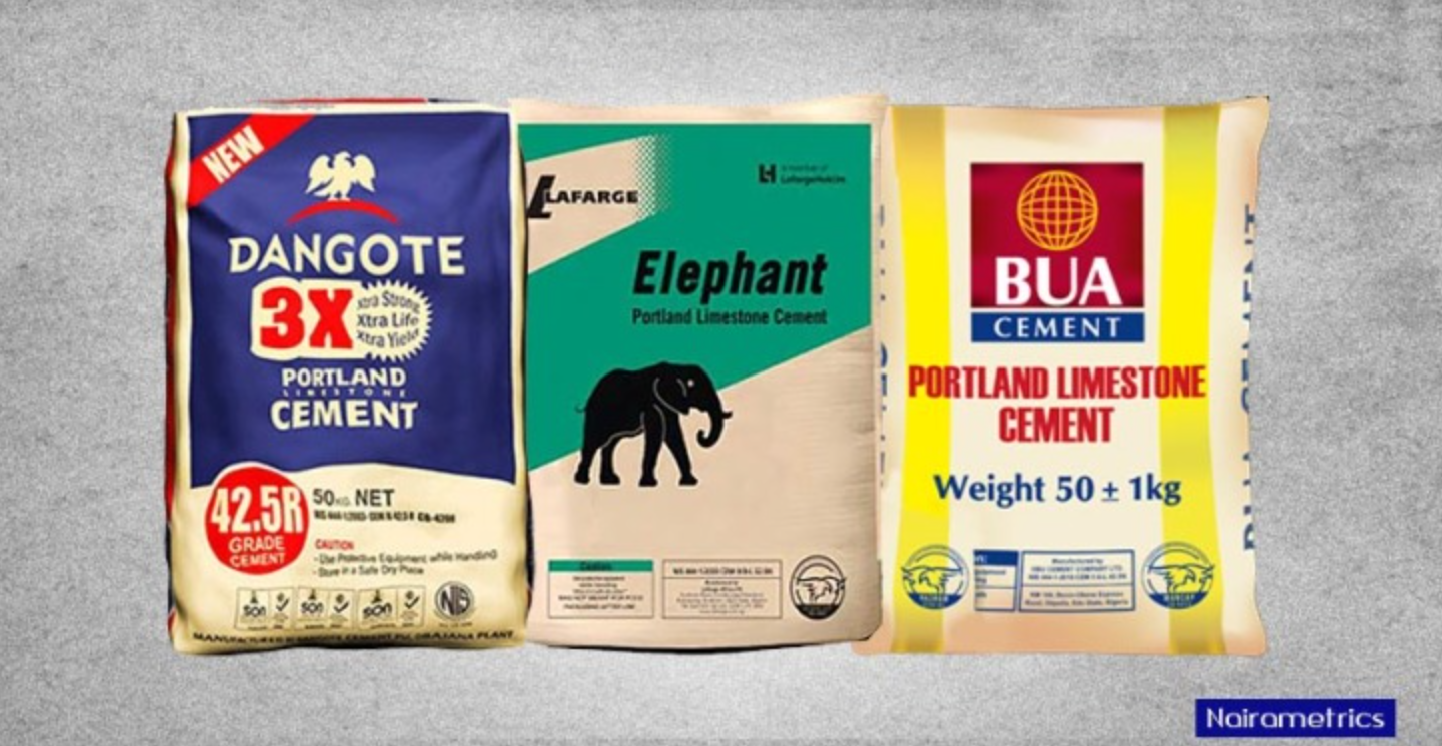
Nigeria’s cement industry has once again posted impressive earnings in H1 2025; but the story behind the numbers is one of consumers bearing the brunt of unrelenting price hikes.
As the economy grapples with stubborn inflation, high energy costs, and expensive imports, cement makers have shifted much of the burden onto households, builders, and developers driving construction costs to new highs.
Over the past two years, cement prices have surged to unprecedented levels. Between 2023 and 2025, the average open-market price of a 50kg bag of cement has more than doubled, climbing from about N5,000 to over N10,000.
Reportedly, earlier this year, during a press briefing, Works Minister David Umahi urged cement manufacturers to slash prices to N7,000 per bag, citing the strengthened naira and declining petrol prices. He credited these improvements to economic policies introduced by President Bola Ahmed Tinubu and argued that producers had no justification for keeping prices at record highs.
Also Read
His remarks followed a 2024 parley between the Federal Government and cement manufacturers over similar concerns about soaring cement costs.
Nigeria’s cement market remains highly concentrated in the hands of three dominant players, a structure that limits competition and gives producers significant pricing power.
The producers have consistently attributed the price hikes to rising costs of diesel and other industrial fuels, as well as frequent disruptions in gas supplies, which they say significantly impacted production costs.
However, despite these, the industry’s average operating profit margin in H1 2025 held firm at around 40%, meaning that for every N100 earned, about N40 was retained as operating profit before interest and taxes as reflected in their H1 financial statements
The players: Dangote Cement, BUA Cement, and Lafarge Africa have released their half-year 2025 results, and the numbers underline their market dominance.
For Dangote Cement, that cushion came even as output slipped. With an installed capacity of 52 million metric tons, the company produced 12.981 million tons in H1 2025 about 6% lower than the same period in 2024. Sales volume fell 4% to 13.365 million tons.
In the full year 2024, production rose just 1% and sales barely 1.57%, yet revenue still surged more than 62%, highlighting that pricing not volume has been the main growth lever.
CEO Arvind Pathak admitted as much in part, saying the group’s strong results reflected “strategic pricing actions” alongside steady demand. Dangote’s revenue for H1 2025 rose 17.7% to N2,071.6 billion from N1,760.1 billion in H1 2024.
BUA Cement delivered the sharpest profit leap, with after-tax earnings skyrocketing 428% to N180.9 billion from N34.3 billion a year ago.
Revenue rose 59% to N580.3 billion, fuelled primarily by higher prices, with some boost from increased production and sales volumes.
In 2024, the company expanded its installed capacity from 11 million to 17 million tons, pushing production to 8.137 million tons up 21% year-on-year.
Management said the new capacity wasn’t fully optimised last year, suggesting more volume gains ahead, but price hikes remain a clear driver of the revenue surge.
Lafarge Africa Plc also enjoyed a robust half-year, posting revenue of N516.997 billion. Operating expenses: covering raw materials, overheads, and administrative costs came in at N44.421 billion, giving the company a striking revenue-to-operating-cost ratio of 11.64.
In other words, Lafarge generated N11.64 for every N1 spent on operating costs, a gap that highlights its strong pricing power.
However, Lafarge’s total production capacity and volumes remain undisclosed, but its impressive revenue growth makes it hard to ignore the role of price hikes in driving results.
Commenting on its H1 2025 results, Lafarge CEO Lolu Alade-Akinyemi said: “Following our impressive Q1 results, Q2 performance showcases the strength of our team, market positioning, operational efficiency, cost management, and dedication to value creation. We achieved excellent financial results in Q2, with Net Sales growth of 70%, Operating Profit up 153%, and Profit After Tax growth of 248%. This strong performance closes H1 with a sales and operating profit growth of 75% and 144% respectively. This performance is driven by our innovative product offerings and strategic operational initiatives.”
For Nigeria’s cement consumers, the numbers tell a sobering story: in a sector where volumes are flat or barely growing, the revenue and profit boom is being fueled less by producing more and more by charging more.
The outcome is a construction market where every bag of cement is costlier, every project more expensive, and the weight of macroeconomic headwinds is shifted squarely onto those building homes, roads, and infrastructure.
Expressing worries over the development, a construction engineer based in Lagos, Mr. Aremu Olusegun, said:
“Soaring cost of cement is actually affecting every sphere of the construction industry and it will be ideal if the price of cement is reasonably reduced. This will encourage more investors and more people to build and bridge the huge housing deficit in the country.”
With pre-tax profit margins still hovering around 36% despite elevated energy and raw material costs, analysts argue that the industry has enough room to absorb part of these pressures instead of passing them wholesale to end users.