Follow Us on Google Discover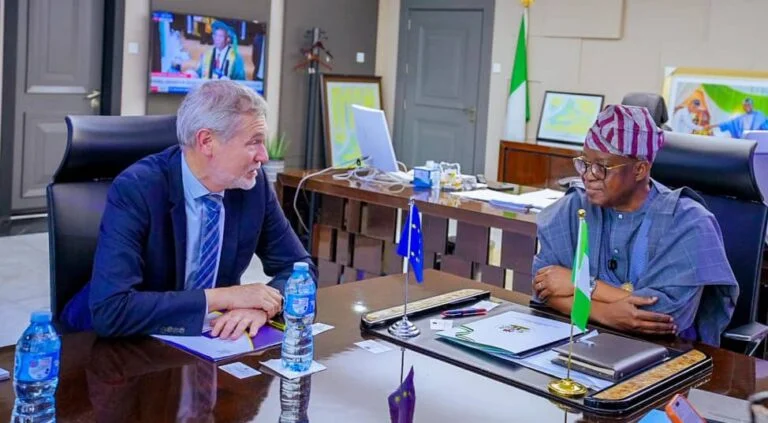
Nigeria is seeking to leverage the €59 million West Africa Sustainable Ocean Programme (WASOP), a European Union-backed regional initiative designed to strengthen ocean governance, sustainable fisheries management and marine ecosystem protection across West Africa, to combat illegal fishing in the Gulf of Guinea.
The Minister of Marine and Blue Economy, Adegboyega Oyetola, disclosed this during a meeting with the European Union Ambassador to Nigeria, Gautier Mignot, in Abuja.
The development was contained in a statement issued on Sunday by the minister’s Special Adviser, Bolaji Akinola.
According to estimates by the Fisheries Cooperative Federation of Nigeria Limited, Nigeria loses about $70 million annually due to outdated fishing regulations, illegal fishing activities, inadequate monitoring and enforcement mechanisms, and the persistent exploitation of the country’s waters by unlicensed operators.
Other News
What they are saying
According to Oyetola, illegal and unregulated fishing not only undermines Nigeria’s food sovereignty but also poses a serious threat to national security.
- “Illegal, unreported and unregulated fishing is a direct threat to national security, food sovereignty and the survival of our coastal communities,” the minister said.
He warned that continued illegal exploitation of Nigeria’s marine resources is depleting fish stocks, weakening coastal economies and threatening the livelihoods of thousands of people who depend on the sector for survival.
The minister stressed that addressing the challenge would require stronger cooperation among countries, enhanced surveillance systems and tougher enforcement measures to prevent offenders from operating with impunity.
- “This is necessary to permanently dismantle these illicit operations and safeguard our waters,” Oyetola said.
More insights
Beyond the fight against illegal fishing, Oyetola highlighted ongoing reforms under the National Policy on Marine and Blue Economy, which he said are aimed at promoting innovation, attracting private sector participation and ensuring the sustainable development of ocean resources.
He noted that the government has recorded improvements in port efficiency, maritime logistics and security while continuing investments in maritime infrastructure to enhance Nigeria’s competitiveness in international trade.
- The minister also called for broader international cooperation in tackling maritime crimes, including environmental offences and human trafficking, while seeking increased technical support from the European Union in areas such as surveillance technology, fisheries monitoring and enforcement capacity.
- For his part, EU Ambassador Gautier Mignot reaffirmed the bloc’s commitment to strengthening maritime cooperation with Nigeria and other countries in the region. He said the WASOP initiative is designed to promote sustainable fisheries management, improve ocean governance and protect coastal ecosystems across West Africa.
Mignot added that the programme would enhance coordination among coastal nations, strengthen enforcement frameworks and support the growth of an inclusive and sustainable blue economy.
What you should know
The €59 million West Africa Sustainable Ocean Programme (WASOP) is a European Union-funded initiative aimed at improving ocean governance, strengthening fisheries management, enhancing enforcement cooperation among coastal states and protecting marine ecosystems across West Africa.
The programme is amid recent developments which suggest growing investor and government interest in Nigeria’s fisheries and marine sector, particularly as the country seeks to reduce dependence on imported fish and unlock opportunities within the blue economy.
- In late May, Nairametrics reported that Tantalizers Plc signed a memorandum of understanding with Karflex Fisheries Limited and Karflex Investment Limited as part of its expansion into Nigeria’s fisheries and marine industry. The proposed transaction involves the acquisition of 24 fish trawlers and shrimpers, as well as 13 cold room facilities and other commercial fisheries assets.
The move reflects increasing confidence in the sector and aligns with broader government efforts to boost domestic fish production, improve value chains and expand investments in marine infrastructure.
Nigeria has also been pursuing policies aimed at achieving greater self-sufficiency in fish production. In July 2025, Oyetola announced plans by the Federal Government to reduce the country’s dependence on fish imports by increasing local production and supporting young people and women with grants to establish fisheries-related businesses.